


MultiversX activates Supernova on 10 September, cutting block times from six seconds to roughly 600 milliseconds and cross-shard settlement from about 18 seconds to 2.4. EGLD has gained more than 30% in a week ahead of it. What happened to other Layer-1 tokens around their own upgrades is the reason to stay careful.
Supernova Cuts MultiversX Block Time to 600ms
Supernova activates on 10 September at block round 32157661 and cuts block time from six seconds to roughly 600 milliseconds. It does that by separating transaction execution from block consensus, so validators agree on a block while execution runs in parallel instead of waiting for it to finish.
Finality within a shard drops below 250 milliseconds and cross-shard settlement shortens from roughly 18 seconds to around 2.4. Addresses, keys and balances remain backward compatible, though MultiversX will pause new transactions for roughly 24 minutes while the network changes over.
EGLD Price Today and the Run-Up Into Supernova
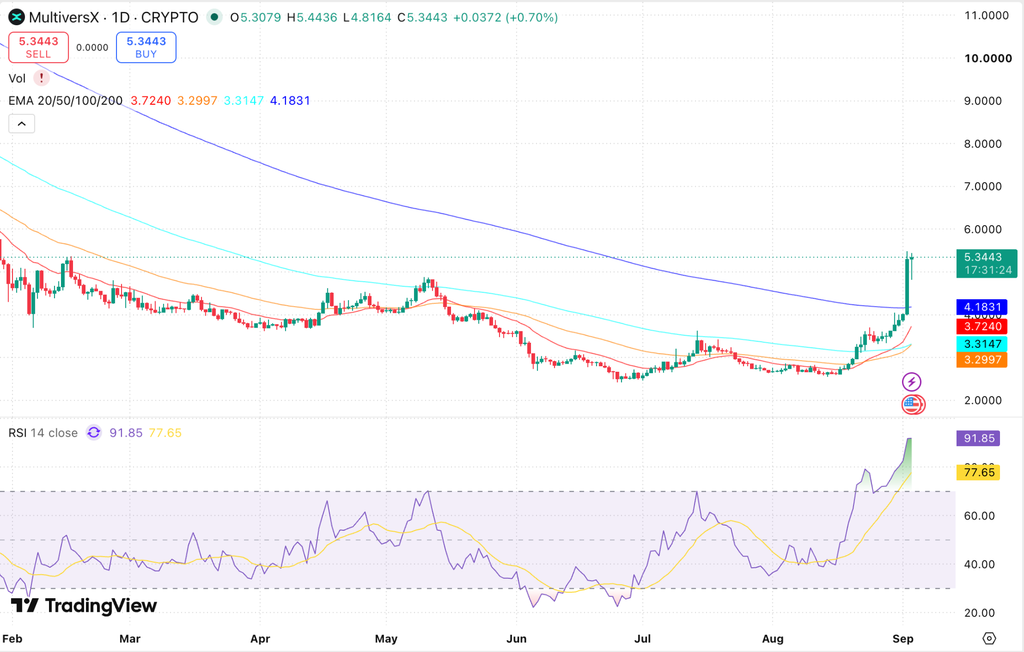
The EGLD price reached $4.61 on 3 September, up 17.46% over 24 hours. The MultiversX price has now cleared $4 for the first time since May, giving the network a market capitalization of $141.4 million.
Source: TradingView
Turnover of $28.03 million equals 19.8% of market cap, high enough to show real participation, and EGLD is up roughly 32% across seven days.
EGLD Still Trades 99% Below Its 2021 Peak
EGLD trades roughly 99% below its November 2021 peak, which is why a 32% weekly gain still leaves the token ranked 147th by market value.
This week’s advance recovers about 0.2% of the distance back to that high, and EGLD would need to rise more than a hundredfold to reach it. A successful upgrade changes what the network can process, not that arithmetic.
Read our MultiversX (EGLD) Coin Price Prediction
Why EGLD Could Fall After Supernova Activates
Ether went into the September 2022 Merge on the same kind of setup, having roughly doubled from its June lows ahead of a known activation date. It then fell 15.2% in the five days after the switch, while bitcoin fell 4.4%.
The 11-point difference between those two falls is the part macro conditions do not explain. Analysts at the time said the Merge had been priced in well before it happened, which is what traders mean by buy the rumor, sell the news. EGLD has now run 32% into a dated upgrade of its own.
EGLD Levels to Watch Before 10 September
EGLD traded below $4 from May until last weekend and now sits at $4.61. That puts the first support about 13% below spot, and a drop back through $4 would mean the breakout failed.
The public node feed had not shown upgrade adoption when the activation window opened. Nodes still running old software after the switch will read transactions differently and drop out of sync with the majority chain.
What EGLD Traders Should Watch Next
If daily transaction counts rise after 10 September, the upgrade is doing its job. If they do not, MultiversX has a faster chain and the same demand, and EGLD has to hold $4 on its own.
Disclaimer: This article is for informational purposes only and does not constitute investment advice. Crypto assets are unregulated and highly volatile. Readers should conduct their own research before making any trading decisions.
FAQs
When is the MultiversX Supernova upgrade?
The MultiversX Supernova upgrade activates on 10 September 2026 at block round 32157661. The network will pause new transactions for roughly 24 minutes during the changeover, after which the faster configuration takes over.
What does Supernova change for MultiversX?
Supernova decouples transaction execution from block consensus, so validators vote on a block while execution runs in parallel. Block time falls from six seconds to about 600 milliseconds and cross-shard settlement shortens from roughly 18 seconds to around 2.4.
Will the EGLD crypto price rise after Supernova?
The EGLD crypto price would not automatically rise after Supernova activation. Whether Supernova supports EGLD depends on transaction growth after launch.
Does Supernova affect EGLD holders or validators?
Supernova leaves addresses, keys and balances backward compatible, so ordinary EGLD holders do not need to take any action. Validators do have to act, because nodes running outdated software after activation could interpret transactions differently and lose sync with the majority chain.