



Japanese bond market saw one of its most volatile episodes in decades, as 30-year government bond yield surged 28 basis points to 4.22%, rattling global investors. What began as concern over fiscal policy and political uncertainty has quickly turned into a broader risk-off event, one that traders across asset classes are now closely watching.
Japan’s Short-Term Bond Yields Are Also Surging
Volatility is no longer limited to long-dated Japanese government bonds. Short-term yields are now rising sharply, adding to concerns that Japan’s ultra-loose monetary era may be nearing a turning point.
Japan’s 2-year government bond yield surged to around 1.28%, its highest level since 2008, as markets increasingly price in additional Bank of Japan rate hikes this year. According to Nomura, there is a 60% probability that the BoJ delivers three rate hikes by mid-2027, lifting the policy rate toward 1.50%, while a more hawkish scenario assigns a 40% probability to four hikes by end-2027, pushing rates to 1.75%, levels last seen in the early 1990s.
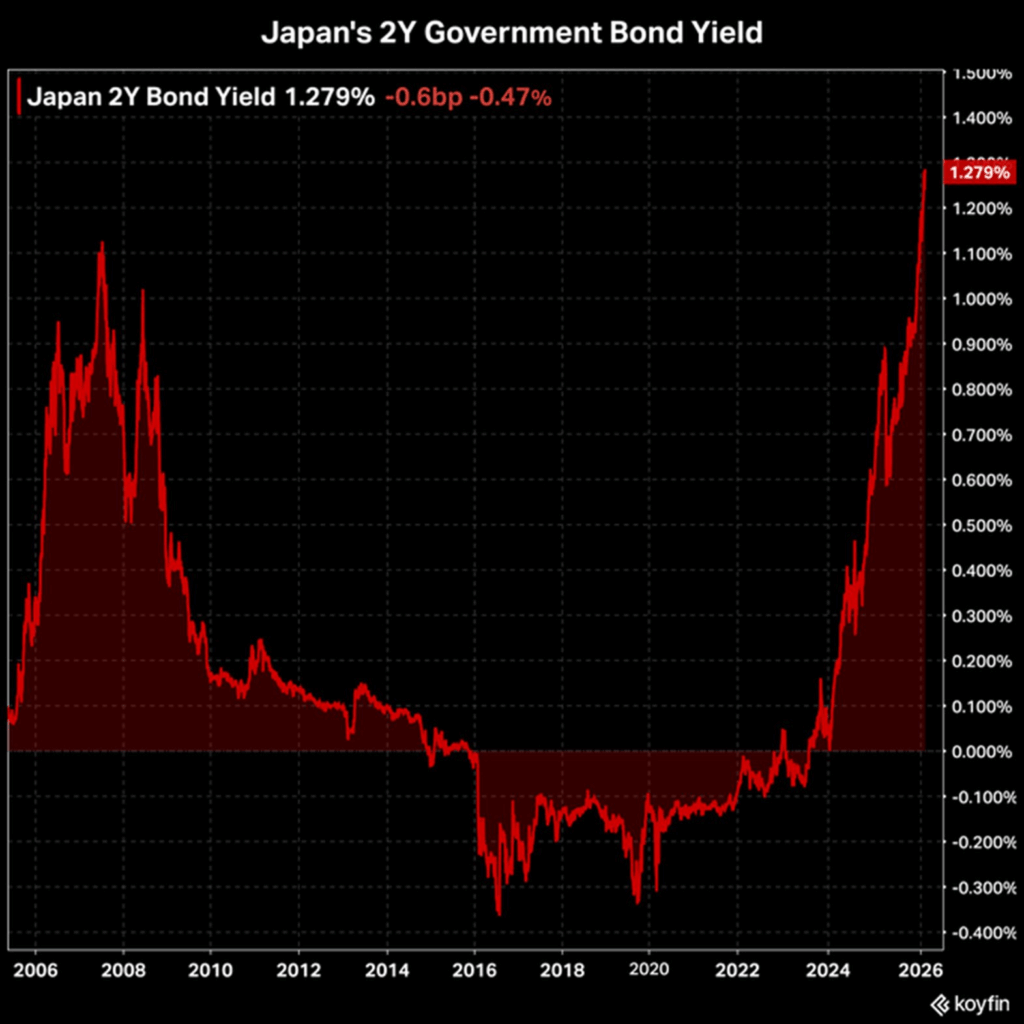
While long-dated bond volatility reflects concerns around fiscal sustainability, the sharp move in short-term yields is more disruptive for global markets. Rising front-end rates directly impact funding conditions, currency carry trades, and liquidity flows, increasing stress across risk assets.
Crypto market including Bitcoin and stocks prices pull back sharply as investors flee risk assets. The Bank of Japan is facing pressure to intervene, but rising inflation and debt levels is fueling uncertainty. This turmoil sparks concerns about the stability of one of the world’s largest and most heavily controlled bond markets.
Why Japanese Bonds Are Suddenly Unsettling Markets
Japan’s bond market has long been viewed as a low-volatility anchor, supported by years of intervention from the Bank of Japan. That perception is now being tested.
Recent political developments, expectations of higher government spending, and concerns over debt sustainability have pushed investors to demand higher yields. As bond prices fell, yields jumped sharply, particularly at the long end of the curve, triggering fears that liquidity could dry up further if selling accelerates.
While the initial shock emerged in long-dated Japanese bonds, the recent surge in short-term yields signals that markets are reassessing the entire Japanese yield curve. This shift suggests expectations of sustained policy tightening rather than a one-off technical dislocation, keeping volatility elevated across maturities.
Why Traders Are Nervous: Bonds Aren’t Supposed to Do This
Bond markets are typically seen as safe, slow-moving, and predictable. When they turn volatile, it often signals deeper stress in the financial system.
For traders, the concern isn’t just Japan, it’s what happens when:
- “Risk-free” assets lose stability
- Yield volatility forces portfolio rebalancing
- Leverage across markets comes under pressure
This is why global markets, including crypto, have reacted even before equities showed meaningful damage.
How the Japanese Bond Crash Is Affecting Crypto Markets
Crypto markets have begun to reflect this broader macro shift. As Japanese bond yields rise, global liquidity conditions tighten, particularly in leveraged markets that rely on low funding costs and stable currency dynamics.
Historically, sharp moves in sovereign bond yields tend to:
- Reduce the attractiveness of carry trades and leverage
- Force portfolio rebalancing across global markets
- Increase short-term volatility in high-beta assets like crypto
Rather than acting as an immediate hedge, crypto market often reacts first during macro stress, serving as a liquidity outlet as traders reduce exposure. On-chain and derivatives data suggest participants are becoming more cautious, with leverage trimming and positioning adjustments accelerating as bond market volatility persists.
Is This a Contagion Risk or a Temporary Shock?
Some analysts argue that Japan’s bond market could stabilize if fiscal clarity improves and policy intervention resumes. Others warn that once volatility enters long-dated sovereign bonds, it tends to persist longer than expected.
For traders, the key takeaway is not panic, but positioning:
- Watch bond yields, not just equity indices
- Expect higher volatility across risk assets
- Be cautious with leverage while macro uncertainty remains elevated
If bond market stress deepens, crypto asset is unlikely to stay insulated, even if long-term narratives remain intact.
Bottom Line for Traders
The Japanese bond market turmoil highlights how quickly macro risk can reprice global markets. When sovereign bonds destabilize, liquidity tightens, correlations rise, and crypto volatility increases. With both long-term and short-term Japanese yields under pressure, traders are now watching whether policy clarity emerges, or if bond-driven stress becomes the next sustained global risk catalyst.
FAQs
Q1. What is happening in the Japanese bond market?
Japan’s bond market has experienced sharp volatility, with long-dated government bond yields rising rapidly in recent sessions. The sell-off reflects growing investor concerns around fiscal policy, political uncertainty, and the sustainability of Japan’s debt levels, despite long-standing support from the Bank of Japan.
Q2. Why are Japanese bond yields rising?
Japanese bond yields are rising as investors demand higher returns to hold government debt. Key drivers include expectations of increased government spending, reduced central bank intervention, inflation pressures, and uncertainty around future bond issuance. When bond prices fall due to selling pressure, yields move higher.
Q3. Is this a Japanese bond market collapse?
While some market participants describe the move as a “collapse,” it is more accurately characterized as a period of extreme volatility. Bond markets typically move slowly, so rapid yield spikes, especially in long-dated bonds, are viewed as destabilizing, even if prices later recover.
Q4. What does the Japanese bond market chart show right now?
Japanese bond market charts show a steep rise in long-term yields, particularly in 20-year and 30-year government bonds. This reflects aggressive selling and reduced demand at recent auctions, signaling stress in parts of the yield curve rather than a uniform market breakdown.
Q5. Why are investors nervous about Japanese bonds?
Investors are concerned because Japan’s bond market has historically relied on heavy central bank support. Increased volatility raises questions about liquidity, price stability, and whether government debt can continue to be absorbed without further intervention. Sudden yield spikes can also trigger broader portfolio rebalancing.
Q6. How is foreign investment affecting the Japanese bond market?
Foreign investors play a smaller role in Japan’s bond market compared to domestic institutions, but shifts in foreign demand can still amplify volatility. Global macro factors, such as rising yields in the U.S. and Europe, have made Japanese bonds less attractive on a relative basis, contributing to selling pressure.
Q7. Does the Japanese bond market turmoil affect global markets?
Yes, because Japan has one of the largest government bond markets in the world. Volatility in Japanese bonds can spill over into global markets by tightening liquidity, influencing currency flows, and increasing risk-off sentiment across equities, commodities, and crypto assets.
Q8. Can the Bank of Japan stabilize the bond market?
The Bank of Japan has multiple tools to manage bond market stability, including bond purchases and yield control measures. However, markets are closely watching how much intervention policymakers are willing to deploy, as sustained volatility may challenge long-standing policy frameworks.