


Goldman Sachs CEO David Solomon has acknowledged that he owns a small amount of Bitcoin, marking a notable change in tone from his earlier skepticism toward crypto. Speaking at the World Liberty Forum in Florida, Solomon described his holdings as “very, very limited” and clarified that he is not a Bitcoin forecaster, but an observer of financial innovation.
The $3.5 trillion investment firm reportedly holds approximately $2.36 billion in crypto exposure, including around $1.1 billion in Bitcoin, $1.0 billion in Ethereum, $153 million in XRP, and $108 million in Solana. As of February 2026, this exposure is primarily held through exchange-traded funds.
Bitcoin remains a central topic on Wall Street and across global markets, which adds context to his remarks. The disclosure strengthens the institutional involvement trend in digital assets and shows that even the highest echelons of mainstream finance are changing their views.
Trade Crypto in INR on 
Deposit and withdraw in INR (₹).
No Conversion to Crypto Required.

Goldman Sachs’ Growing Crypto Exposure
In 2024, David Solomon has twice labeled Bitcoin as being volatile and speculative. At the time, the CEO said that he still didn’t understand the use case for the digital asset.
Despite the skepticism, Goldman Sachs has been increasing its crypto footprint under Solomon’s leadership. The company has created trading desks and custody services targeting institutional clients. This institutional expansion helps explain Solomon’s personal position.
That progression connects directly to the broader repositioning of Wall Street toward digital assets.
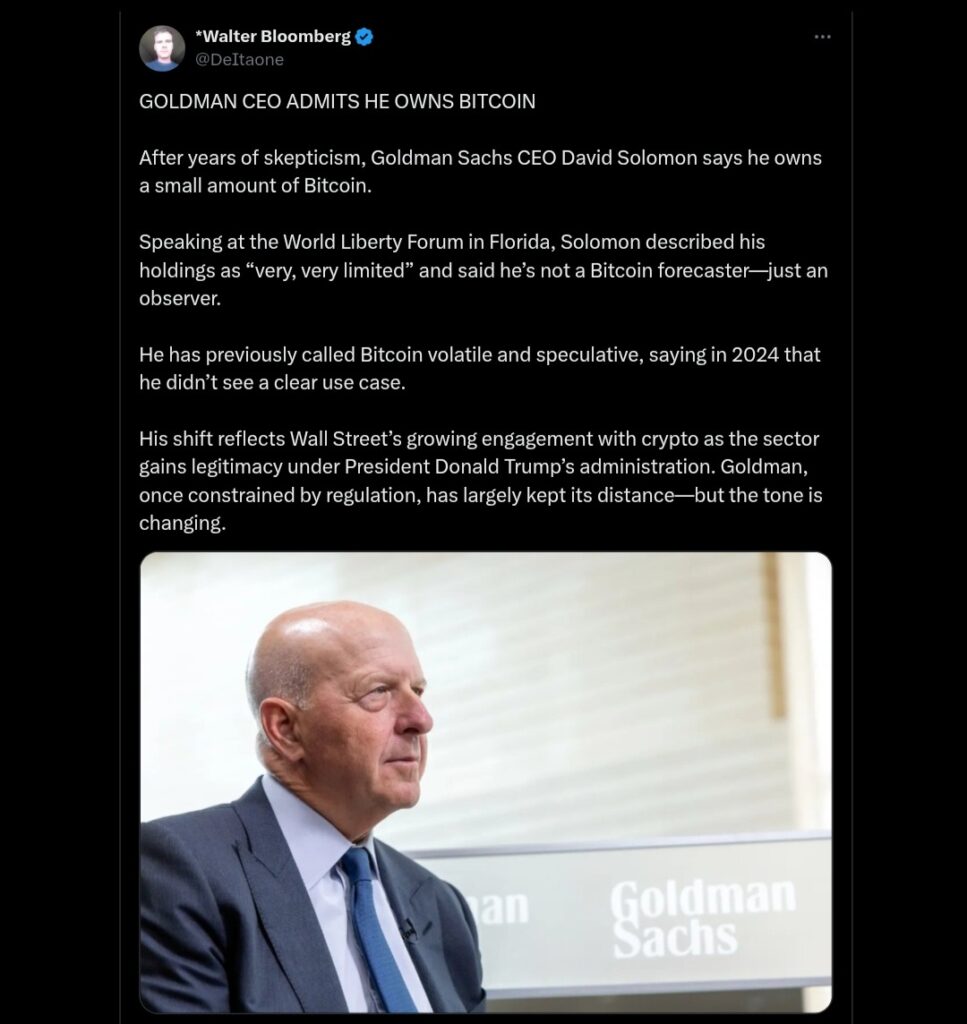
Source: Walter Bloomberg
What This Means for Bitcoin and Wall Street
Solomon’s change of stance reflects a wider recalibration across Wall Street. Traditional finance and crypto are no longer treated as opposing systems. Instead, major institutions are integrating digital assets into existing financial frameworks. This shift has occurred alongside growing policy discussions in Washington and increasing demand from institutional investors.
Bitcoin, which operates without central bank control and relies on decentralized verification through miners, has matured into an asset class monitored by global financial leaders. Institutional trading desks, custody solutions, and exchange-traded products have reinforced its presence in mainstream portfolios.
Solomon emphasized that finance remains “one system” and that digital tokens will play an important role in its future. His framing underscores a structured approach rather than speculative enthusiasm.
Conclusion
David Solomon’s admission that he owns Bitcoin marks a meaningful evolution in the conversation between Wall Street and crypto markets. As Goldman Sachs expands its crypto capabilities, the CEO’s personal disclosure reinforces the firm’s engagement with digital assets.
The shift from skepticism to limited ownership captures a broader transformation in institutional finance. Bitcoin is no longer viewed solely through a speculative lens. It is increasingly recognized as part of the modern financial system.