

Chainlink launched CCIP 2.0 on 28 September, allowing institutions to add their own checks to cross-chain transfers. LINK also reached a reported 2026 high during the session. The upgrade follows an Infosys partnership announced the previous week, but neither announcement identifies a new bank using CCIP 2.0 in production
Chainlink CCIP 2.0 New Features and Rules
The protocol serves as Chainlink’s flagship cross-chain messaging and liquidity transport layer. The release of CCIP 2.0 alters the network’s verification mechanics by introducing the cross-chain verifier (CCV) framework.
Under this model, financial institutions and digital asset issuers can deploy private verification nodes within native corporate cloud environments (such as AWS or Google Cloud) or mandate third-party attestations. Destination blockchains can require designated verifiers to cryptographically sign off on inbound transfers, letting regulated issuers enforce sovereign risk parameters instead of relying entirely on a single universal validation layer.
The release also includes programmable compliance modules, such as automated sanctions screening and address verification, alongside configurable finality mechanisms. CCIP 2.0 lets issuers configure confirmation requirements. Chainlink says a faster Ethereum path is planned for when Ethereum’s Fast Confirmation Rule launches
The Infosys Banking Framework
The launch release featured commentary from Bill McCahey, Managing Director for Digital Assets at Infosys, detailing enterprise deployment pathways for the new verification infrastructure. This integration builds directly upon a formal corporate agreement announced on 22 September, where Infosys outlined plans to support adoption of the Chainlink technology suite across its digital banking and payment modernization practices.
The 1.7 billion figure needs care. It describes the reach of Infosys’s financial services business, not the number of users of anything built on Chainlink. Neither party has named a bank, a payment network, commercial terms or a production date.
LINK Touches $15.777 Calendar-Year High
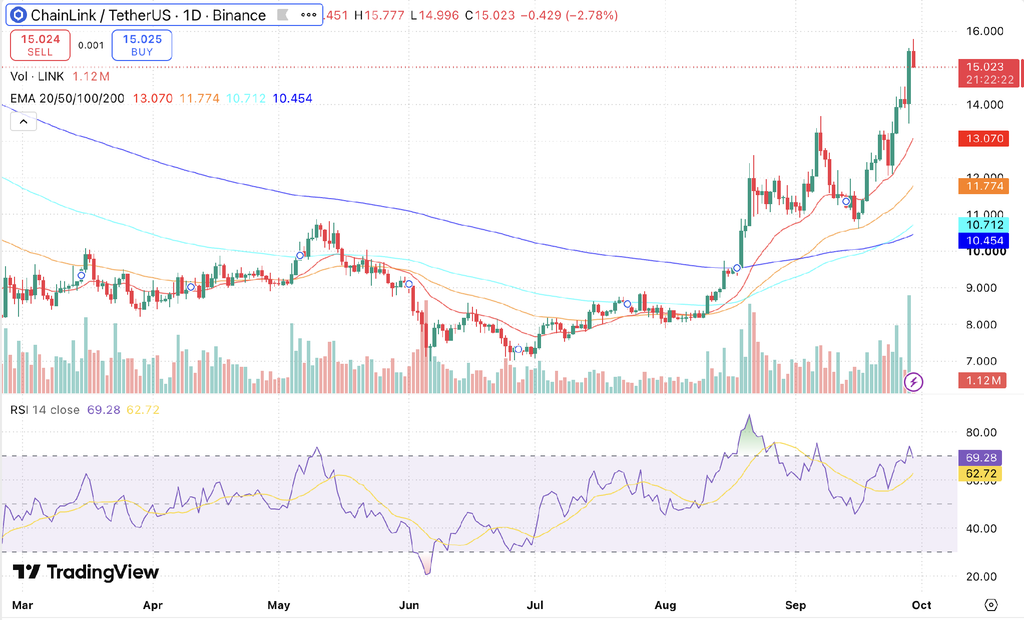
LINK daily chart with EMA 20/50/100/200 and RSI 14. Source: TradingView.
LINK trades at $15.02 in the current session, down 2.78% after a range of $14.996 to $15.777. That high is the top of the 2026 range, which runs from a low of $6.996, and the token is up 22.99% for the year.
The moving averages are in uptrend order, which separates LINK from the rest of the week’s leaders. The 20-day EMA at $13.070 sits above the 50-day at $11.774, which sits above the 100-day at $10.712 and the 200-day at $10.454. The price is 1.44 times the 200-day. RSI 14 reads 69.28 against a signal line of 62.72, below the overbought readings on most of the day’s other gainers.
Two figures cut the other way. LINK is down 30.15% over twelve months, and it trades about 71% below its 2021 high of $52.88.
Looking for LINK price targets: Chainlink (LINK) Price Prediction: Daily, Weekly 2026-2040
Programmatic Value Accrual: The Strategic Reserve
Payment Abstraction converts offchain enterprise payments and onchain service fees into LINK using CCIP, Automation and Price Feeds, routes the purchases through Uniswap V3 on Ethereum and deposits them into the Chainlink Reserve, a timelocked contract launched in August 2025 that anyone can inspect on Etherscan.
The Reserve held 6,047,498 LINK on 26 September, roughly 0.81% of circulating supply, after 373,791 were added during September. Chainlink has said it expects no withdrawals for several years. That does not make the token cheap, but it does mean enterprise adoption has a stated and auditable route to the token, which is not true of most of the week’s other movers.
Industry Presence: Executive Panels at Sibos 2026
Institutional visibility for the protocol was reinforced by chainlink news from the financial services sector during the final week of September. The annual Swift-organized financial operations conference, chainlink sibos 2026, convened at the Miami Beach Convention Center from 28 September to 1 October.
Chainlink maintained a formal enterprise presence (Stand I028), with co-founder Sergey Nazarov scheduled across four panel sessions, including discussions on cross-chain collateral mobility alongside the Depository Trust & Clearing Corporation (DTCC) and capital market workshops on transaction resilience.
FAQs
What is Chainlink CCIP 2.0?
Chainlink CCIP 2.0, released on 28 September 2026, is an update to Chainlink’s cross-chain interoperability protocol that introduces Cross-Chain Verifiers. Asset issuers configure their own verification layer, and a destination chain can require named verifiers to approve a transaction before it executes. The release also adds KYC, AML and sanctions screening functions and configurable finality speeds.
What does the Infosys partnership mean for Chainlink?
The Infosys partnership means Infosys will standardize adoption of the Chainlink platform across its banking and payments work, covering CCIP, the Chainlink Runtime Environment, the Automated Compliance Engine, Proof of Reserve, Data Feeds and Data Streams. The widely quoted 1.7 billion figure is the reach of Infosys’s financial services business, not users of a Chainlink-based product, and no bank or production date has been named.
Does enterprise revenue reach the LINK token?
Enterprise revenue does reach the LINK token, through a mechanism called Payment Abstraction. It converts offchain enterprise payments and onchain service fees into LINK and deposits them in the Chainlink Reserve, an Ethereum contract launched in August 2025 that held 6,047,498 LINK on 26 September and can be audited publicly.
Is LINK at an all-time high?
LINK is not at an all-time high. Its session high of $15.777 is the highest level of 2026, but the token remains about 71% below its all-time high of $52.88 set in May 2021 and is down 30.15% over the past twelve months.


