



Bitcoin’s biggest holders, often called “whales,” have quietly made one of the most significant moves in 2026. Over the past month, these large investors have bought around 270,000 BTC, which is roughly $23 billion at today’s prices. That’s about 1.3% of all BTC in circulation, making it the largest net purchase by this group in over 13 years. The accumulation data is based on on-chain wallet analysis tracking large, non-exchange Bitcoin addresses, which helps distinguish long-term holder activity from routine exchange wallet movements.
In crypto markets, “Bitcoin whales” typically refer to wallets holding 1,000 BTC or more, a cohort whose movements are closely watched due to their potential influence on liquidity and price trends.
What makes this move interesting isn’t just the size of the buy. It’s when it happened. Historically, big whale accumulations like this don’t happen at obvious market highs. Instead, they occur quietly, often when most people are distracted, unsure, or focused on short-term price swings.
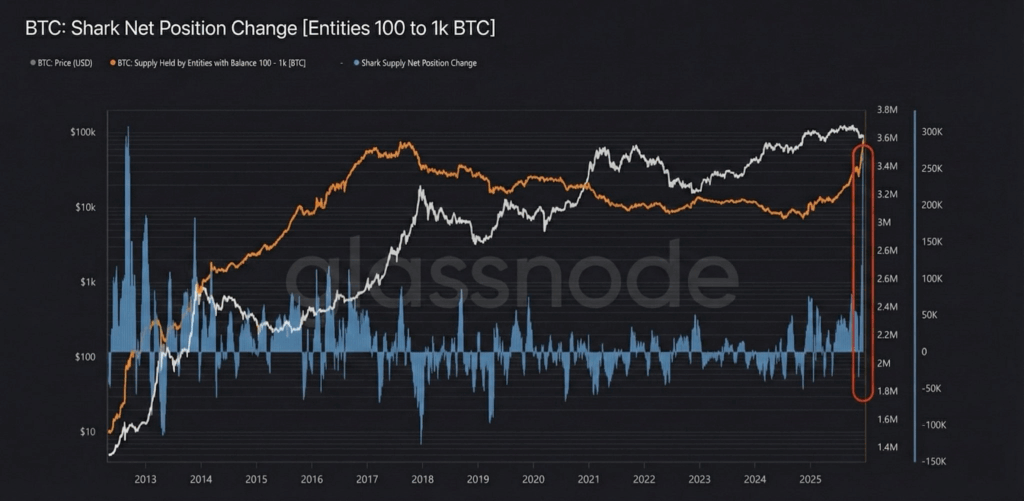
Source: X
Why Crypto or Bitcoin Whales Accumulation Matters
Whales tend to buy when the market feels uncertain. They aren’t chasing quick gains, they’re thinking long-term. Over the years, similar patterns have emerged before major market shifts. While this doesn’t mean Bitcoin’s price will skyrocket tomorrow, it does signal confidence from those who have held BTC for years, not days.
By increasing their exposure now, whales are effectively betting on Bitcoin’s future, even as retail traders worry about altcoins or short-term market dips. Their moves suggest they see current prices as a strategic opportunity, not a reason to panic. This type of positioning usually goes unnoticed because it happens quietly, under the radar, when everyone else is focused on daily headlines or volatile price swings.
Some analysts caution that not all large transfers represent true accumulation, noting that exchange restructuring and internal wallet management can sometimes distort headline whale data.
Historically, similar whale positioning phases have preceded extended consolidation periods, a pattern explored further in our Bitcoin price prediction for 2026.
Impact on Bitcoin’s Supply and Market
Buying 270,000 BTC within 30 days not only influences the price but also several other factors. Since the total number of Bitcoins will never exceed 21 million, each large purchase by whales significantly reduces the amount of BTC available to others. Having fewer BTC on the market can eventually lead to higher prices if demand remains strong, especially from institutional investors or funds seeking to purchase Bitcoin in large quantities.
Meanwhile, retail investors tend to get sidetracked by short-term changes, leading to a divergence between the actions of long-term holders and the observations of most traders. This divergence has historically been predictive of larger moves, but patience is essential. Accumulation is not necessarily an immediate price increase; sometimes it quietly signals a new uptrend.
Notably, this Bitcoin whales accumulation contrasts with recent spot Bitcoin ETF outflows, highlighting a divergence between long-term on-chain holders and shorter-term institutional flows.
Conclusion
Bitcoin whales are sending a clear message: they believe in the long-term value of the crypto. Their largest BTC accumulation in over a decade reflects confidence in BTC, even as the broader market remains uncertain. While this isn’t a guarantee that prices will surge overnight, it highlights a trend many may overlook: experienced investors are quietly positioning for the future. For anyone watching the market, this is a reminder that the smartest moves often happen when no one is paying attention.
FAQs
1. Do Bitcoin whales manipulate the market?
Bitcoin whales can influence short-term price action due to the size of their trades, especially in low-liquidity conditions. However, Bitcoin’s market has matured significantly, and no single whale or group can fully control price direction. Market structure, macro conditions, and broader demand play a much larger role over time.
2. Are whale transactions always a bullish signal?
No, whale transactions are not always a bullish signal. This is because large Bitcoin transfers can have multiple explanations, including custodial movements, OTC settlements, or internal exchange wallet maintenance. This is why analysts often focus on non-exchange wallet behavior and long-term holding patterns, rather than isolated transactions.
3. How is whale activity different from Bitcoin ETF flows?
Whale activity reflects on-chain behavior by large holders, while ETF flows represent regulated, market-facing institutional demand. At times, these signals can diverge, for example, whales accumulating Bitcoin while ETFs see short-term outflows, highlighting different investment horizons and risk appetites.
4. Can retail investors track Bitcoin whale activity?
Yes. Retail investors can monitor whale movements using on-chain analytics platforms and whale-tracking tools. However, interpreting this data requires caution, as raw transaction sizes alone do not always reveal intent. Context, such as wallet type, exchange involvement, and broader market trends, is critical.
5. Who owns most of the Bitcoin supply?
Bitcoin ownership is widely distributed across individual holders, early adopters, exchanges, custodians, institutional investors, and long-term wallets. While whales control a significant share of circulating BTC, no single entity owns anywhere close to the majority of Bitcoin’s total supply.
6. Are Bitcoin whales more important than retail investors?
Whales influence liquidity and volatility, but retail investors collectively play a crucial role in market participation, adoption, and long-term demand. Bitcoin’s price dynamics are shaped by the interaction between large holders, institutions, and millions of smaller participants worldwide.


