


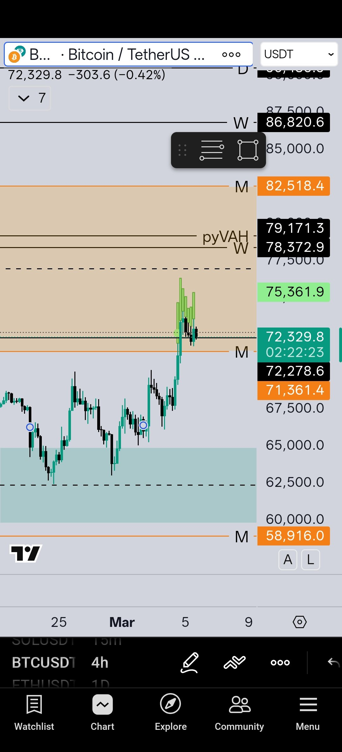
Bitcoin price is currently trading within a defined price corridor between $65,000 and $78,000. This consolidation phase has captured traders’ attention, as neither bulls nor bears have gained decisive control of the market.
The crypto token has oscillated within this range for several weeks, repeatedly testing both the $65K support and $78K resistance without achieving a sustained breakout. Trading volume often spikes near these levels, reflecting defensive activity from both buyers and sellers. Market sentiment remains divided, with bulls defending the lower bound while bears continue to protect the upper threshold. Range-bound trading typically signals market indecision and can often precede a period of increased volatility after a breakout.
Bitcoin Price Support: Understanding the $65K Level
The $65,000 level has emerged as a crucial support zone for bitcoin, representing a price point where buying interest consistently materialises. Each time bitcoin approaches this threshold, buyers step in to prevent further downside movement.
Historical price action shows bitcoin bouncing from this level on multiple occasions, reinforcing its importance within the current market structure. Long-term holders view this price range as attractive, and institutional participants appear to share similar sentiment.
On-chain data suggests accumulation behaviour during dips toward this zone, with clusters of buy orders forming near the $65K level. Technical indicators such as moving averages and volume profiles also highlight this area as a key defensive position for buyers. As a result, $65K has become a critical line in the sand for bitcoin’s near-term trajectory.
Read more: Bitcoin Price Prediction
Bitcoin Price Resistance: Why $78K Remains a Key Barrier
While $65K serves as strong support, the $78,000 level remains a major resistance zone. Selling pressure increases whenever Bitcoin approaches this level, preventing the crypto from establishing higher ground.
Previous attempts to break above $78K have been met with swift rejections. Profit-taking behaviour becomes more visible as bitcoin nears this price point, with short-term traders often closing swing positions here.
Order book data also reveals concentrated sell orders around the resistance zone. The repeated rejections underscore the psychological significance of this level, making it a key barrier to upward momentum.
Trade BTC in INR on 
Deposit and withdraw in INR (₹).
No Conversion to Crypto Required.

Key Market Factors Influencing Bitcoin’s Next Move
Several macroeconomic factors continue to shape bitcoin price dynamics. Expectations around interest rates, global liquidity conditions, and inflation data influence both institutional allocation decisions and retail participation in crypto markets.
Institutional activity remains a major driver as well. Exchange-traded fund flows, corporate treasury allocations, and large-scale investor movements all impact market sentiment. On-chain indicators such as exchange reserves, whale wallet accumulation, and long-term holder behaviour also provide insight into potential directional bias within the market.
Bitcoin Price Outlook: Watching the $65K–$78K Breakout
Technical indicators currently reflect a balanced market. Momentum oscillators such as the Relative Strength Index or RSI and MACD show neither extreme bullish nor bearish signals, suggesting bitcoin remains in equilibrium.
Volatility has gradually decreased as the price continues to test both support and resistance. This compression in price movement often precedes a decisive breakout. If Bitcoin breaks above the $78,000 resistance with strong volume, it could trigger renewed bullish momentum. Conversely, a drop below the $65,000 support may lead to a deeper correction.
Until a clear breakout occurs, traders will continue watching these levels closely as the consolidation phase unfolds. This period represents a critical juncture for crypto news today and could shape bitcoin’s next major move.