


BitMEX co-founder Arthur Hayes has linked the escalating Iran conflict to potential Federal Reserve easing, arguing that prolonged geopolitical tension could ultimately support the Bitcoin price. In his latest essay, Hayes draws historical parallels between US military operations and subsequent Fed rate cuts, suggesting that renewed conflict could create conditions for monetary accommodation. Markets remain on edge as investors assess whether escalating geopolitical tensions could accelerate a shift in US monetary policy.
Currently, Bitcoin is trading at around $65,722, down approximately 47% from its all-time high in October 2025. The market sentiment remains cautious, as the Crypto Fear and Greed Index remains at the extreme fear level. In such a scenario, Hayes’s interpretation brings a macroeconomic perspective to the current debates over crypto Market News and US Politics.
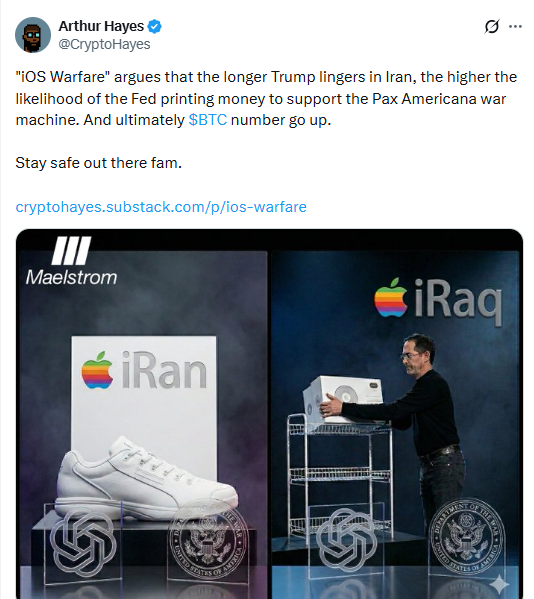
Source: Arthur Hayes
Iran Conflict and Fed Rate Cuts: Arthur Hayes’ Historical Thesis
In “iOS Warfare,” Hayes argues that every US president since 1985 has initiated military action in the Middle East, followed by monetary easing by the Federal Reserve. He points to the 1990 Gulf War under President George H.W. Bush, when the Fed shifted toward rate cuts as the conflict continued.
He also references the post-September 11 environment in 2001. Then-Fed Chair Alan Greenspan implemented an emergency 50-basis-point rate cut to stabilize financial markets. The wars in Iraq and Afghanistan unfolded alongside an extended easing cycle.
During President Obama’s 2009 troop surge in Afghanistan, interest rates were already at zero and quantitative easing was in place. According to Hayes, the pattern remains consistent: geopolitical stress creates political space for accommodative policy.
This historical framing forms the foundation of his current outlook. It sets the stage for examining how a renewed Iran conflict under President Donald Trump could influence monetary conditions.
Could the Iran Conflict Trigger Federal Reserve Easing?
Hayes contends that if US involvement in Iran deepens, fiscal pressures could rise. Financing extended military operations would likely increase federal spending. He notes that the Department of Veterans Affairs budget has grown faster than overall federal spending since 1985, reflecting the long-term cost of military engagement.
In such an environment, the Federal Reserve may face pressure to maintain liquidity and stabilize financial markets. Hayes believes that rate cuts or renewed money printing would serve that purpose. He frames this as part of the broader Pax Americana strategy, where monetary tools support geopolitical objectives.
However, Hayes does not advise immediate action. He clearly states that investors should wait for confirmed policy moves. A rate cut or clear shift toward easing would provide stronger validation. Until then, caution remains warranted.
This measured stance bridges macro theory with practical investment strategy. It shifts the focus from speculation to observable policy signals.
Bitcoin Price Outlook if the Federal Reserve Eases
Bitcoin’s current market structure reflects sustained pressure. The asset has declined for five consecutive months and remains significantly below its peak of $126,000 reached in October 2025. Year-over-year performance is also negative.
Hayes argues that monetary expansion has historically benefited scarce assets. In prior easing cycles, liquidity injections supported risk assets, including cryptos. If similar conditions emerge, Bitcoin could attract renewed capital flows.
Yet he emphasizes timing. Entering the market before actual easing begins exposes investors to ongoing volatility. The prudent approach, he writes, is to observe Federal Reserve decisions before increasing exposure to Bitcoin and select altcoins.
Read more: Bitcoin Price Prediction
Trade BTC in INR on 
Deposit and withdraw in INR (₹).
No Conversion to Crypto Required.

What This Means for Bitcoin and Crypto Markets
Arthur Hayes presents a macro-driven argument linking Iran conflict escalation to potential Federal Reserve easing. His thesis draws on historical patterns where US military engagement preceded accommodative monetary policy.
While he maintains a long-term constructive view on Bitcoin, he advises patience. Clear evidence of rate cuts or money printing should guide investment decisions. With Bitcoin trading well below its all-time high and sentiment at extreme fear levels, policy direction may prove decisive in shaping the next major move.