

A clear look at what is left of the tap-to-earn boom.
Choosing a Telegram crypto game in 2026 takes more than a glance at its token price. The questions worth asking are what the game actually involves, what the token behind it is worth, and whether enough of that token trades each day for you to sell what you earn.
This guide compares five of them on those terms: Notcoin, Catizen, DOGS, Hamster Kombat and Major. For each one it sets out how the game plays, how much of the token supply has yet to reach the market, how much changes hands in a day and what the daily chart shows. Points earned inside a mini-app are not cash and do not become withdrawable crypto on their own, and for anyone starting now the realistic expectation is engagement rather than earnings.
What Are Telegram Tap-to-Earn Crypto Games?
Telegram tap-to-earn crypto games are mini-apps or bots hosted on Telegram that reward users for simple actions such as tapping the screen, completing tasks, or inviting friends. Players earn in-game points that may later convert into real crypto tokens through token launches or airdrops.
Most tap-to-earn games run on The Open Network (TON), allowing seamless wallet integration, low fees, and easy distribution to Telegram’s massive user base. In 2025, Telegram made TON the required chain for crypto mini-apps, which cleared a large number of low-quality clones out of the ecosystem. The appeal lies in accessibility: users can start playing instantly without installing apps or making upfront investments.
Also read: What is Crypto Gaming
How Do Tap-to-Earn Games Work?
Tap-to-earn games follow a simple but addictive loop:
- Tapping mechanics: Players tap to generate in-game points or coins
- Energy systems: Taps consume energy that regenerates over time or via upgrades
- Upgrades and boosts: Increase tapping power or passive earnings
- Tasks and referrals: Earn bonuses by completing missions or inviting friends
- Token rewards: Points may convert into tokens during airdrops or launches
In 2026, the projects that survived have moved away from endless tapping toward deeper mechanics, sybil filtering to block multi-account farming, and tighter reward schedules designed to limit token inflation.
Top 5 Tap-to-Earn Crypto Games
The five games below are ranked by market capitalisation. All five have live, tradeable tokens with meaningful daily volume, which is a lower bar than it sounds: several once-prominent names in this category now trade so thinly that entering or exiting a position is impractical.
| Game | Price | Market Cap | 24h Volume | Vol / Mkt Cap |
|---|---|---|---|---|
| Notcoin (NOT) | $0.0003665 | $36.44M | $1.76M | 4.83% |
| Catizen (CATI) | $0.04477 | $25.31M | $2.99M | 11.81% |
| DOGS (DOGS) | $0.00003576 | $18.48M | $4.05M | 21.92% |
| Hamster Kombat (HMSTR) | $0.0001383 | $8.9M | $2.27M | 25.51% |
| Major (MAJOR) | $0.03622 | $3.01M | $455.23K | 15.12% |
Data as of 26 October 2026. Source: CoinMarketCap.
1) Notcoin (NOT)
Notcoin is the Telegram-based tap-to-earn game that started the category. Built on TON, it was deliberately simple: tap to earn, with no complex mechanics to learn. That simplicity, combined with Telegram’s distribution, made it the first crypto game to reach a genuinely mainstream scale, and it remains the reference point every later project is measured against.
In 2026, Notcoin is best understood as a benchmark rather than a growth opportunity. Active tapping rewards have largely wound down, and the project’s value now rests on brand recognition and its integrations across the TON ecosystem. Its team has been candid that the pure tap-to-earn model is fading, and has pushed development toward games with deeper retention mechanics.
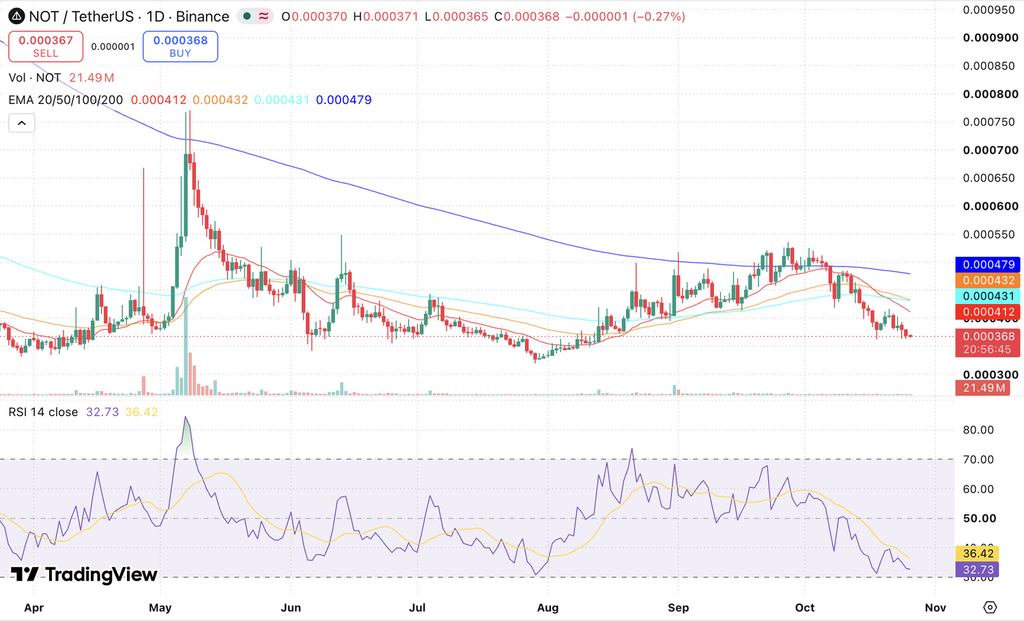
Notcoin Price Chart. Source: TradingView
| Metric | Value |
|---|---|
| Price | $0.0003665 |
| 24-Hour Volume | $1.76M |
| Market Cap | $36.44M |
| Circulating Supply | 99.42B NOT |
| Total Supply | 102.45B NOT |
On the daily chart NOT trades at $0.000368, below its 20-day EMA at $0.000412, its 100-day at $0.000431, its 50-day at $0.000432 and its 200-day at $0.000479, with RSI at 32.73 against a signal line of 36.42. Notcoin is the only project here with nearly all of its supply already circulating, at 99.42 billion of a 102.45 billion total, so there is effectively no unlock overhang left to weigh on the price. Against that, it turns over the smallest share of its market capitalization of any token on this list, at 4.83%, which makes larger positions harder to exit.
Read more: Toncoin Price Prediction
2) Catizen (CATI)
Catizen is a blockchain gaming platform built around a cat-collecting and merging game, launched in 2023 by a team of blockchain and gaming developers. Rather than relying on tapping alone, it combines casual gameplay with events, challenges and a token economy in which CATI holders can vote on platform development.
Among 2026 tap-to-earn survivors, Catizen is consistently described as the most mature. It moved earliest and furthest away from repetitive tapping toward genuine game content, which has helped it retain users where pure clickers lost them. Actual earnings for new players remain modest, and its long-term value depends on continued retention and ecosystem expansion rather than airdrop speculation.
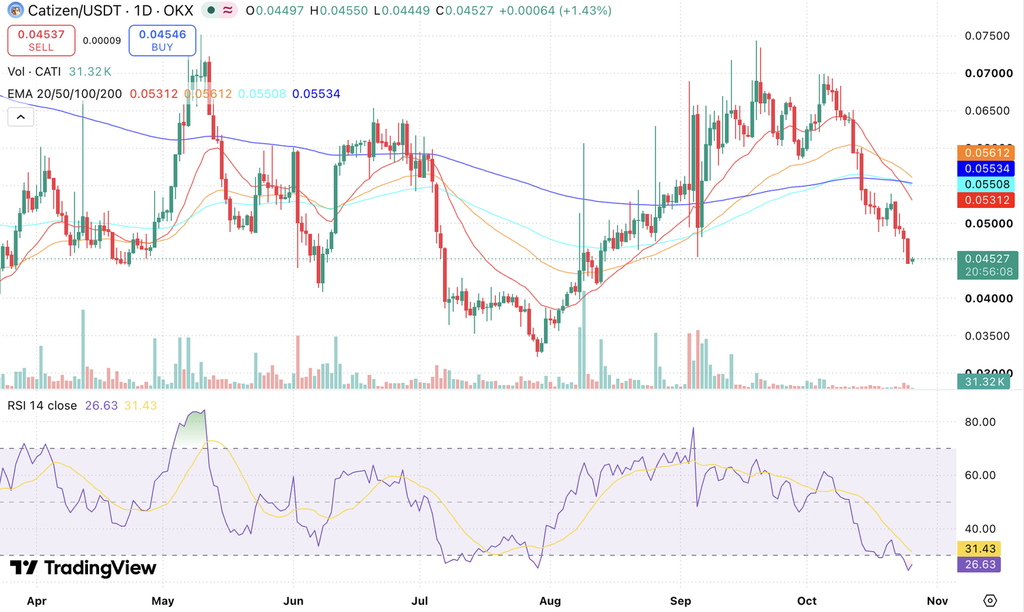
Catizen Price Chart. Source: TradingView
| Metric | Value |
|---|---|
| Price | $0.04477 |
| 24-Hour Volume | $2.99M |
| Market Cap | $25.31M |
| Circulating Supply | 565.5M CATI |
| Total Supply | 1B CATI |
The chart does not currently support that reputation. CATI trades at $0.04527, below its 20-day EMA at $0.05312, its 100-day at $0.05508, its 200-day at $0.05534 and its 50-day at $0.05612, and RSI at 26.63 against a signal of 31.43 is the lowest reading on this list, well inside the territory usually described as oversold. Supply is the other caution: 565.5 million of a 1 billion total is circulating, leaving over 40% still to reach the market, and tokens released later can dilute the value of those held now.
3) DOGS (DOGS)
DOGS is a TON-based token built around Spotty, a dog mascot originally drawn by Telegram founder Pavel Durov for a charity auction. Its distribution model was unusual: rather than rewarding tapping volume, DOGS allocated tokens based on Telegram account age and genuine activity, rewarding long-standing users instead of the most aggressive farmers.
That approach produced one of the widest holder bases in the category and avoided much of the multi-account farming that undermined other airdrops. The project has since focused on ecosystem integrations with other Telegram mini-apps, tokenised stickers, quests and charitable initiatives. It is listed on Binance and other major exchanges, which gives it considerably better liquidity than most projects of its size.
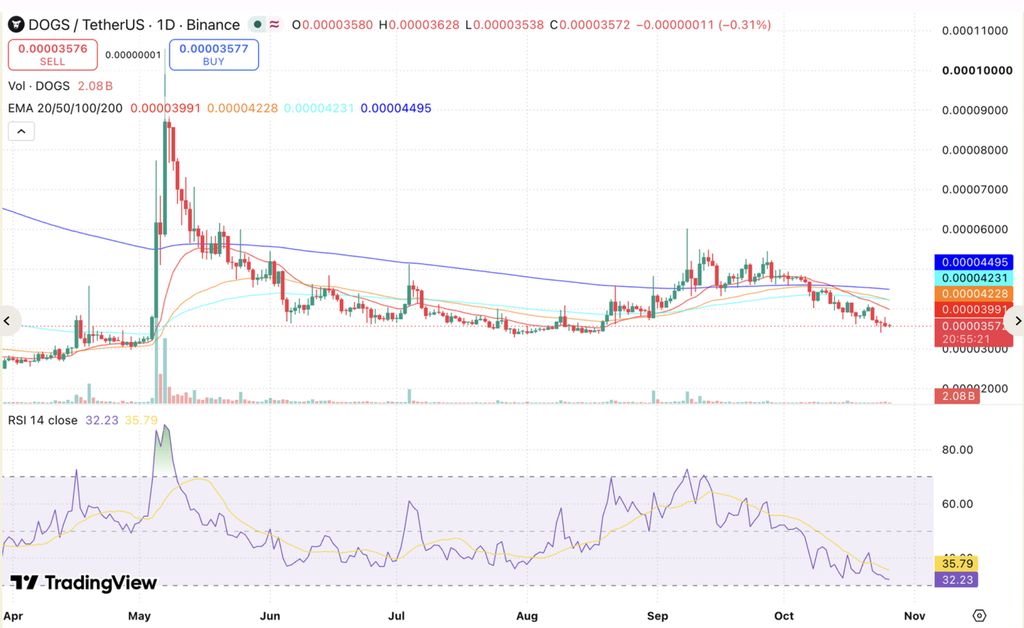
DOGS Price Chart. Source: TradingView
| Metric | Value |
|---|---|
| Price | $0.00003576 |
| 24-Hour Volume | $4.05M |
| Market Cap | $18.48M |
| Circulating Supply | 516.75B DOGS |
| Total Supply | 545.21B DOGS |
DOGS turns over roughly a fifth of its market capitalization daily, at 21.92%, the second-highest ratio on this list, and with 516.75 billion of a 545.21 billion total already circulating the remaining dilution is limited. The chart is weaker than that liquidity suggests. Price at $0.00003572 sits below the 20-day EMA at $0.00003991, the 50-day at $0.00004228, the 100-day at $0.00004231 and the 200-day at $0.00004495, with RSI at 32.23 against a signal of 35.79.
4) Hamster Kombat (HMSTR)
Hamster Kombat combined tap-to-earn mechanics with a management-style loop in which players ran a fictional crypto exchange operated by a cartoon hamster. Instead of tapping alone, it emphasised upgrades, daily tasks and strategic progression, and at its peak it reached roughly 300 million registered users, making it the largest crypto game ever launched by that measure.
User numbers have fallen from around 300 million to roughly 13 million, and the token now trades at about a third of the high near $0.00040 it reached in July. Widespread complaints that airdrop allocations were negligible relative to months of play did lasting damage to player trust, and the episode is a large part of why subsequent projects adopted sybil filtering. Hamster Kombat still operates and still trades actively, but as a project it is more instructive than promising.
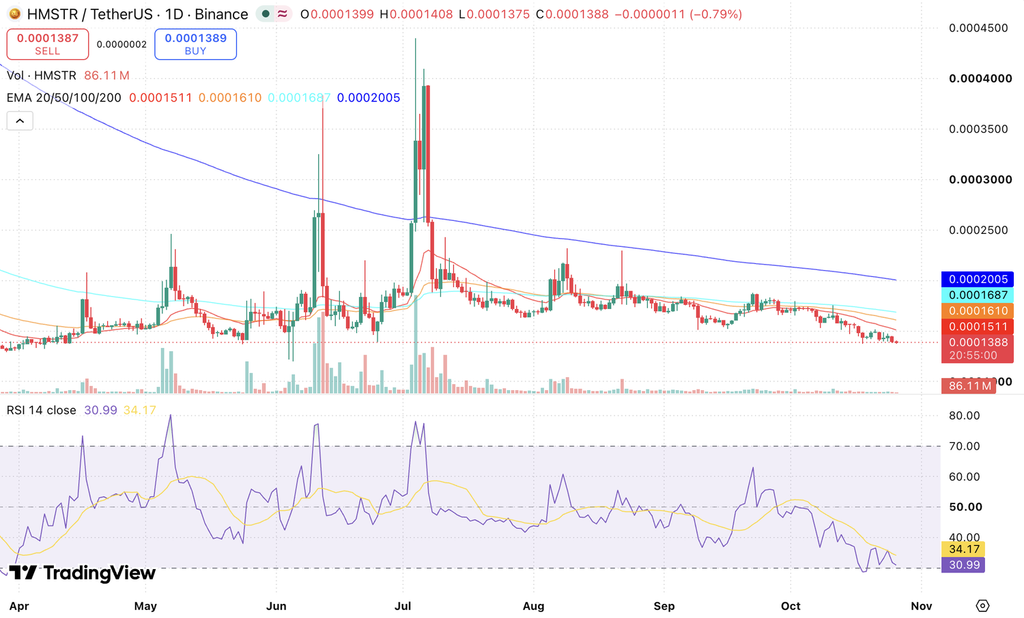
Hamster Kombat Price Chart. Source: TradingView
| Metric | Value |
|---|---|
| Price | $0.0001383 |
| 24-Hour Volume | $2.27M |
| Market Cap | $8.9M |
| Circulating Supply | 64.37B HMSTR |
| Total Supply | 100B HMSTR |
The technical picture is weak but the liquidity is strong: HMSTR turns over 25.51% of its market capitalization daily, the highest ratio on this list, so traders have not abandoned it even as the chart has deteriorated. Price at $0.0001388 sits below all four key averages, at $0.0001511, $0.0001610, $0.0001687 and $0.0002005 for the 20, 50, 100 and 200-day EMAs, with RSI at 30.99 against a signal of 34.17. Note also that 64.37 billion of a 100 billion total is circulating, leaving meaningful unlocks outstanding.
Read more: Hamster Kombat Price Prediction
5) Major (MAJOR)
Major, known in full as Major of Telegram, was built to drive adoption of the TON platform through daily challenges, puzzles and competitive leaderboards rather than continuous tapping. The MAJOR token functions as in-game currency, paying for actions and enabling exchange of NFT numbers and Telegram usernames, which ties it directly into Telegram’s own digital asset marketplace.
It is the smallest project on this list by a wide margin, and its token is close to fully distributed, with 83.34 million of a 99.99 million total already circulating. That gives it the cleanest supply position of the five, with little further dilution ahead.
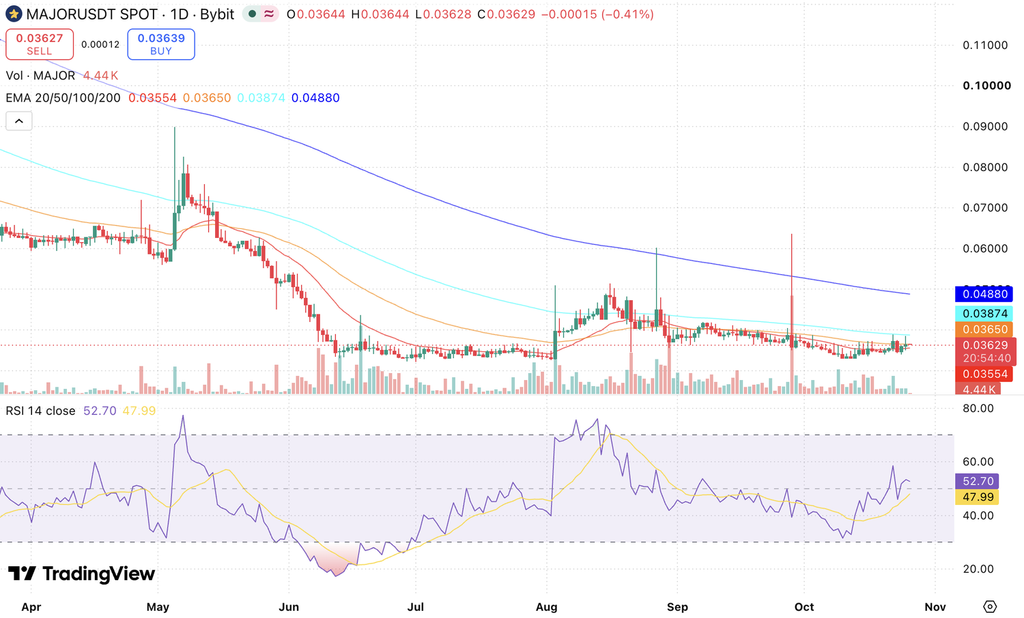
Major Price Chart. Source: TradingView
| Metric | Value |
|---|---|
| Price | $0.03622 |
| 24-Hour Volume | $455.23K |
| Market Cap | $3.01M |
| Circulating Supply | 83.34M MAJOR |
| Total Supply | 99.99M MAJOR |
Major has the only chart here showing any upturn. Price at $0.03629 sits above its 20-day EMA at $0.03554, though still below the 50-day at $0.03650, the 100-day at $0.03874 and the 200-day at $0.04880, and RSI at 52.70 against a signal of 47.99 is the only reading on this list above both the midpoint and its own signal line. Set against that, this is by far the thinnest market of the five, with $455,230 traded in 24 hours, so an order that would pass unnoticed elsewhere can move this price.
What is the Future of Tap-to-Earn Crypto Games
The format peaked in mid-2024, and the reasons it declined are well understood: gameplay had no depth beyond repetition, reward pools were spread across tens of millions of participants until individual payouts became negligible, and multi-account farming let a small number of users capture a disproportionate share. Hamster Kombat’s collapse from 300 million users to 13 million is the clearest single example.
What has replaced it is more interesting: Telegram’s 2025 requirement that crypto mini-apps run on TON removed a large tier of low-quality clones, and surviving projects have added sybil filtering to block multi-account farming before distribution. Four of the five trade below all four of their key moving averages, Catizen among them at an RSI of 26.63, and only Major sits above even its 20-day average.
For anyone considering these games now, the realistic expectation is engagement rather than income. The large airdrops that made early Notcoin and Hamster Kombat participants money were a function of a specific moment that has passed. What remains worthwhile is low-risk exposure to how Web3 wallets, tokens and on-chain rewards actually work, delivered through an interface most people already have on their phone.
Looking for more trending crypto games and new token insights? Stay ahead of the curve with the CoinDCX blog, your go-to source for daily crypto news, real-time price analysis, and the latest projects making waves in the market
Additional Read:
1. What are Play to Earn Crypto Games?
2. How Blockchain Is Revolutionising the NFT Gaming Scene
FAQs
Q1. What are game coins in crypto?
Game coins are blockchain-based tokens used in gaming ecosystems for trading, purchases or rewards. They often power play-to-earn models and can represent in-game currencies, governance tokens or NFTs. In the Telegram category specifically, examples include NOT, CATI, DOGS, HMSTR and MAJOR. Broader gaming tokens include SAND, GALA, AXS and IMX.
Q2. Can I earn crypto by playing games?
Yes, though expectations should be realistic. Play-to-earn and tap-to-earn games distribute tokens through airdrops, quests and in-game achievements. The large payouts associated with 2024 Telegram airdrops are no longer typical: reward pools are now spread thinly and sybil filtering removes a significant share of claims.
Q3. What is the best Telegram tap-to-earn game in 2026?
By market capitalization, Notcoin leads at $36.44M, followed by Catizen at $25.31M and DOGS at $18.48M. On chart strength none is clearly strong: Major is the only one trading above even its 20-day moving average. On liquidity, Hamster Kombat turns over the highest share of its market cap daily, at 25.51%.
Q4. Is crypto gaming considered gambling?
Many blockchain games are skill-based or engagement-based and offer earnings through gameplay, which distinguishes them from gambling. However, games featuring randomised loot boxes, wagering mechanics or paid spins may resemble gambling, and regulations vary by jurisdiction. Indian users should note that crypto gains are taxable at 30% plus applicable TDS, however they were earned.
Q5. Which Telegram games pay real money in crypto?
Notcoin, Catizen, DOGS, Hamster Kombat and Major all have live tokens trading on major exchanges, so rewards from these can be converted to value. Many other Telegram games either never launched a token or have tokens with negligible trading volume, which means rewards cannot realistically be sold.
Q6. Are tap-to-earn tokens a good investment?
They are high-risk, small-cap assets. Every token on this list trades far below its launch price, and four of the five sit below all four of their key moving averages. Catizen and Hamster Kombat both have large portions of supply still to enter circulation. Check the circulating-to-total supply ratio and daily volume before any purchase.