



KEY TAKEAWAYS
- A bear market is a drop of more than 20% from a recent peak. Crypto has been in one since Bitcoin’s October 2025 high, and in the first week of October 2026 that decline reached exactly the one-year mark.
- Bitcoin peaked at $126,198 on 6 October 2025, bottomed near $59,300 in June 2026, and trades in the mid-$80,000s in early October 2026, roughly 32% below the record and up about 45% from the low.
- Every major Bitcoin high has been followed by a bear market. The 2018 and 2022 declines each ran roughly 365 days, the mark this cycle has just reached.
- CryptoQuant data showed the largest holders adding through the decline, and in late August the firm shifted its own reading from late-stage bear to the early phase of a new bull market, with confirmation set at a sustained close above roughly $81,700.
- Each bear market bottom so far has been higher than the last, but nothing guarantees that pattern repeats, and the October 2025 high remains unreclaimed.
Whenever we hear about digital assets, the spotlight usually falls on crypto bull runs, the big rallies, the hype, and the influx of new money. The quieter side of the story, the crypto bear market, is where the real character of this industry is revealed.
A bear market is not just falling charts. It is a period that tests patience, confidence, and belief. Prices slide, headlines turn negative, and for many people it feels like the party is over. These are also the moments when the noise dies down and only the strongest projects keep building.
That is why studying bear markets matters. They are not simply bad times; they are a natural part of the cycle. Bulls bring excitement, and bears bring perspective. Every crypto bear market so far has set the stage for the next wave of growth, and the 2025-26 bear, now a year old, is showing the late-cycle signs this article was built to track.
BTC Chart and Bitcoin Bear Market Analysis
If you zoom out on Bitcoin’s price history, a clear rhythm appears. Every big rally to a new all-time high (ATHs) has been followed by a painful correction, and the chart shows not just where Bitcoin peaked but how far and for how long it fell before finding a bottom.
Bitcoin: Peaks and Bottoms Through the Years
Four cycles are now on record. Each one followed the same shape at a larger scale.
- 2017: Bitcoin reached nearly $20,000, specifically $19,666. Within a year, the market had completely flipped, and prices slid more than 80% by the end of 2018. For anyone who lived through it, it was a brutal experience.
- 2021: Bitcoin ran up to nearly $69,000 and the story played out again on a bigger stage. The market bled slowly through the following year, and by late 2022 Bitcoin had crashed to $15,479. For newcomers, that fall felt worse than 2018 because expectations had been higher.
- 2025: Bitcoin set its record high of $126,198 on 6 October 2025, clearing the $124,500 level it had touched in mid-August. Total crypto market capitalisation peaked alongside it at about $4.27 trillion. Unlike previous blow-off tops, this peak gave way to a slower structural cooling rather than an immediate collapse.
- 2026: Prices held above $100,000 into November, drifted to roughly $88,000 by late December, and kept sliding through the first half of 2026. In June, Bitcoin broke below $60,000 for the first time in the cycle and reached a 21-month low near $59,300. That low has held: Bitcoin bottomed through July, rallied roughly 24% in August, closed September near $83,500, and entered October in the mid-$80,000s.
Where the Crypto Market Stands in October 2026
The market has done more than stabilise. The question has shifted from how far prices can fall to whether the recovery can be confirmed.
As of early October 2026, total crypto market capitalisation stands at about $2.9 to $3.0 trillion, recovering from a roughly $50 billion macro-driven dip in the first days of the month. Bitcoin trades between roughly $84,000 and $87,000 with dominance near 56.9%, while Ethereum sits around $2,700 and holds about 11% of the market. That leaves Bitcoin roughly 32% below its October 2025 record and the total market about 30% below its own peak, drawdowns that stood at 53% and 46% respectively at the June low.
Technically, the configuration has inverted since August. Bitcoin now trades above the 200-day moving average near $70,000 that CryptoQuant identifies as first support, and, more importantly, above the 365-day moving average around $81,700 that the firm treats as the dividing line between bear and bull regimes. Bitcoin’s September monthly close near $83,500 cleared that line; what remains is for it to hold. Until the October 2025 high is reclaimed, the long-term trend is a recovery inside a bear market rather than a new advance.
The regulatory catalyst resolved, and it resolved badly. The CLARITY Act, which had cleared the House in July 2025 and the Senate Banking Committee in May 2026, failed a Senate cloture vote 49-50 on 15 September 2026, short of the 60 votes required. The House has adjourned until after the November election, so comprehensive US market-structure rules now wait for the lame-duck session or 2027. The market absorbed the news without breaking the June low, which is itself a data point: the decline’s last scheduled catalyst failed, and the price held anyway.
How Long Do Crypto Bear Markets Last?
To understand how long Crypto bear markets, lets look at the history
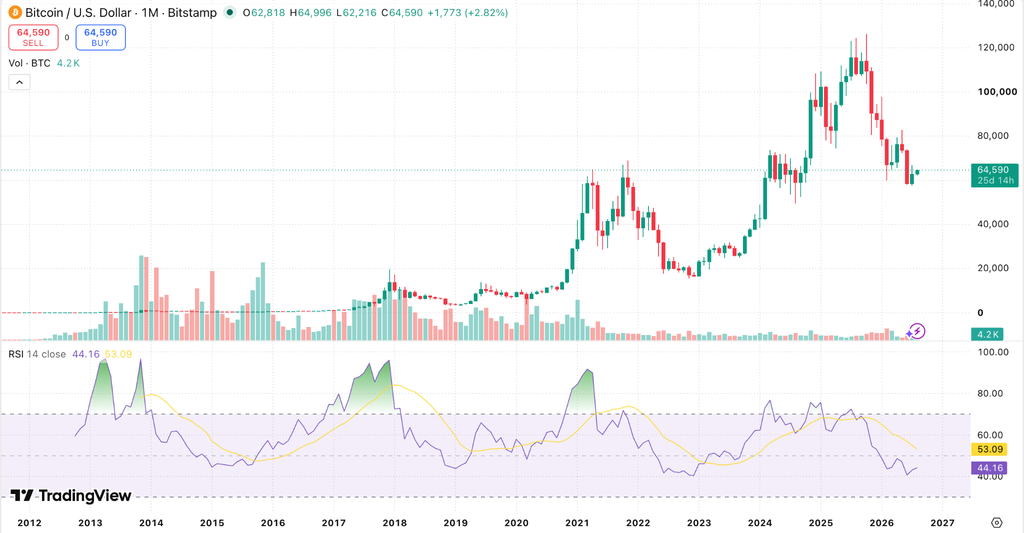
Bitcoin market chart, Source: TradingView
One striking feature of the chart is the symmetry: both the 2018 and 2022 bear markets lasted almost exactly 365 days. That suggests Bitcoin follows a natural one-year reset phase after a peak, in which excess hype is flushed out and stronger hands slowly rebuild.
Measured from the 6 October 2025 peak, the current decline reached that one-year mark in the first week of October 2026. The June low near $59,300, set roughly eight months in, sits inside the window in which the last two bears found their bottoms, and it has now held for four months while price recovered about 45%. Duration alone has never been a reliable timing signal, and nothing obliges this cycle to match the last two, but the symmetry the chart shows is no longer a projection. It has happened.
The Two Phases of a Bear Market
Bear markets rarely fall in a straight line. They tend to move through two distinct phases, and knowing which one you are in changes how you read the price action.
The first is a sharp break, usually driven by leverage unwinding, as in the 10 October 2025 event that wiped out roughly $19 billion of positions within a day. The second is the long grind: months of lower highs, thinning volume, and sideways basing, which is where this cycle sat through the first half of 2026 before the August turn.
Reading Sentiment in the Data
The Relative Strength Index at the bottom of the chart offers another clue about where a cycle sits.
When RSI shoots above 70, the market is usually in greed mode, and a top may be near. When RSI sinks into the 30s, fear and capitulation take over, and those moments have historically marked bottoms.
Google Trends: Retail Fear Peaked Before the Low
Search behaviour is one of the cleanest measures of retail sentiment, because people search for what worries them. On this measure, the fear phase of this cycle has come and gone.
Between late December 2025 and mid-2026, global search interest for the phrase ‘Bitcoin bear market’ surged to its highest level in five years, above the spikes seen during the 2021 crash and the 2022 to 2023 bear market.
This matters because retail investors do not search for ‘bear market’ at the top of a cycle. They search for it when fear peaks, when prices are volatile, confidence is shaken, or markets appear to be reversing sharply.
Historically, these search-based panic spikes have aligned with late-stage corrections, cycle bottoms forming, capitulation phases ending, and periods when large holders quietly accumulate. That is how this one resolved: the search-interest peak preceded the June price low, and by early October the Crypto Fear and Greed Index had swung to readings of 71 to 74, in Greed territory, the inverse of the first half of the year. Sentiment gauges, as ever, described the turn only after it happened.
What On-Chain Data Says: Whales Accumulated Through the Decline
Search interest measures how retail feels. On-chain data measures what the largest holders actually do, and through 2026 the two pointed in opposite directions until price resolved the argument in the whales’ favour.
CryptoQuant’s Smart Money report, published on 5 August 2026, found that the biggest holders of Bitcoin, Ether, and XRP had been adding to their positions through the decline. The firm read this as a late-stage bear market rather than a bottom that had already formed.
- Bitcoin: Whale balances, excluding exchanges, mining pools, ETFs, and treasury companies, had recovered to about 3.06 million BTC from a low of 2.87 million in December 2025. Accumulation accelerated after Bitcoin fell below $60,000 in June. Balances remained below the 2025 bull-market peak near 3.23 million BTC, which left room for further buying.
- Ether: Wallets holding between 10,000 and 100,000 ETH had grown from roughly 14 million ETH in mid-2025 to a record 19.6 million. Wallets above 100,000 ETH added around 1.8 million more over the same period. Smaller holders sold into that demand, so ownership concentrated.
- XRP: Average spot order sizes stayed in CryptoQuant’s largest bracket while the token traded between $1.00 and $1.20. Cumulative volume delta sitting in neutral territory pointed to quiet absorption rather than aggressive buying, which is what base-building tends to look like.
The accumulation thesis aged well. Within three weeks of that report, Bitcoin had rallied roughly 24%, and CryptoQuant itself changed its framing: on 26 August it said Bitcoin had entered the early phase of a new bull market, with spot demand growing at its fastest monthly pace since December and its Bull Score indicator jumping from 30 to 80 in a week. On 11 September, it put the confirmation line at a sustained close above the 365-day moving average, then near $81,700, with support at the 200-day average around $70,000 and a demand zone at $62,000 to $65,000. By early October, Bitcoin in the mid-$80,000s traded above the confirmation level, while the Bull Score had cooled from 80 to 60, still in bull-regime territory but no longer accelerating.
What this does and does not tell you: CryptoQuant’s head of research, Julio Moreno, was explicit through the rally that prices could still fall and that confirmation requires the level to hold, not merely be touched. Rising whale balances reduce the supply available to sell; they do not set a floor. 10x Research’s earlier bar, a sustained monthly close above $63,000, was cleared by the September close near $83,500, and XRP at roughly $1.40 to $1.47 in early October sits above the $1.00 to $1.20 accumulation band the August report described. Levels that confirmed the turn out of the lows are not the same as levels that confirm a new bull market.
What Past Bear Markets Tell Us
Pulling the history together gives five points worth carrying into any downturn.
- A bear market has followed every major Bitcoin high.
- On average, these down cycles last about a year. The current one reached exactly that mark in the first week of October 2026.
- Bitcoin typically loses 70% to 85% of its value during a bear phase. This cycle’s maximum drawdown was shallower, roughly 53% at the June low, and has since narrowed to about 32%.
- Market sentiment swings from greed at the top to fear at the bottom. This cycle ran the full arc: Greed at the October 2025 peak, five-year highs in ‘bear market’ searches by mid-2026, and Greed readings again by October 2026.
- Each bear market bottom so far has been higher than the last, which reflects Bitcoin’s long-term growth path rather than a guarantee about the next one.
What Can Be the Reasons for the Next Bear Market?
Bear markets never arrive without a reason. Each downturn has been sparked by a combination of shocks, some from inside the industry and some from the broader financial world.
Lessons from the Past
Three episodes explain most of what the market has learned about how downturns begin.
- 2014 to 2015: The collapse of Mt. Gox, then the largest Bitcoin exchange, wiped out investor trust overnight and caused Bitcoin’s value to plummet by over 80%.
- 2018: The ICO bubble burst. Hundreds of overhyped projects raised millions and delivered nothing, leaving retail investors burned and confidence shattered.
- 2022: The domino effect of Terra-Luna’s collapse and the failure of giants like FTX and Celsius produced one of the most painful bear markets in crypto history. Prices declined sharply from late 2021 highs before stabilising towards the end of 2022 and recovering during 2023.
These moments underline a simple truth: bear markets are usually born out of excess, overconfidence, or the collapse of a key piece of infrastructure.
What Could Trigger the Next Bear Market?
Looking ahead, six risks could turn the current recovery back into fear and lead to another crypto market crash. None of them is a prediction; each is a pressure point worth watching.
1. Treasury Company Downfall
Companies such as MicroStrategy, Metaplanet, and SharpLink have become some of the largest holders of crypto, acting almost as unofficial treasuries for the industry. They sit on billions of dollars of Bitcoin and Ethereum as a long-term bet.
If even one of them ran into trouble through financial pressure, sudden regulation, or poor management, it might be forced to sell. In a market this sensitive, a large sell-off from a single holder could spark panic, and once fear sets in, the selling spreads fast.
2. Macro-Economic Shocks
Crypto thrives on liquidity. If global markets tighten, whether through interest rates spiking again or the dollar strengthening sharply, the flow of money into risk assets can dry up.
A recessionary shock would almost certainly drag Bitcoin and altcoins lower. This cycle has already shown how closely crypto tracks broader risk sentiment when macro conditions turn: the early-October dip and rebound tracked US rate expectations almost tick for tick, and a possible Fed decision on 28 October is the next scheduled test.
3. Over-Leverage and Derivatives
The crypto market still runs on leverage, and periods of euphoria see billions locked in leveraged bets.
All it takes is one sharp move down to trigger liquidations and set off a chain reaction, as happened during the deleveraging event on 10 October 2025 that wiped out roughly $19 billion of leveraged positions within 24 hours, days after Bitcoin’s record high.
4. ETF Outflows or Regulatory Pushback
Spot Bitcoin ETFs were the defining structural bid of the last cycle, and 2026 has shown that the channel works in both directions within a single year.
Cumulative flows for the year turned negative for the first time since the products launched in January 2024, after back-to-back record outflow streaks in May and June drained roughly $7.2 billion and pushed the 2026 deficit to about $5.8 billion by mid-July. The reversal since has been equally sharp: August brought $3.52 billion of inflows, the best month of the year, the week of 21 September added $2.4 billion, the strongest week since October 2025, and cumulative 2026 flows swung back to positive at roughly $934 million by late September.
That round trip is the lesson. The ETF bid that vanished in the second quarter returned in the third and is a large part of why the June low held, and it can reverse again just as quickly. On the regulatory side, the CLARITY Act’s 15 September failure means the structural rulebook institutions wanted is deferred, leaving flows hostage to agency action and the macro calendar.
5. Stablecoin Crisis
Stablecoins are the backbone of crypto trading and the settlement layer for most of its volume.
A serious depeg or a regulatory shutdown of a major issuer such as USDT or USDC could freeze liquidity across exchanges and DeFi platforms, sparking a sell-off comparable to the Terra collapse.
6. Altcoin Bubble Burst
Bitcoin may drop 60% to 70% in a bear market, but altcoins tend to bleed harder.
A wave of failures in meme coins, high-risk DeFi projects, or AI-hyped tokens could drag overall sentiment down and pull Bitcoin along with it.
Putting It All Together
The next bear market is unlikely to come from a single cause. It is more likely to be a combination that arrives at once.
A treasury giant forced to sell, ETF money drying up, and a macro shock hitting together would do far more damage than any one of them alone. What is certain is that bear markets do not arrive out of thin air. They start slowly, with cracks in confidence, and accelerate when fear takes over.
The lesson from history is that crypto bear markets do not end the story; they reset it. When the next one comes, the trigger could be larger than a failed project. It could be a blow to the institutions now promoting crypto.
Bear Market in BTC vs Bear Market in Altcoins
Not all bear markets are created equal. When Bitcoin turns south it hurts, and when altcoins follow the pain is usually far worse.
Bitcoin, being the oldest and most established, holds up better. In past cycles BTC has typically fallen 60% to 80% from its highs. That is harsh but survivable. Altcoins often plunge 70% to 95%, and many never recover at all.
The reason is simple. During bear markets investors seek safety, and in crypto that usually means Bitcoin. This shift shows up in Bitcoin dominance, which sits near 56.9% as of early October 2026 and has stayed elevated through both the decline and the rebound. The recovery has been similarly lopsided: Bitcoin trades about 32% below its peak while Ethereum sits roughly 44% and XRP roughly 60% below theirs. DeFi projects see total value locked shrink, meme coins lose their hype, and liquidity in smaller tokens dries up.
Only a handful of altcoins with real utility or strong ecosystems manage to bounce back in the next cycle. The rest fade into history. That is why experienced investors treat altcoins as high-risk, high-reward positions: strong in bull runs, dangerous when the tide turns.
What to Do in a Bear Market?
Bear markets are as much a test of behaviour as of analysis. Four habits separate the people who come through them from the people who do not.
- Do not panic sell: Panic is natural, but selling in fear almost always locks in losses. Crypto has been here before, and those who stayed calm were the ones who benefited most when the tide turned.
- Focus on quality: In good times, hype carries everything higher, including weak projects and outright scams. When the market turns, only projects with real communities, working products, and strong foundations survive.
- Do not try to time the bottom: Nobody calls it perfectly. Buying small amounts over time when prices are low takes the pressure off and puts you in a stronger position for the long run. This cycle made the point again: the June low was visible only in hindsight, and the sharpest gains came in a single August month.
- Use the quiet to learn: The hidden advantage of a bear market is time. With less hype and fewer distractions, it is the best moment to slow down, read, and prepare. The investors who use the quiet seasons are often the ones who do best when excitement returns.
Bear markets are tough, but they are not the end of crypto. They are the reset button.
Conclusion
Crypto bear markets feel uncertain, but they are a natural part of every market cycle. Periods of fear, macro pressure, and volatility usually signal a reset rather than an end.
The 2025-26 bear market has now run the length of the pattern suggested. One year on from the $126,198 peak, Bitcoin sits roughly 32% below the record after a 45% recovery from June’s $59,300 low; sentiment has swung from five-year-high fear searches to Greed readings, and the largest holders accumulated through the entire decline, exactly the behaviour that separated this phase from the depths of 2018 or 2022. CryptoQuant now frames the market as the early phase of a new bull cycle, pending a sustained hold above roughly $81,700. US regulatory clarity, by contrast, resolved the wrong way for 2026, with the CLARITY Act dead until at least the lame-duck session.
A one-year-old bear with a held low, recovering flows, and an unreclaimed high is late-cycle by every historical measure, but late-cycle is not the same as finished. It is not a guarantee of a bottom, and it is not a reason to abandon position sizing. For investors, staying patient, focusing on strong projects, and understanding market cycles remain the things that matter most.
Frequently Asked Questions
Q1. Is Bitcoin entering a bear market?
Bitcoin has been in a bear market since its October 2025 peak, and that decline reached the one-year mark in early October 2026. It now trades in the mid-$80,000s, roughly 32% below the record, after rebounding about 45% from its June low near $59,300. On-chain analysts who called a late-stage bear in August now describe an early bull phase awaiting confirmation.
Q2. Why is Bitcoin bearish now?
The 2025-26 decline came from a familiar mix: profit-taking after the October 2025 record, a $19 billion leverage flush on 10 October 2025, spot ETF flows turning negative through the first half of 2026, tighter liquidity, and unresolved US regulation. Several of those drivers have since reversed, with ETF flows back to positive for the year, which is why the second half of 2026 has looked very different from the first.
Q3. What is a bear market in crypto?
A crypto bear market is a prolonged period of declining prices, reduced trading activity, and negative sentiment. It usually follows a major cycle top and can last several months to a year. During this phase Bitcoin and altcoins may drop 60% to 90%.
Q4. What happened to Bitcoin today?
Bitcoin trades between roughly $84,000 and $87,000 in early October 2026, back above its 200-day moving average near $70,000 and above the $81,700 level analysts watch for bull-market confirmation. Short-term moves do not always reflect long-term trends, and sharp intraday swings are common.
Q5. Bitcoin Bear Market 2026: what can we expect?
The 2026 bear market has largely played out along historical lines. Bitcoin peaked at $126,198 in October 2025, ground lower through the first half of 2026, bottomed near $59,300 in June, and recovered about 45% by early October. What happens next depends on whether price holds above the $81,700 confirmation level, whether ETF inflows persist, and how macro policy and the stalled US regulatory agenda develop.
Q6. Will there be a crypto bear market in 2026?
The market spent most of 2026 in one, with Bitcoin trading well below its October 2025 record and sentiment gauges in fear territory for extended stretches of the first half. Since the June low the picture has inverted: prices recovered roughly 45%, sentiment moved to Greed, and the open question is no longer how deep the bear runs but whether the recovery is confirmed as a new bull cycle.
Q7. Why is the crypto market down today?
On days the market falls in late 2026, the usual drivers are shifting US interest rate expectations, dollar strength, and profit-taking after the sharp recovery off the June low, as in the roughly $50 billion market-cap dip in the first days of October. The regulatory overhang from the CLARITY Act's Senate failure adds background caution, though the broader trend since June has been upward.
Q8. Will there be a crypto winter in 2026?
A full crypto winter did not materialise. The first half of 2026 showed winter-like conditions, with leverage unwinding, record ETF outflows, and weak sentiment, but the June low held and flows returned in the third quarter. Whether the recovery sticks depends on Bitcoin holding its reclaimed levels and institutional flows persisting; a renewed macro shock could still turn conditions wintry again.
Q9. When did Bitcoin reach its lowest price?
Bitcoin's all-time lowest recorded price was in 2010, when it traded at fractions of a cent shortly after launch. During the 2022 bear market it fell to around $15,000 to $16,000, and in the current cycle it reached a 21-month low near $59,300 in June 2026, a level that has held since.
Q10. What caused the crypto bear market in 2022?
Rising interest rates, inflation concerns, the collapse of Terra Luna, the FTX bankruptcy, and broader risk-off sentiment across global financial markets all contributed.
Q11. How did Bitcoin recover after the 2022 bear market?
Bitcoin recovered gradually through improving macro sentiment, growing ETF optimism, institutional adoption, and renewed demand for digital assets as inflation concerns eased.
Q12. What can traders learn from the 2022 crypto bear market?
It highlighted the importance of risk management, diversification, avoiding excessive leverage, and focusing on fundamentally strong projects during periods of volatility.
Q13. Could another crypto bear market happen again?
Yes. Crypto markets are cyclical and have historically experienced both bull and bear phases. Macroeconomic conditions, regulation, liquidity, and sentiment can all influence future downturns.
Q14. What is a 20% market drop called?
A drop of more than 20% from a recent peak is called a bear market. It usually signals prolonged investor pessimism and often coincides with a wider economic slowdown.
Q15. Why is crypto crashing, and will it recover?
Crypto is no longer crashing: the 2025-26 decline bottomed in June 2026, and the market has recovered roughly 45% since. The decline itself reflected tight liquidity, record ETF outflows, and forced liquidations of leveraged positions. Historical cycles suggested recovery would come, and this one began on schedule, though no recovery is guaranteed to continue and the prior high remains unreclaimed.
Q16. What are analysts saying about the crypto market now?
Views have converged compared with mid-year, though not on the destination. CryptoQuant describes the early phase of a new bull market pending a sustained hold above roughly $81,700; Citigroup delivered the year's first institutional upgrade on 1 October with a 12-month Bitcoin target of $113,000, while Standard Chartered's reduced $100,000 end-2026 target and Fidelity's consolidation-year framing counsel caution. The spread of views is itself the signal.