
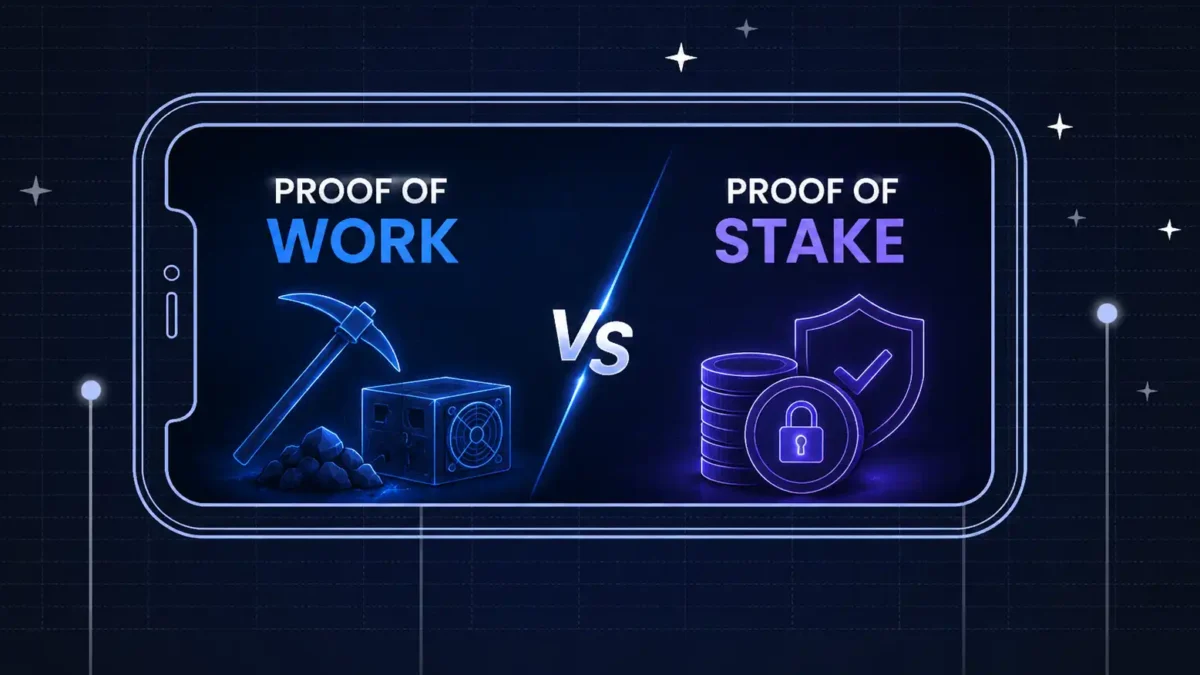


Blockchain was born from the desire to create a secure, transparent ecosystem where transactions could occur without Central oversight. To achieve this, developers devised consensus mechanisms—protocols that validate transactions and preserve the integrity of decentralized systems.
Two such mechanisms, proof of work and proof of Stake, have redefined how networks operate. Ethereum’s shift from Proof-of-Work (PoW) to Proof-of-Stake (PoS) has reignited discussions about which model is better suited for rapidly expanding the world of Web3. To fully understand how each mechanism works and its implications for the future of Blockchain, continue reading this detailed blog.
5 Types of Consensus Mechanisms in Blockchain
In blockchain, a consensus mechanism is used to validate transactions and ensure that all nodes in the network agree on the ledger’s state. There are several types of consensus mechanisms in blockchain, including:
- Proof of Work (PoW): This is the original consensus mechanism used in Bitcoin. PoW requires nodes in the network to solve complex mathematical problems to validate transactions and add blocks to the blockchain. It is considered very secure but requires a significant amount of computational power, making it energy-intensive.
- Proof of Stake (PoS): This consensus mechanism is utilized in several newer blockchain networks, including Ethereum 2.0. In Proof-of-Stake (PoS), nodes validate transactions and add blocks to the blockchain based on the amount of crypto they hold and “stake” in the network. This reduces the computational power required and makes it less energy-intensive than PoW.
- Delegated Proof of Stake (DPoS): This consensus mechanism is similar to Proof of Stake (PoS), but instead of every node having a stake in the network, only a select group of nodes (known as “delegates” or “witnesses”) is responsible for validating transactions and adding blocks to the blockchain. This makes DPoS faster and more efficient than PoW and PoS, but also more centralized.
- Proof of Authority (PoA): This consensus mechanism is utilized in private or consortium blockchains, where a group of authorized nodes validates transactions and adds blocks to the blockchain. Proof of Authority (PoA) is considered fast and efficient, but less secure than other consensus mechanisms.
- Byzantine Fault Tolerance (BFT): This consensus mechanism is used in permissioned blockchain networks, where a select group of nodes (known as “validators”) is responsible for validating transactions and adding blocks to the blockchain. BFT ensures that the network can reach consensus even if some of the nodes are malicious or fail.
These are some of the most common consensus mechanisms used in blockchain networks, each with its strengths and weaknesses, depending on the specific use case.
What is Proof-of-Work?
Proof-of-work was the most important consensus mechanism, which was first proposed in 1993 to combat spam and other service abuses. It received its official name, Proof-of-Work, in 1997. It was heavily unused till Satoshi Nakamoto used it in the development of Bitcoin. Bitcoin utilized this consensus mechanism to establish a peer-to-peer network, which was subsequently employed to secure the Bitcoin blockchain. In this mechanism, the probability of receiving the reward is determined by measuring the work generated. The larger the output of the work, the greater the chances of obtaining the reward.
Crypto miners are required to solve complex cryptographic puzzles. However, this puzzle is challenging to solve, but it is easy to verify. Once the solution is found, it is broadcast onto the network, and the other nodes verify it; after which, the miner receives the reward. For the block to be valid, the output is expected to start with a certain number of zeroes at the beginning of the hash value, known as “The Difficulty”. The output gets changed by the computing power of the network. The adjusted difficulty of the Bitcoin network slows down the creation of new blocks.
Advantages and Disadvantages of Proof-of-Work
Advantages
- Higher security level
- Let the miners earn crypto rewards
- Provides a decentralized method for verifying transactions
Disadvantages
- High consumption of energy.
- Expensive fees with low transaction speed.
- Expensive equipment is required for mining
Top 5 PoW tokens by Market Cap
| Name | Price (USD) | Market Cap (USD) | Circulating Supply |
| Bitcoin (BTC) | $108,051.00 | $2.046 trillion | 18.93 million BTC |
| Dogecoin (DOGE) | $0.2214 | $31.1 billion | 140.5 billion DOGE |
| Ethereum Classic (ETC) | $18.57 | $4.06 billion | 148.77 million ETC |
| Litecoin (LTC) | $95.86 | $7.23 billion | 75.4 million LTC |
| Monero (XMR) | $351.42 | $6.4 billion | 18.2 million XMR |
Latest Crypto News on Proof of Work Tokens
- The Bitcoin price, which had been performing slightly better than the Ethereum price in recent months, is now extending its bullish lead. Over the weekend, Bitcoin continued to push further upward, distancing itself from Ethereum’s relatively stagnant trend. Bitcoin is currently trading well above its long-term trend line support. The BTC price skyrocketed past its psychological resistance level of $100,000 and is now hovering around the $107,000 mark.
- DOGE has regained its position among the top 10 crypto assets by Market Cap. The token benefited from the DOT price decrease of more than 11% over the past week, which was an unusual drop even in the context of generally negative sentiment on the crypto market.
- The ETC Price has remained relatively stable, currently around the $18.50 mark. While there has been broader growth and DeFi TVL across the chains, there has been no significant spike in ETC-specific TVL post-merge, unlike during the earlier anticipation period.
What is Proof-of-Stake?
In the proof-of-stake system, validators, which are equivalent to miners in PoW, are chosen to identify a block based on the number of tokens they hold, rather than having a competition between miners to decide which block to add. This system replaces the work a miner does in PoW with the amount “staked” by the user. This staking structure secures the network because potential participants must purchase the crypto asset and hold it until they are chosen to form a block, earning rewards in the process.
Proof of Stake is similar to depositing money in a bank account, where interest is generated based on the duration and amount held. Cryptos utilize it by allocating tokens based on their Coin Age. Coin Age is the duration of time for which the tokens are held. For instance, if 100 tokens are held for 20 days, then their coinage is 2000. In the proof-of-stake mechanism, the size of the stake decides the chances for a validator to be chosen to forge the new block.
Advantages and Disadvantages of Proof-of-Stake
Advantages
- Does not require expensive equipment for participation.
- Fast and inexpensive transaction speed.
- Energy-efficient.
Disadvantages
- Lacks in terms of security when compared to proof-of-work.
- Validators with extensive holdings can influence the verification of transactions.
- Few of the PoS cryptos require locking up staked coins for a certain period of time.
Additional Read: Which is the best crypto to invest in?
Ethereum Merge: Why is Ethereum shifting to Proof of Stake?
This has been long-awaited by the Ethereum community due to various reasons, but it has taken quite some time for the engineers to implement the final PoS Ethereum Beacon Chain onto the mainnet. This process is referred to as the Ethereum Merge, where the PoS-enabled Beacon Chain has been merged into the mainnet.
The reasons why this shift is beneficial are:
- As the largest smart contract-capable blockchain network in the crypto space, this move will bring about a significant increase in transaction processing speed on the chain, making the Ethereum experience quicker and more efficient.
- One of the primary reasons is that, being the largest PoW-based smart contract blockchain, the Ethereum network consumes a tremendous amount of energy. Thus, a shift to Proof-of-Stake (PoS) would reduce the global energy consumption of the Ethereum network by 99.95% (according to Ethereum.org), which is a total of 0.2%, representing the largest decarbonization ever.
- Ethereum remains the largest, but numerous newer and more efficient blockchains are quickly catching up with it. Hence, this move would maintain Ethereum’s leadership in the space.
Know more about: Ethereum Shanghai Upgrade
Top 5 PoS tokens by Market Cap
| Name | Price (USD) | Market Cap (USD) | Circulating Supply |
| Ethereum (ETH) | $2,711.75 | $326.5 Billion | 120.3 Million ETH |
| BNB (BNB) | $684.47 | $96.5 Billion | 140.9 Million BNB |
| Cardano (ADA) | $0.7534 | $26.6 Billion | 35.3 Billion ADA |
| Polkadot (DOT) | $4.56 | $6.0 Billion | 1.3 Billion DOT |
| Avalanche (AVAX) | $23.33 | $9.9 Billion | 421.2 Million AVAX |
Latest Crypto News on Proof of Stake Tokens
- Ethereum is poised for significant growth with the Pectra upgrade, aiming to enhance speed and reduce costs. ETH is currently trading above $2700.
- BNB rallies past $680, backed by a strong Web3 development movement and continued support from significant tech partnerships, including Google Cloud.
- Cardano maintains steady traction post-upgrades with ADA trading around $0.75, as developers focus on scalability and innovative contract improvements.
Key Differences Between Proof of Work and Proof of Stake
The two most commonly used consensus mechanisms, Proof of Work (PoW) and Proof of Stake (PoS) are used by various crypto projects to validate their transactions and add new blocks to the blockchains.
Here are the key differences between PoW and PoS:
- Resource Utilization: In PoW, miners need to solve complex mathematical problems using computational resources to validate transactions and add blocks to the blockchain. This process requires a substantial amount of computational power, electricity, and specialized hardware, making it a resource-intensive operation. In contrast, PoS requires validators to hold a certain amount of crypto to validate transactions and create new blocks. This negates the need for enormous resources for mining.
- Security: Proof-of-work (PoW) is considered a more secure consensus mechanism due to its robust security against 51% attacks. In PoW, a miner must control 51% of the network’s computing power to launch a successful attack, which is a challenging and expensive endeavor. In Proof-of-Stake (PoS), the security of the network depends on the amount of crypto held by validators, which makes it more vulnerable to attacks if a large number of validators collude.
- Decentralization: Proof-of-Work (PoW) is often criticized for its centralization of mining power in the hands of a few large mining pools, which can lead to the centralization of the entire network. In Proof-of-Stake (PoS), the amount of crypto held by validators determines their voting power, which can also lead to centralization if a few large stakeholders control a significant portion of the crypto supply.
- Energy Efficiency: Proof-of-Work (PoW) is known for its energy-intensive nature, as miners must solve complex mathematical problems using substantial computational power. This has led to criticism of PoW for its environmental impact. PoS, on the other hand, requires less energy as it eliminates the need for resource-intensive mining.
Overall, PoW is more established and widely used, but PoS is gaining popularity due to its energy efficiency and lower resource requirements. However, both consensus mechanisms have their advantages and disadvantages, and the choice between them depends on the specific requirements of the blockchain project.
Proof of Stake vs Proof of Work – Which is Better?
In short, several fundamental differences distinguish Proof of Work from Proof of Stake. Below are some of those fundamentals:
- Proof-of-work (PoW) is the first generation of consensus mechanisms that emerged with the advent of Bitcoin, while Proof-of-Stake (PoS) is the next generation of consensus mechanisms. Some of the biggest networks employing this method include Cardano (ADA) and Algorand (ALGO). Even Ethereum, the largest smart contract blockchain, is slated to transition from Proof-of-Work (PoW) to Proof-of-Stake (PoS).
- Proof-of-Work (PoW) involves competing to solve a complex mathematical problem to obtain the chance to verify the block. At the same time, Proof-of-Stake (PoS) operates on the principle of staking.
- Due to the difference in principles, PoW requires significantly more energy to verify one block, while PoS can perform the same function at a tiny fraction of the energy used by PoW.
- Proof-of-work (PoW) is a much slower process due to its operational mechanism, whereas Proof-of-Stake (PoS) is faster than PoW in verifying transactions by an order of magnitude, which is also attributed to its consensus mechanism.
Examining the fundamental differences between the two major consensus algorithms does not negate their cons. Below are some of the Pros and Cons of the Proof of Work and Proof of Stake consensus models.
Pros
| Proof of Work | Proof of Stake |
| Enhanced security compared to Proof of Stake as miners use energy-intensive operations to add transactions to a block. | Highly energy efficient as compared to PoW |
| Offers better decentralization, as the authority to manage transactions is distributed among miners. | Dramatically faster in processing transactions |
| Less likely to get attacks as mining and verifying transactions on PoW requires expert computational knowledge. | Doesn’t require special equipment like ASIC chips required for mining in PoW |
Cons
| Proof of Work | Proof of Stake |
| Proof-of-work (PoW) is energy-intensive and generates a substantial carbon footprint. | Not as proven in terms of network security as PoW |
| Requires expensive equipment and resources to operate Proof-of-Work (PoW) operations. | Validators with a large number of coins staked can exert influence on verification |
| High network fees and slow processing time causes network congestion. | Coins in PoW need to be locked up in the smart contract and may have a lock-in time |
What Does This Mean for Crypto Investors?
This transition of the Ethereum network to the Proof of Stake consensus is primarily aimed at reducing energy consumption. With this transition, Ethereum has become an energy-efficient blockchain, which not only saves a significant amount of energy, approximately 0.2% of the global energy, but also facilitates faster block validations and a more secure network. The Ethereum Developers are already working towards the next step in this transition process, the Shanghai Update!
Additional Read: How will Ethereum Proof of Stake work?
Top FAQs on PoS & PoW
- Is Bitcoin proof of work or proof of stake?
The Bitcoin network employs a Proof of Work consensus mechanism. Proof of Stake is better than Proof of Work in the sense that it is much more energy-efficient, and validators do not require as intense a method to add a block to the network.
- Is proof of stake better than proof of work?
Proof of Stake is better than Proof of Work in the sense that it is much more energy-efficient, and validators do not require as intense a method to add a block to the network.
- Is Ethereum a PoS or PoW?
Ethereum is now a Proof-of-Stake (PoS) system following its transition via The Merge and the Shapella upgrade.
- Why is PoS faster than PoW?
PoS crypto assets work faster than PoW, as the processes set for block validation are faster and more advanced.