


SpaceX buys 800MHz spectrum for Starlink Mobile and AT&T, Verizon fall 6%. OpenAI revenue report drags Nvidia and chips. Asia mixed as Hang Seng Tech jumps 3%.
TLDR
- SpaceX agreed to buy a nationwide set of 800MHz low-band spectrum licenses from Grain Management, a step toward making Starlink Mobile a full US phone carrier. AT&T, Verizon and T-Mobile each fell more than 6% after hours, while SpaceX rose about 2.5% to 3%.
- A Financial Times report put OpenAI’s annualized revenue near $50 billion at the end of September, below the roughly $68 billion cited earlier. Chip stocks fell hard: Intel -5.3%, Micron -4.8%, Nvidia -2.9%.
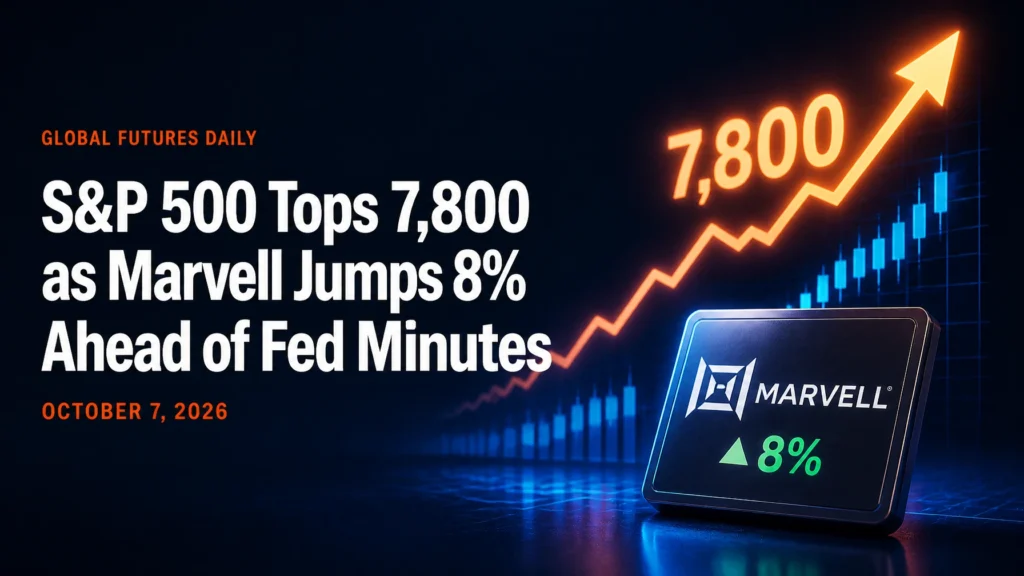
- The Nasdaq fell 1.25% to 27,193.34 and the S&P 500 fell 0.47% to 7,765.36. The Dow edged up 0.10% to 51,231.64.
- A later Bloomberg report said OpenAI could reach $70 billion or more by December, and US futures turned higher overnight.
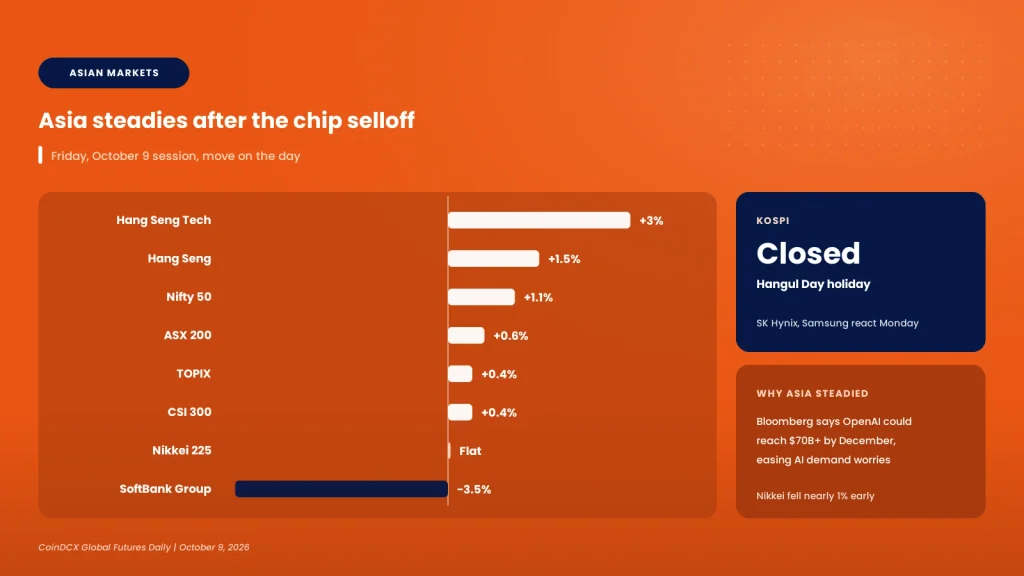
- Asia is mixed. The Hang Seng is up about 1.5% and Hang Seng Tech nearly 3%, while the Nikkei is flat. South Korea is closed for a holiday.
- Apple is reported to be planning a second launch around October 27 with M6 Macs, Tesla sold 95,366 China-made cars in September, and Meta banned ByteDance and TikTok ads.
Market Regime
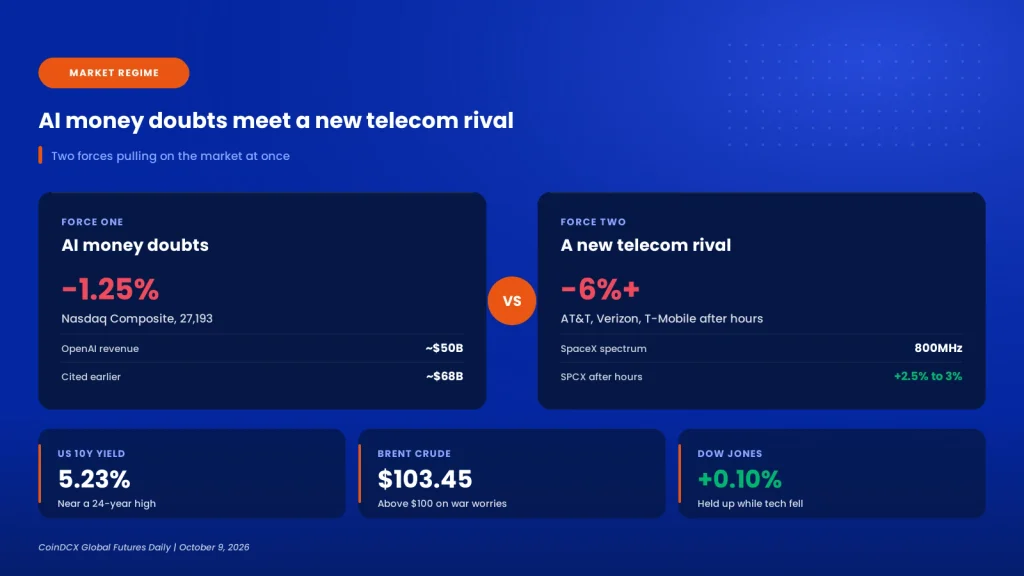
The market is caught between two forces. One is a fresh doubt about AI money: if OpenAI is bringing in less than people thought, the giant data centre spending that has lifted chip stocks all year looks harder to pay back. That doubt hit Nvidia, Micron, Intel and the AI cloud names on Thursday, and dragged the Nasdaq to its second straight loss.
The other force is a reminder that disruption is now coming from outside tech. SpaceX buying national phone spectrum puts a direct question mark on AT&T, Verizon and T-Mobile, three of the most stable names in the US market. Add Brent crude above $103 and the 10-year Treasury yield near 5.23% after a 24-year high earlier this week, and there is little room for error. What could change the mood: OpenAI’s higher year-end number holding up, or yields and oil easing together.
Bullish Factors
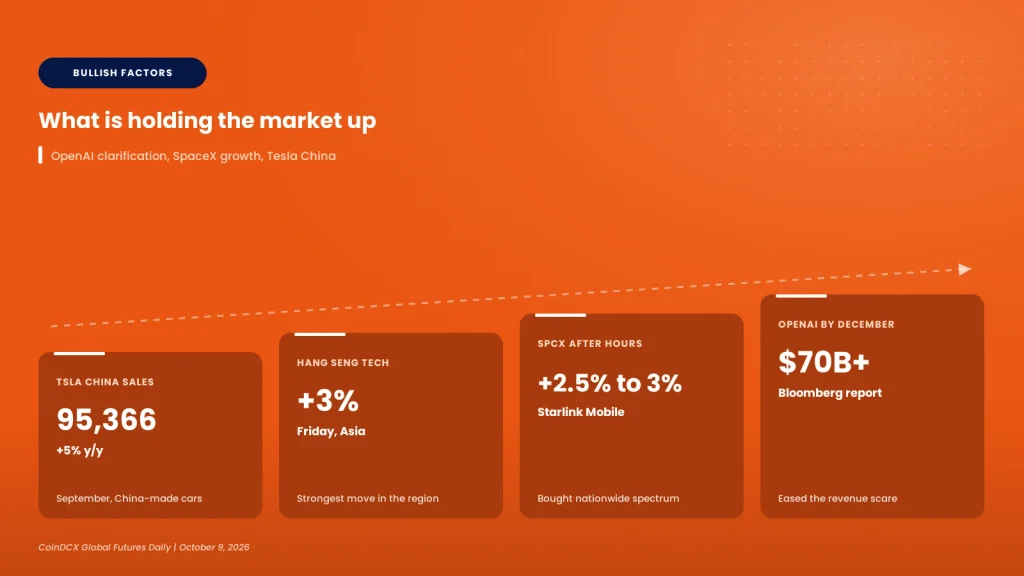
- OpenAI clarification. Bloomberg reported OpenAI could reach $70 billion or more in annualized revenue by December, which helped US futures and Asian tech recover.
- SpaceX gets a new business line. Low-band 800MHz spectrum travels far and goes through buildings, which is what Starlink Mobile needs to compete with ground networks.
- Hong Kong tech rebound. Hang Seng Tech is up nearly 3% on Friday, one of the strongest moves in the region.
- Tesla China sales grow. September China-made sales of 95,366 cars are up 5% from a year ago, per the China Passenger Car Association.
- Apple product run. A second launch around October 27 with M6 MacBook Pro and iMac models would give Apple two events in one month.
Bearish Factors
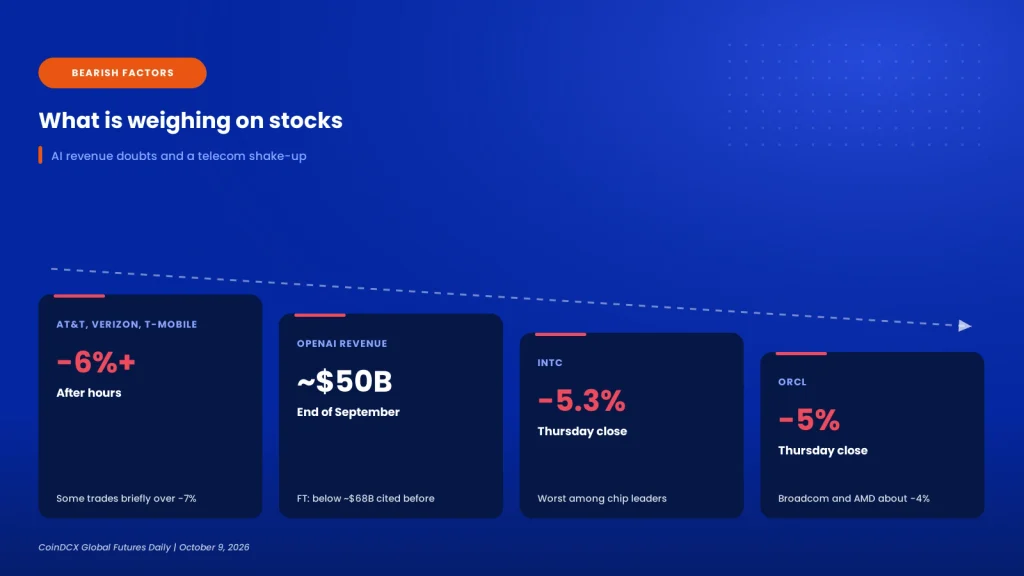
- AI revenue doubt. The FT’s $50 billion OpenAI figure raised questions about how fast AI spending pays off. Oracle fell about 5%, Broadcom and AMD about 4%.
- Telecom selloff. AT&T, Verizon and T-Mobile each fell more than 6% after hours, with some trades briefly down over 7%.
- Oil above $100. Brent crude topped $103 on Thursday on Middle East war concerns before easing slightly Friday.
- Bond yields near multi-decade highs. The 10-year Treasury yield is near 5.23% and the 30-year near 5.61%.
- Nasdaq losing streak. Two straight down days for the Nasdaq after a run of records earlier this week.
Asian Markets This Morning
- Japan: the Nikkei 225 is flat after falling nearly 1% early, while the broader TOPIX is up about 0.4%. SoftBank Group, a major OpenAI backer, is down about 3.5%.
- Hong Kong: the Hang Seng is up about 1.5% and the Hang Seng Tech index nearly 3%, as the higher OpenAI forecast eased worries about AI demand.
- China: the Shanghai Composite and CSI 300 are up 0.3% to 0.4% after dropping more than 1% early in the session.
- Australia: the ASX 200 closed up 0.6%.
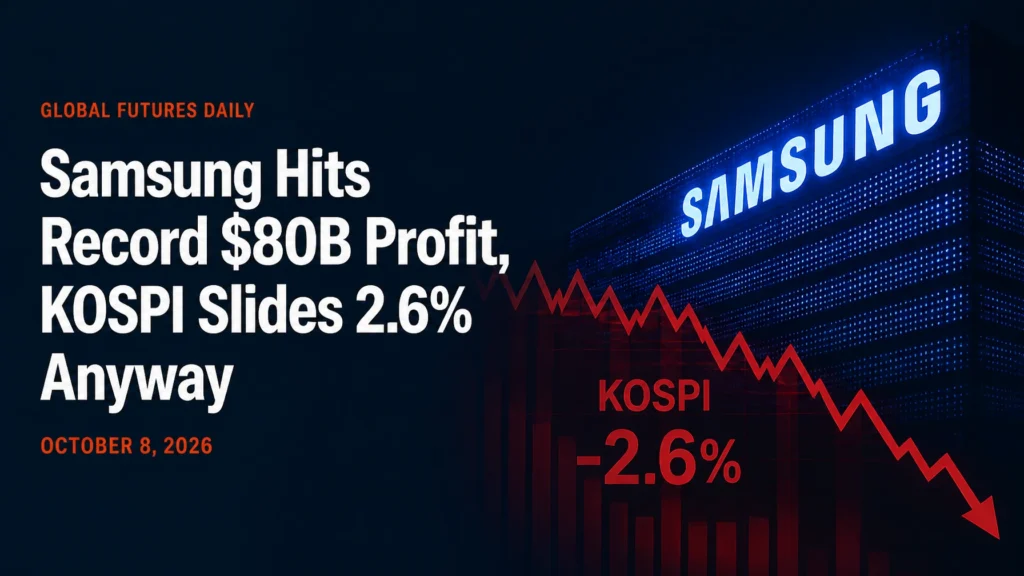
- South Korea: the Kospi is closed for Hangul Day, so SK Hynix and Samsung will react to the chip selloff on Monday.
- India: the Nifty 50 is up about 1.1%, with TCS higher on faster AI revenue growth.
What Moved Wall Street Today
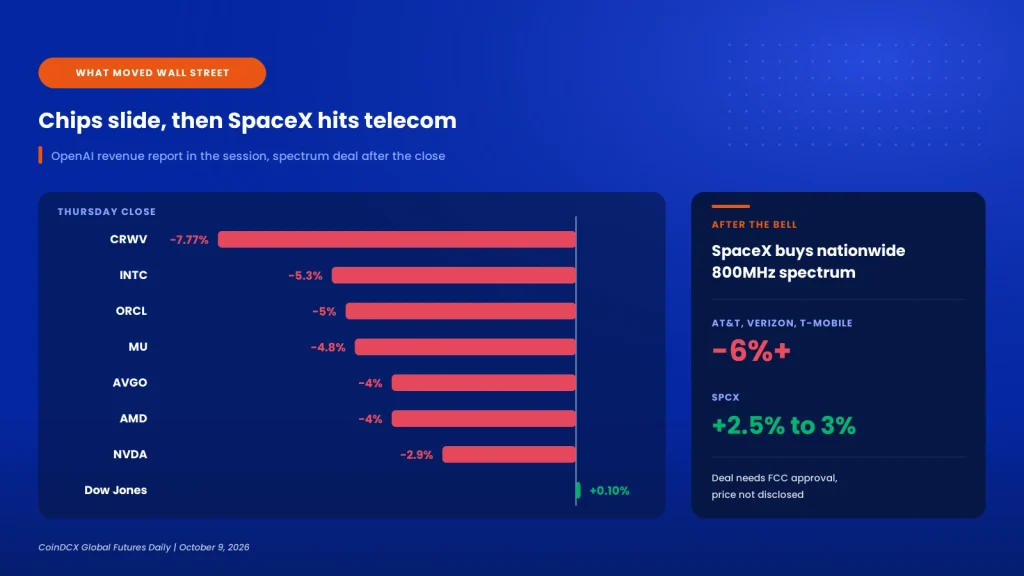
Chips led the losses on Thursday after the FT report on OpenAI revenue. Intel fell 5.3%, Micron 4.8% and Nvidia close to 3%. Oracle lost about 5%, while Broadcom and AMD each dropped about 4%.
CoreWeave fell 7.77% to $81.58 even as ZDNet reported it is discussing data centre partnerships in South Korea. The AI cloud names took the brunt of the revenue worry.
After the bell, SpaceX said it will buy nationwide 800MHz spectrum from Grain Management, pending FCC approval. AT&T, Verizon and T-Mobile all fell more than 6%, and Comcast also dropped. SpaceX rose about 2.5% to 3%.
The Dow held up better than the other two indexes, finishing 0.10% higher at 51,231.64. All three are still on track for a weekly gain.
Assets in Focus
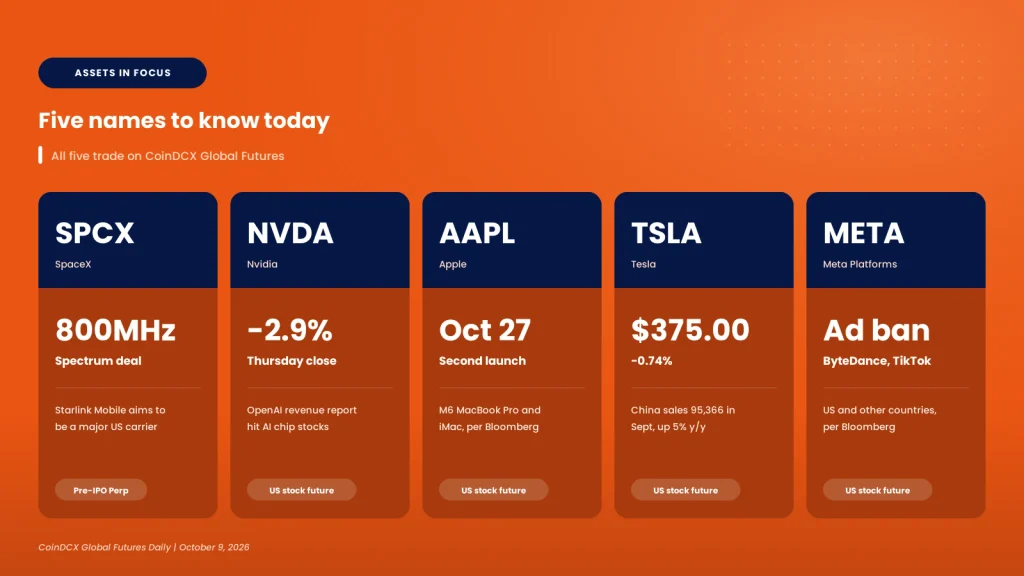
SPCX (SpaceX)
SpaceX agreed to buy up to 14MHz of paired 800MHz spectrum covering the whole US from Grain Management. Grain got these licenses from T-Mobile in a swap in August. The price was not disclosed and the deal needs FCC approval.
The goal is to turn Starlink Mobile into a major US phone carrier. SpaceX rose about 2.5% to 3% after hours while AT&T, Verizon and T-Mobile fell more than 6%. SPCX trades on CoinDCX Global Futures as a pre-IPO Perp.
NVDA (Nvidia)
Nvidia fell close to 3% on Thursday as the OpenAI revenue report raised doubts about how long AI chip demand can keep growing at this pace.
The later Bloomberg report of $70 billion or more by December helped futures recover overnight. Whether Nvidia bounces will show how much of Thursday was a real change in view and how much was a headline reaction.
AAPL (Apple)
Bloomberg reports Apple is planning a second product launch on or around October 27, including 14-inch MacBook Pro and iMac models with M6 chips.
Two launches in one month keeps Apple in the headlines into its holiday quarter, while most of tech is dealing with AI spending questions.
TSLA (Tesla)
Tesla sold 95,366 China-made vehicles in September, up 5% from a year ago, according to the China Passenger Car Association.
The stock was near $375.00, down 0.74%. Tesla reports third-quarter results later this month, and China demand will be one of the first questions.
META (Meta Platforms)
Meta has banned ads from ByteDance and TikTok on its platform in the US and other countries, Bloomberg reports.
TikTok has been a large advertiser on Meta while also being its main rival for younger users. Meta gives up that ad money but makes it harder for TikTok to win users on Facebook and Instagram.
Index Levels to Watch
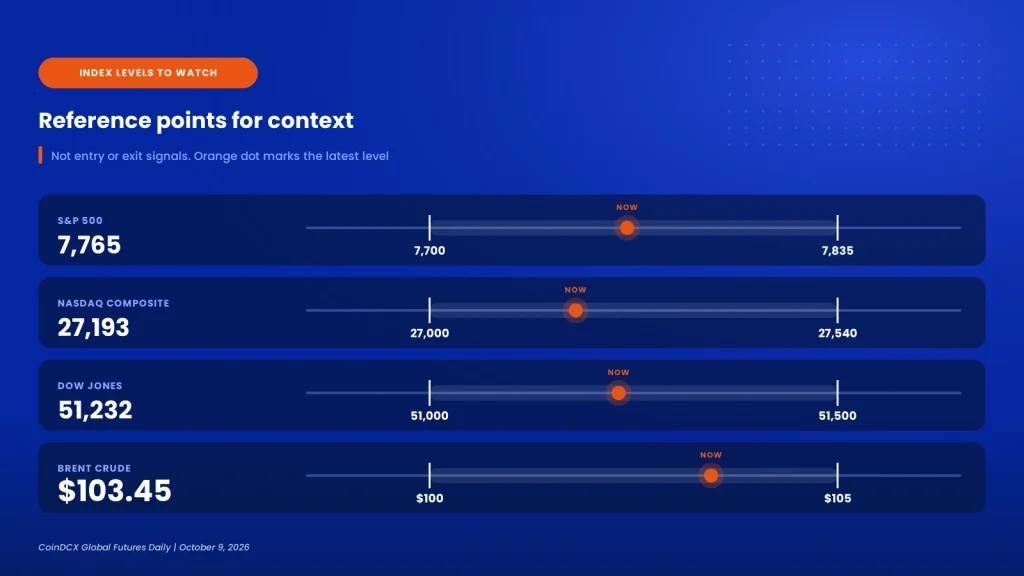
- S&P 500: Closed at 7,765.36. 7,700 is the nearby round number below, and 7,835 is the record intraday high set earlier this week.
- Nasdaq Composite: Closed at 27,193.34 after a 345-point drop. 27,000 sits below, and the prior close near 27,540 sits above.
- Dow Jones: Closed at 51,231.64. 51,000 below and 51,500 above.
- Brent crude: Near $103.45. $100 is the round number below, $105 above.
- US 10-year yield: Near 5.23%, just under this week’s 24-year high. A move back above it would add pressure on stocks.
Disclaimer
Cryptocurrencies and futures are unregulated virtual assets, not legal tender, and subject to market risk. The information above is for education and general awareness only. It is not investment advice or a recommendation to buy, sell, or hold any asset. Levels and estimates are reference points for context, not entry or exit signals. Please do your own research and consult a registered advisor before making investment decisions.
Frequently Asked Questions
Q1. What spectrum did SpaceX buy on October 8, 2026?
SpaceX agreed to buy a nationwide portfolio of up to 14MHz of paired 800MHz low-band spectrum from Grain Management. The price was not disclosed and the deal needs FCC approval.
Q2. Why did AT&T and Verizon stocks fall after hours?
Investors see Starlink Mobile becoming a direct competitor for US phone customers. AT&T, Verizon and T-Mobile each fell more than 6% after hours on October 8.
Q3. Why did chip stocks fall on Thursday, October 8?
The Financial Times reported OpenAI's annualized revenue was about $50 billion at the end of September, below the roughly $68 billion cited earlier. Intel fell 5.3%, Micron 4.8% and Nvidia close to 3%.
Q4. How did the Nasdaq and S&P 500 close on October 8, 2026?
The Nasdaq fell 1.25% to 27,193.34 and the S&P 500 fell 0.47% to 7,765.36. The Dow rose 0.10% to 51,231.64.
Q5. Is the Korean stock market open on October 9, 2026?
No. The Kospi is closed for Hangul Day, so Korean chip stocks will react to Thursday's selloff when trading resumes.