UNI trades at $8.475, up 38.39% on the week and above the 200-week exponential moving average at $7.815 for the first time in two years. Protocol fees now burn UNI at an annualised rate above $250 million. The weekly candle has not closed yet, which is what the breakout still needs.
UNI Crypto Price Today
The Uniswap price reached $8.475, up 38.39% across a weekly candle that has run from $6.000 to $8.869. UNI traded at $6.26 as recently as 16 September, and the Uniswap market cap now stands near $5.3 billion at 18th by market value.
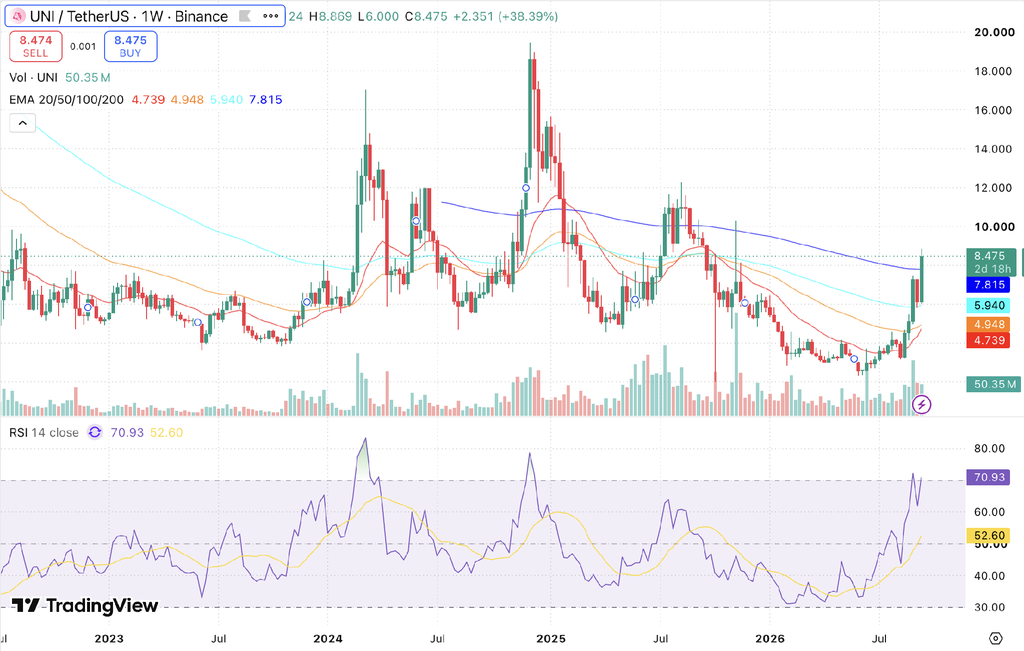
UNI token price, weekly with EMA 20/50/100/200 and RSI 14. Source: TradingView, Binance.
Futures volume rose 82.67% to $1.40 billion and open interest gained 20.81% to $601.45 million, while $2.95 million of the $3.71 million in liquidations came from short positions, so the derivatives market confirmed the move.
The Level That Confirms the Breakout
The 200-week exponential moving average sits at $7.815, and UNI is currently 8.4% above it. A weekly close above that line confirms the two-year falling wedge has resolved instead of producing a false break, and the candle still has more than two days to run.
The weekly moving averages remain in downtrend order beneath it, with the 200-week above the 100-week at $5.940, the 50-week at $4.948 and the 20-week at $4.739. Analysts tracking the structure put the next objective near $12.70, about 80% higher. The weekly RSI reads 70.93 against a signal line of 52.60, more than 18 points apart.
How the UNI Burn Works
Uniswap governance passed the UNIfication proposal in December 2025, activating a long-debated fee switch. Protocol fees now accumulate in a contract called TokenJar, and anyone can burn 4,000 UNI through a mechanism named FirePit to claim what has gathered there. A one-time retroactive burn of 100 million UNI from the treasury accompanied the change.
Uniswap v2 and v3 began routing fees on Ethereum in December 2025 and added further chains through March and June, while v4 switched on in July 2026. In September, roughly 184,000 UNI worth about $1.15 million was burned in a single day.
Uniswap’s 30-Day Volume Reached $71 Billion
Uniswap recorded $71.1 billion in 30-day DEX volume on DeFiLlama, more than its next three competitors combined, with v4 contributing around $38 billion and v3 about $32 billion. Protocol revenue from January through July reached $28.2 million.
Founder Hayden Adams noted the annualised burn rate moving from near $200 million to above $250 million within days. Against roughly 623 million circulating UNI, a $250 million annual burn at current prices removes around 5% of supply a year, provided volume holds.
Uniswap on Robinhood Chain
Uniswap enabled fee collection on Robinhood Chain in July, and v3 and v4 together have since accounted for more than $1.17 billion in trading activity there. That places UNI on the same network driving the memecoin activity that has dominated Robinhood Chain coverage.
Uniswap Labs also released the StablePair Hook on 10 September for pairs such as USDC/USDT and USDC/USDG, replacing static fees with dynamic pricing on stablecoin routes.
What UNI Traders Should Watch
A weekly close above $7.815 is the confirmation the breakout needs, and anything less leaves the two-year wedge unresolved. Below that, the weekly low of $6.000 is the reference point.
The burn rate is the fundamental number to track, because it moves with volume, not sentiment. A fall in DEX volume cuts the burn directly, which removes the mechanism the current valuation argument rests on.
Disclaimer: This article is for informational purposes only and does not constitute investment advice. Crypto assets are unregulated and highly volatile. Readers should conduct their own research before making any trading decisions.
FAQs
1. Why is the Uniswap price rising?
The UNI crypto price is rising because it has cleared a two-year falling wedge on record DEX volume, reaching $8.475 and up 38.39% on the week. Short liquidations accounted for $2.95 million of $3.71 million in total, and accelerating token burns funded by protocol fees are adding a fundamental argument to the technical move.
2. How does the UNI burn mechanism work?
The UNI burn works by trading tokens for fees: anyone can burn 4,000 UNI through a contract called FirePit and claim the protocol fees pooled in a second contract, TokenJar. Every claim permanently removes those 4,000 UNI from supply. The system started with the UNIfication proposal in December 2025 and now covers Uniswap v2, v3 and v4 across multiple chains.
3. How much UNI is being burned?
UNI is burning at an annualised rate above $250 million, which founder Hayden Adams noted had risen from near $200 million days earlier. The heaviest single day in September removed roughly 184,000 UNI worth about $1.15 million. Circulating supply stands at about 623 million UNI.
4. What UNI price level matters now?
$7.815 is the level to watch, the 200-week exponential moving average, and UNI sits 8.4% above it at $8.475. Confirming the wedge breakout needs a weekly close above that line, and the current candle has more than two days to run. Analysts point to $12.70 as the next objective, while a failure to hold would return the uni token price to its previous range.