

Introduction
The inverted cup and handle is one of many chart patterns crypto traders discuss, usually in the hope of working out where a price is heading. This guide explains what it is, how people identify it, and how unreliable it actually is.
You will learn what the inverted cup and handle is, how it differs from the regular cup and handle, what traders watch for, and why risk management matters far more than any pattern.
What Is the Inverted Cup and Handle Pattern?
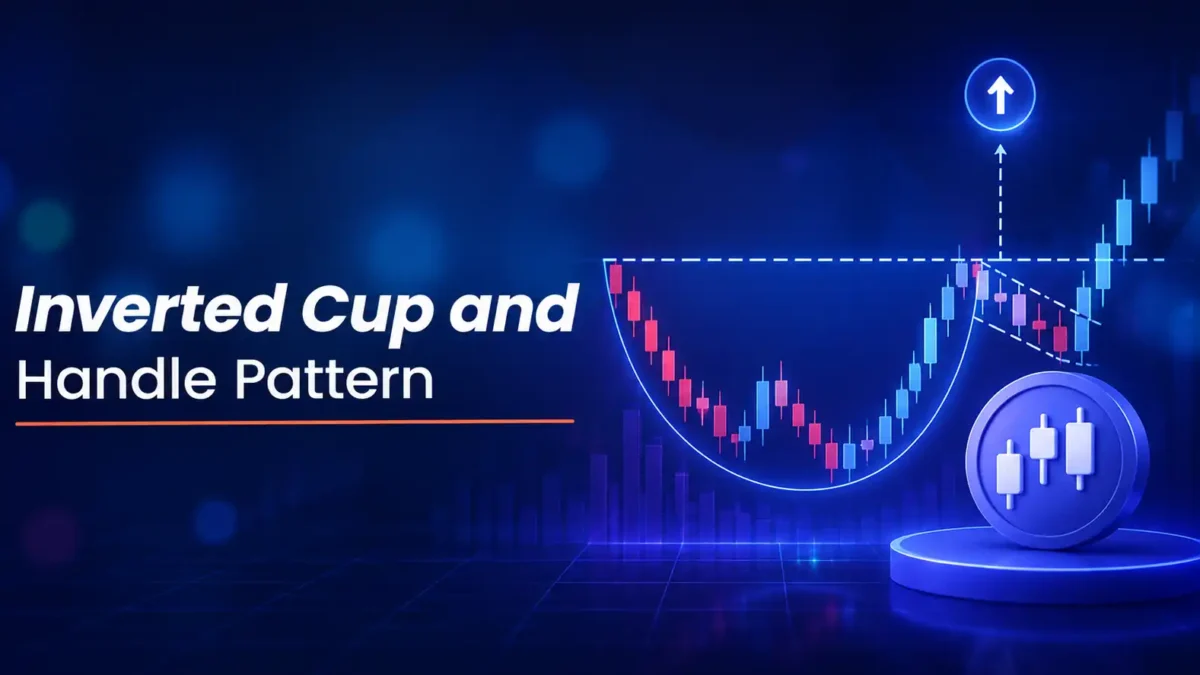
The inverted cup and handle, also called the inverse cup and handle, is a shape that sometimes appears on a price chart. As the name suggests, it looks like an upside-down cup followed by a small upward drift that forms a handle. The cup is a rounded dome rather than the U-shape of a normal cup, and the handle is a short, slight bounce upward before the pattern is said to complete.
Some traders read this shape as a bearish pattern, meaning they treat it as a possible hint that the price could keep falling after the handle. The word possible is carrying the weight in that sentence. Like every chart pattern, it is a shape some people notice. It is not a rule, a signal, or a promise about what the price will do next.
Inverted vs Regular Cup and Handle
The inverted version makes more sense once you know the original. The regular cup and handle is one of the best-known chart patterns, popularised by the investor William O’Neil, and the inverted version is an informal mirror of it with far less documentation behind it.
Regular Cup and Handle
This looks like a normal cup, a rounded ‘U’ shape, followed by a small dip that forms the handle. Some traders read it as a possible bullish sign, meaning they think the price might rise, so the pattern is described as pointing upward. It is the better-documented of the two shapes.
Inverted Cup and Handle
This is the mirror image, a rounded dome followed by a slight upward drift. Some traders read it as a possible bearish sign, meaning they think the price might fall further, so the pattern is described as pointing downward. It has a much thinner track record than the version it is derived from.
In both cases the important phrase is ‘some traders read it as’. Neither pattern causes anything to happen. They are interpretations rather than facts, and both are frequently wrong, especially in fast-moving crypto markets.
How to Identify an Inverted Cup and Handle
Traders who use this pattern look for three features: a rounded, dome-like top forming the inverted cup, a short upward drift forming the handle, and then a ‘breakdown’, where the price falls out of the pattern. Volume is usually expected to fade as the dome forms and then pick up sharply on the breakdown, which is treated as confirmation. Some also project the depth of the dome downward from the breakdown point as a rough target.
The part the hype skips is that spotting this pattern is highly subjective, and clean textbook shapes rarely appear in real, messy crypto charts. Two people can look at the same chart and disagree about whether the pattern is there at all. A shape that looks perfect can fail immediately.
The Inverted Cup and Handle Is Not a Profit Formula
The inverted cup and handle, like every chart pattern, is not a crystal ball and not a way to trade profitably with any certainty. Patterns fail constantly. Part of the reason they sometimes appear to work is that many traders watch the same shapes and act on them together, which can briefly become self-fulfilling. That effect is weak and is easily overwhelmed by real events.
Anyone who promises that this pattern lets you trade profitably, or that a bearish shape ‘means’ the price will drop by a set amount, is overstating what technical analysis can do. Serious traders treat patterns as one small, uncertain clue among many, never as an instruction to buy or sell. Believing patterns are certainties is one of the most common ways beginners lose money.
Trade Crypto in INR on 
Deposit and withdraw in INR (₹).
No Conversion to Crypto Required.

Risk Management Matters More Than the Pattern
Since chart patterns are unreliable, what actually protects a trader is risk management. These principles apply whether or not you ever use the inverted cup and handle.
Never Rely on One Pattern
A pattern is a weak clue at best, so look for other evidence before acting on it. Assume in advance that a meaningful share of your reads will be wrong. Any approach that only holds up when the pattern behaves as expected is not an approach at all.
Always Use a Stop-Loss
Fix the exit price before you enter, so a losing trade closes itself instead of waiting on your judgement. The hardest moment to think clearly is while a position is moving against you, which is precisely when the stop-loss does its work. Place it when you open the trade.
Keep Positions Small
Commit only a small fraction of your capital to any one trade, so that being wrong costs you very little. Staying in the game matters more than winning on any single position. Smaller positions also make it easier to honour your own stop-loss.
Be Extremely Careful With Leverage
Patterns like this one are often traded with leverage, which multiplies losses and can trigger liquidation quickly. Borrowed exposure converts a misread chart into a large, sometimes total, loss. The higher the leverage, the smaller the move needed to close you out.
Never Trade Money You Cannot Afford to Lose
Keep rent, savings, borrowed money, and emergency funds out of it entirely. Work on the assumption that any single trade can go to zero, because it can. Money borrowed to trade is the worst case, since the debt outlives the position.
FAQs
Q1. What is the inverted cup and handle pattern?
The inverted cup and handle, also called the inverse cup and handle, is a chart shape that looks like an upside-down cup followed by a small upward drift called the 'handle'. Some traders read it as a bearish pattern, a possible hint that the price could keep falling. It is only a shape some traders notice, not a rule or a prediction.
Q2. What is the difference between the cup and handle and the inverted cup and handle?
They are mirror images. The regular cup and handle looks like a rounded 'U'-shaped cup with a small dip for the handle, and is read as a possible bullish sign. The inverted version is that shape flipped over: a rounded dome with a slight upward drift, read as a possible bearish sign. The regular pattern is the better documented of the two.
Q3. Is the inverted cup and handle a bearish pattern?
It is generally described as bearish, meaning some traders interpret it as a possible sign a price may continue falling after the handle forms. 'Bearish' describes how some traders read the shape, not a certainty. Chart patterns fail often and are easily overwhelmed by news and volatility.
Q4. How do traders identify an inverted cup and handle?
Traders look for a rounded, dome-like top, a short upward drift forming the handle, and then a 'breakdown' where the price falls out of the pattern, with volume fading through the dome and rising on the breakdown. Identifying it is highly subjective, and clean textbook shapes rarely appear in real crypto charts.
Q5. Can I trade the inverted cup and handle profitably?
No one can promise that. Chart patterns like this are unreliable, fail frequently, and guarantee nothing, so there is no 'profitable strategy' built on them that works with any certainty. They are most often used in short-term and leveraged trading, where most retail traders lose money.
Q6. Should beginners trade based on chart patterns like this?
This guide does not recommend trading based on chart patterns, and they are not a shortcut for beginners. Patterns like the inverted cup and handle are unreliable and subjective, and using them in leveraged trading is very high-risk. Beginners are better served by understanding crypto and risk properly first.
The inverted cup and handle is an interesting shape to understand, but it is not a prediction and not a route to guaranteed profit, and risk management matters far more than any chart pattern. Learn how crypto and charts work with CoinDCX's education guides, use only FIU-IND registered platforms, never trade money you cannot afford to lose, and never share your seed phrase with anyone.