
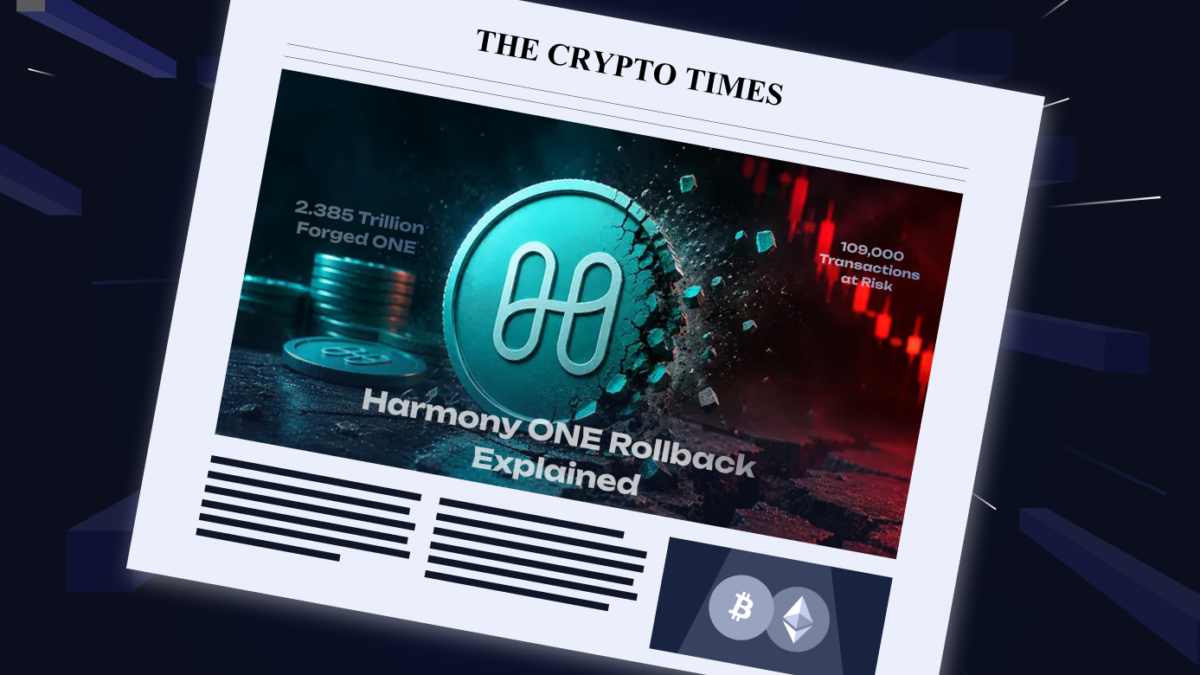


Harmony will rewind its blockchain to a checkpoint from 11 August to erase the effects of an exploit that forged trillions of ONE tokens. The reset removes the counterfeit supply, but it also deletes 109,126 regular transactions and 315 staking transactions that ordinary users made after that point. Harmony says restoring those selectively is not possible without breaking the rebuilt chain.
What Harmony Is Rolling Back and When
Validators will revert to shard 0 block 92,730,034 and shard 1 block 94,978,278, both recorded at 23:25:37 UTC on 11 August, then restart block production from the next heights using replacement databases. Everything confirmed after those blocks disappears from the chain’s history.
The checkpoint was chosen with a deliberate margin. The first confirmed forged mint landed on shard 0 at block 92,730,036, so Harmony rewound one block further back as a safety buffer, choosing a block that contained no transactions, no incoming receipts and no gas use.
How 2.385 Trillion Forged ONE Moved in 106 Seconds
The scale explains why a targeted cleanup was never realistic. One wallet tied to the forged mint attempted 534 transfers of five billion ONE each within 106 seconds, and 477 succeeded, moving 2.385 trillion tokens in under two minutes.
That figure dwarfs the roughly four billion ONE reported when the incident first surfaced, as set out in our earlier report on the Harmony exploit. Inside that same window the tokens reached standalone wallets, exchange accounts, decentralised exchange routers and pools, liquidity provider positions, bridge contracts, wrapped ONE and staking wallets.
Why 109,126 Legitimate Transactions Cannot Be Saved
Harmony examined whether it could restore genuine activity while discarding the fraudulent state, and concluded the approach was unsafe. Account balances, smart contract states, nonces and other conditions would no longer match on the rebuilt chain, so replaying a transaction could produce a different result from the one the user originally got.
The composition of those transactions softens the impact. Of the 109,126 regular transactions, 104,545 or 95.8% were automated, with decentralised exchange bots accounting for 99,863 of them. That leaves roughly 4,500 transactions likely made by people rather than machines, plus 315 staking transactions.
What the Rollback Means for Holders and Exchanges
Anyone who traded, transferred or staked ONE after 23:25 UTC on 11 August should assume that activity no longer exists once the reset completes. Balances return to what they were at the checkpoint, which means a profitable trade made in the window is undone alongside a losing one.
Exchanges and bridges face the harder problem, since deposits credited during the window may correspond to transactions that no longer exist on the restarted chain. Harmony says it is working with exchanges, bridges, law enforcement and an independent security firm, and has suspended bridge services.
Don’t miss the market moves. Download the CoinDCX app now to trade ONE tokens instantly while on-chain activities settle.
Trade ONE in INR on 
Deposit and withdraw in INR (₹).
No Conversion to Crypto Required.

What a Rollback Costs a Blockchain
Finality is the property a blockchain is meant to guarantee: once a transaction is confirmed, it stays confirmed. A rollback proves that guarantee can be withdrawn when enough validators agree, which is why networks treat it as a last resort rather than a repair tool.
Harmony has also been careful about what tracing does and does not achieve. The team notes that following tokens to a wallet, pool or exchange does not identify who controlled them, and does not make those balances safe to destroy, because shared pools hold assets belonging to unrelated users.
What Harmony Users Should Watch Next
Whether validators actually adopt the plan is the first question, since a rollback needs enough of them to run the replacement databases for the new chain to become the accepted one. Client version v2026.1.2 has been configured to reject the block hashes linked to the incident.
After that, watch whether exchanges reopen deposits and withdrawals, and whether Harmony publishes a full account of the flaw in cross-shard receipt validation that allowed the mint. Harmony is the second network this year to attempt reversing confirmed activity after an exploit, following Ravencoin.
FAQs
1. What is the Harmony ONE rollback?
The Harmony rollback reverts the blockchain to checkpoints recorded at 23:25:37 UTC on 11 August, erasing the forged ONE tokens created in the exploit. Validators restart block production from the next heights using replacement databases.
2. What happens to transactions on harmony one made after 11 August?
Transactions confirmed after the checkpoint are discarded, covering 109,126 regular transactions and 315 staking transactions. Balances revert to their state at the checkpoint, so trades and transfers made in that window are undone.
3. Why can Harmony not restore only the legitimate transactions?
Harmony determined that selective restoration is unsafe because balances, contract states and nonces would differ on the rebuilt chain. Replaying a transaction into that different state could produce a different outcome from the original.
4. How many ONE tokens were forged in the exploit?
Investigators traced 2.385 trillion forged ONE moved through 477 successful transfers in 106 seconds, far above the roughly four billion estimated when the incident first emerged.
Disclaimer: Crypto products and NFTs are unregulated and can be highly risky. There may be no regulatory recourse for any loss from such transactions. This article is for informational purposes only and does not constitute financial, investment or trading advice. Conduct your own research before making any investment decision.


