

SanDisk closed up 13.67% after CFO guided NAND market to $500B by 2027. S&P 500 broke 7,800 for the first time, Nikkei topped 69,000, Kospi tagged 7,000.
TLDR
SanDisk closed up 13.67% on Wednesday after CFO Luis Visoso told investors at the 2026 Investor Day that the NAND market will pass $300 billion in 2026 and $500 billion in 2027, with supply staying tight into 2028. The stock touched intraday +17%. Market cap reset to $227.7 billion.
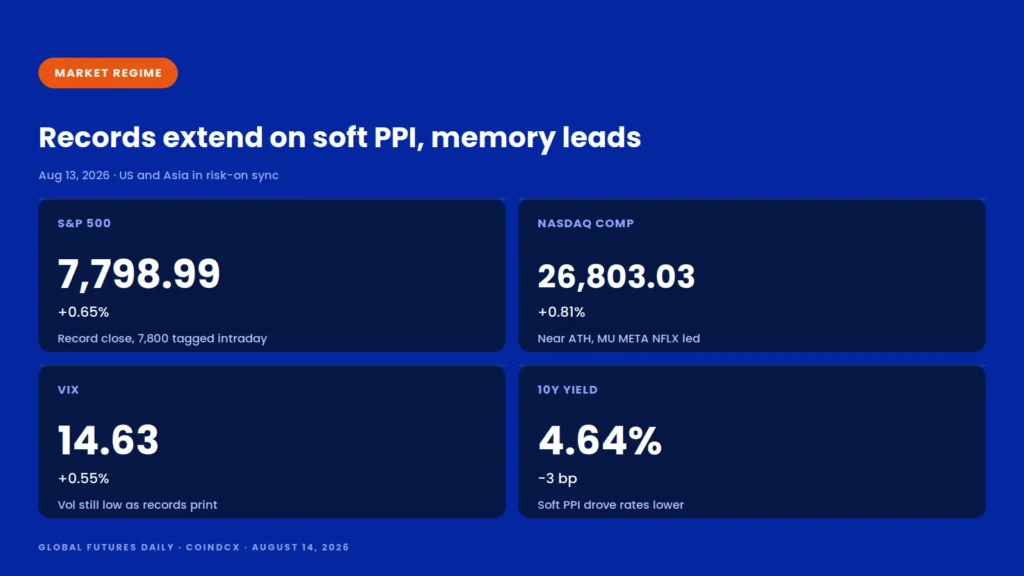
Wall Street set a fresh record. The S&P 500 broke 7,800 intraday for the first time ever, closing at 7,798.99, up 0.65%. Nasdaq gained 0.81% to 26,803.03. A flat July PPI print reinforced the cool CPI from Tuesday and pulled September rate-hike odds down toward 35% from around 50% a week ago.
Asia followed through hard. The Kospi briefly reclaimed 7,000 for the first time in 15 sessions before closing at 6,977.94, up 2.42%. The Nikkei crossed 69,000 for the first time in a month. TOPIX broke 4,200 for the first time ever. Advantest and Kioxia extended records. Elon Musk filed a Schedule 13G disclosing a 48.4% SpaceX stake, valued above $900 billion. SPCX fell 3.33% to $141.29 on the disclosure. Applied Materials beat and guided Q4 at $10.25 billion revenue but slipped 3% after hours. CXMT held its perch as the most valuable China listed company at $524 billion.
Market Regime
The tape is now trading a single, coherent narrative. AI capex is going into memory and equipment. Supply is tight. Guidance from the buyers of those chips keeps being raised. Cool inflation lets the Fed hold, which pulls the tail risk of a fresh tightening cycle off the table. That combination is why the S&P 500 broke a level nobody was talking about at the start of the year, why Nikkei is chasing 70,000, and why the Kospi has ripped 25% off its July 30 low.
The break could come from a positioning air-pocket rather than a fundamental crack. Seven straight up days for TOPIX, five for the Kospi, three for the Nikkei, and profit-taking flagged into Japan’s Obon week. AMAT’s -3% after-hours reaction to a beat and a raise is a small warning shot. Any hint that demand visibility is priced in, or that BoJ moves in October, gets the mean-reversion trade going.
Bullish Factors
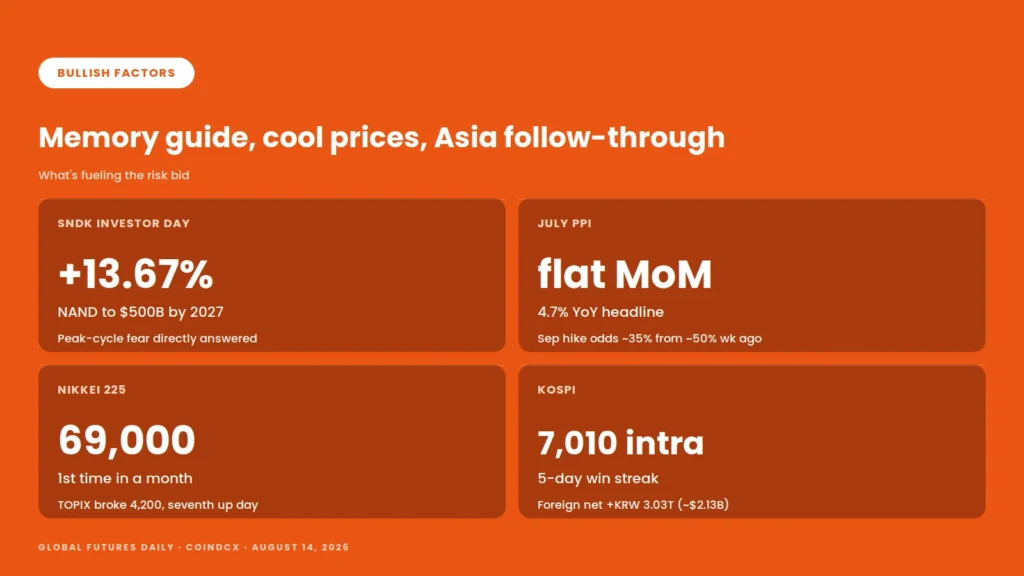
- SanDisk 2026 Investor Day: CFO Luis Visoso guides NAND market to $300B in 2026 and $500B in 2027, supply tight into 2028. Stock +13.67% to close near $1,527, intraday +17%.
- July PPI came in soft, headline flat month-over-month and 4.7% year-over-year, reinforcing the cool CPI from Tuesday. September hike odds dropped toward 35% from around 50% a week ago.
- S&P 500 broke 7,800 intraday for the first time ever, closing at a record 7,798.99. Morgan Stanley and Goldman Sachs both hold 8,000 year-end targets.
- Nikkei 225 reclaimed 69,000 Friday morning for the first time since July 13. TOPIX broke 4,200 for the first time ever, closing Thursday at 4,176.04, seventh straight up session.
- Kospi hit 7,010.86 intraday, first touch above 7,000 in 15 sessions. Closed 6,977.94, up 2.42%. Foreign investors net bought ₩3.03 trillion, or about $2.13 billion, capping a five-day rally.
- Advantest and Recruit hit all-time highs Thursday. Kioxia added roughly 7%. Ibiden gained nearly 10%. The AI supply chain trade broadened beyond a small handful of heavyweights.
- Applied Materials Q3 revenue $9.12B (beat $8.99B est), non-GAAP EPS $3.50 (beat $3.40 est). Q4 guide $10.25B, up 51% year-over-year at the midpoint. Full-year 2027 already flagged as another strong growth year.
- CoreWeave beat and raised on Tuesday continues to trade well, and Wednesday’s move validated AI infrastructure demand for the whole complex.
- Brent fell 2% to $87.07 as Iran-Oman Strait of Hormuz talks reduced the tail risk in crude.
Bearish Factors
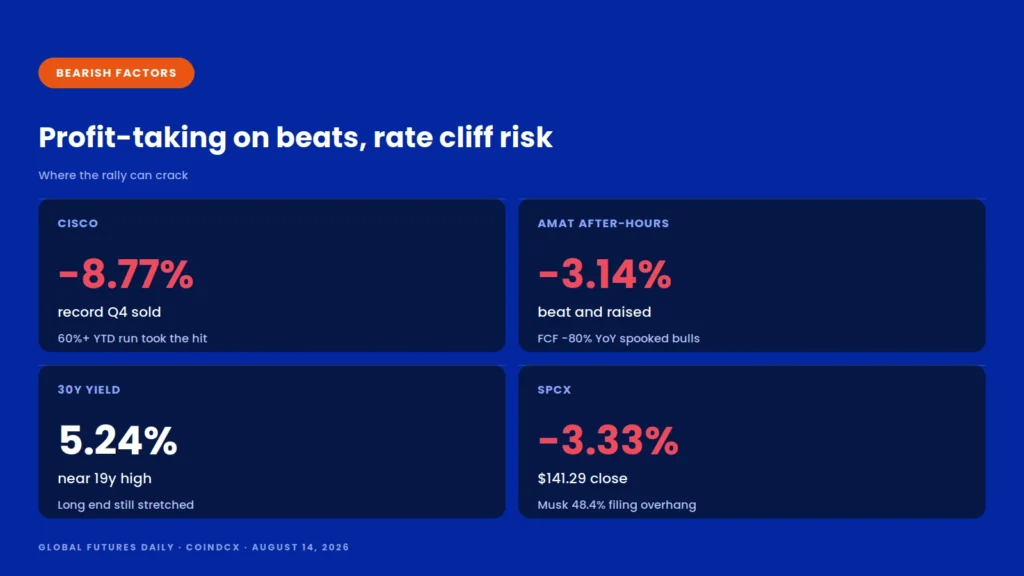
- Cisco fell 8.77% on Thursday after posting a record fiscal Q4. The move is profit-taking after a 60%-plus year-to-date run, but it shows how quick the market is to sell any hint of forward-guide caution.
- Cerebras (CBRS) tumbled after missing on Q2 revenue. AI hardware is not immune to the higher bar.
- Applied Materials slipped 3.14% in after-hours to $517.78 despite the beat and raise. Free cash flow contracted 80% year-over-year to $210 million on the record revenue print. Ramp costs and China exposure are the visible drags.
- SPCX fell 3.33% to $141.29 after Elon Musk’s Schedule 13G filing disclosed a 48.4% stake with more than 82% voting power. Musk himself pushed back on X that “a bunch of it only vests on extremely crazy good outcomes.” Governance overhang.
- 30-year Treasury yield sits near 5.24%, close to a 19-year high. If the long end starts pricing sticky inflation risk again, multiple compression can bite quickly.
- Bank of Japan rate-hike chatter for October has re-entered market pricing. That is a slow tail wind for the yen and a small headwind for exporter earnings.
- Rally speed. TOPIX is on a seven-session streak. Kospi on five. Nikkei three. Japan is heading into Obon week, which historically sees thinner liquidity and a bias toward profit-taking.
- CXMT is ramping capacity to close the output gap with Micron and SK Hynix. Chinese memory supply coming online in late 2026 and 2027 is the structural risk to Visoso’s “supply tight into 2028” call.
Asian Markets This Morning
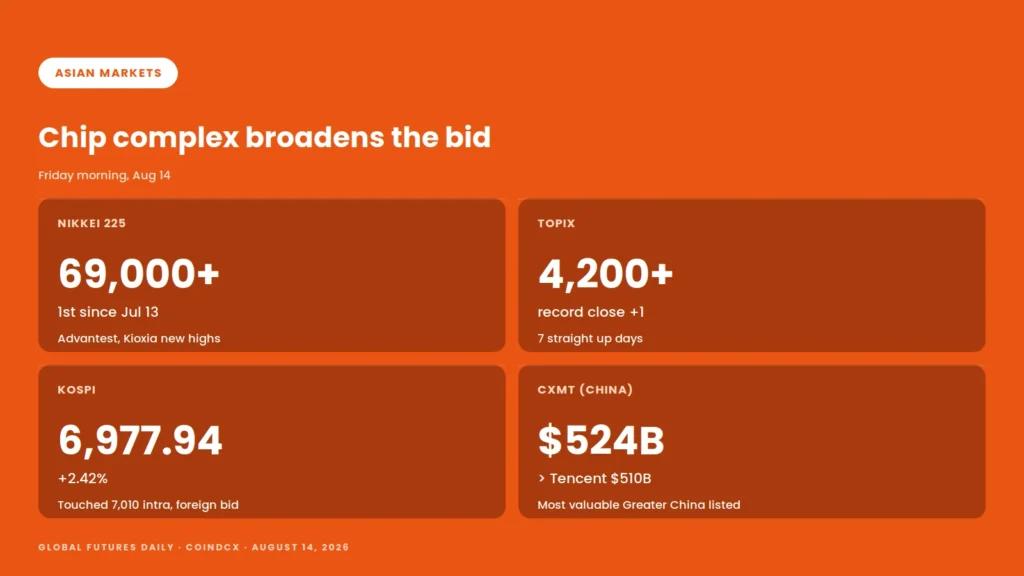
Japan opened firm and extended. The Nikkei 225 reclaimed 69,000 for the first time in a month, opening 502 points, or 0.74%, higher and pushing through as the session progressed. TOPIX broke 4,200 for the first time. Advantest set a fresh record for a second consecutive day. Kioxia continued to surge. The memory and chip equipment complex is pricing SanDisk’s Investor Day and Applied Materials’ Q4 guide as validation of the AI-capex-into-memory narrative.
South Korea capped a weeklong rally. The Kospi opened 2.68% higher and touched 7,010.86 intraday, its first print above 7,000 in 15 trading sessions since July 24. It gave back some gains to close at 6,977.94, up 2.42% or 164.60 points. The index has now rallied close to 25% off its July 30 low. Foreign investors net bought ₩3.03 trillion, about $2.13 billion, while institutions and retail took profits.
China and Hong Kong opened after CXMT’s Thursday-session crossover of Tencent. CXMT is now the most valuable listed company in Greater China at $524 billion market cap. Tencent sits at $510 billion, pressured by a 176% year-over-year jump in Q2 AI capex to ¥52.8 billion that pushed free cash flow negative. Shanghai and Hang Seng were mixed in early trading, with the memory and AI infrastructure names carrying the tape.
What Moved Wall Street
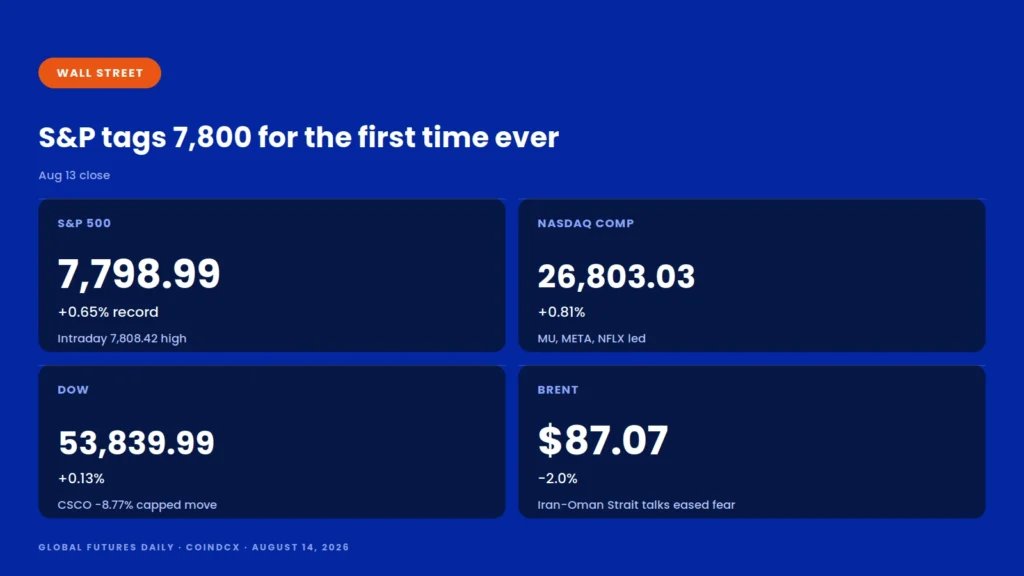
The S&P 500 climbed 0.65% to close at a record 7,798.99. Intraday, it reached 7,808.42, marking the first-ever break above 7,800. The Nasdaq Composite added 0.81% to 26,803.03, closing within striking distance of its all-time high. The Dow Jones inched 0.13% higher to 53,839.99, held back by a big Cisco drag. Russell 2000 gained 0.24% to 3,052.85. VIX rose 0.55% to 14.63.
Rates moved lower on the soft PPI. The 10-year Treasury yield sat near 4.64%, down about 3 basis points. The 30-year still hovers near 5.24%. Dollar Index softened. Brent crude fell 2% to $87.07 and WTI to $81.36, extending the risk-on backdrop. Gold pulled back to around $4,373 an ounce.
The single biggest positive story was SanDisk’s Investor Day. The stock ripped 13.67% to close near $1,527 for a $227.7 billion market cap. Intraday it touched +17%. The catalyst was CFO Luis Visoso’s NAND market outlook. Micron traded up in sympathy. Meta and Netflix helped push the Nasdaq higher. On the other side, Cisco cratered 8.77% on fiscal Q4 profit-taking despite a record top-line print. Cerebras tumbled on the Q2 revenue miss. Applied Materials reported strong Q3 numbers after the close and guided Q4 to $10.25 billion revenue, up 51% year-over-year at the midpoint, but slipped 3.14% in after-hours as investors focused on the free cash flow contraction.
Elon Musk’s Schedule 13G on SPCX landed at 4:16 PM ET, right at the close. He beneficially owns 6.42 billion shares, 48.4% of SpaceX on an as-converted basis, with sole voting and dispositive power. His voting stake remains north of 82% through the dual-class structure. Musk himself noted on X that a large portion of the shares vests only on “extremely crazy good outcomes,” so the effective fully-vested slice is lower. SPCX closed at $141.29, down 3.33%, and rose 0.4% in the overnight session on the clarification.
Assets in Focus
SNDK: NAND Peak Fear Just Got Answered
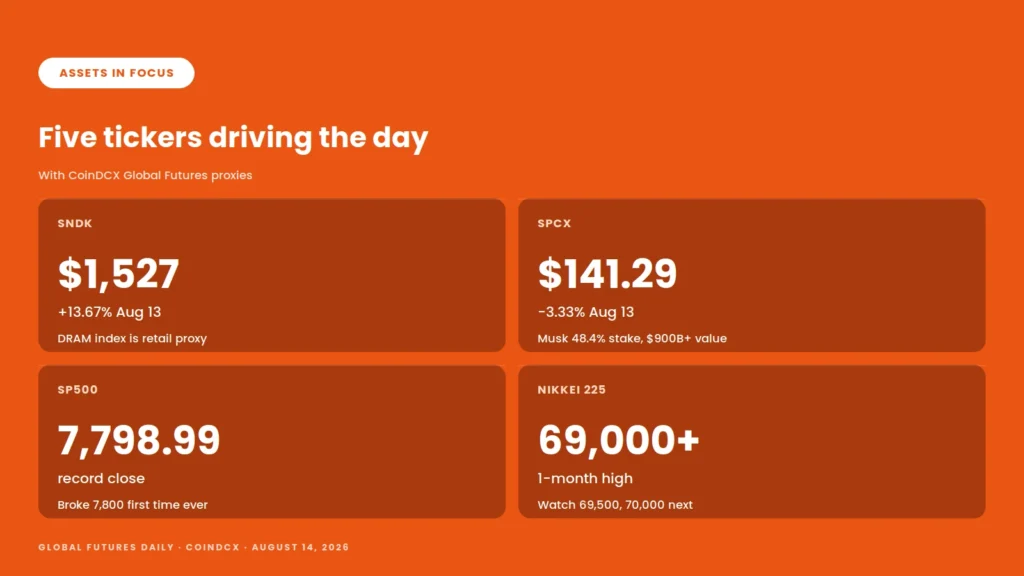
SanDisk closed Wednesday at $1,527 area, up 13.67%, after CFO Luis Visoso guided NAND market revenue to over $300 billion in 2026 and $500 billion in 2027. He said demand continues to outstrip SanDisk supply and output stays tight into 2028. That is the direct answer to the “peak cycle” fear that had knocked the stock 8% lower after a record Q4 print on August 5. Q1 FY27 guide remains $10.3 to $10.8 billion revenue with 83-85% gross margin, only 60 basis points below the Q4 record. Note for the desk: SNDK is not yet on the CoinDCX Global Futures verified retail ticker list. DRAM index remains the tradable memory-cycle proxy.
SPCX: Musk Filing Puts a Number on the Concentration
The Schedule 13G confirms Elon Musk owns 48.4% of SpaceX, worth over $900 billion at the current price. He has never sold a share. Stock closed at $141.29 on Thursday, off 3.33%, but is still up on the week and up substantially from the August 3 low of $104.83. The lockup expiration on August 6 has now been fully absorbed. The next observable catalyst is the vesting-milestone commentary Musk flagged: some of the disclosed stake vests only on “extremely crazy good outcomes for SpaceX.” Governance overhang from the dual-class structure is the standing bear case.
S&P 500: 7,800 Was the Level Nobody Was Talking About
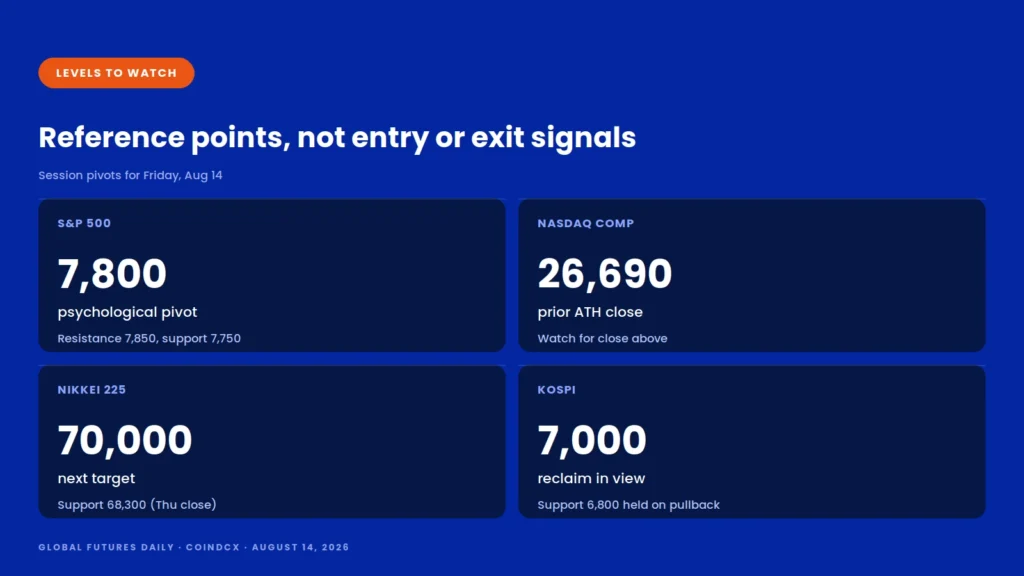
The intraday break of 7,800 on Thursday was the first ever. The closing record of 7,798.99 was set on the back of a soft PPI print, cooler CPI on Tuesday, and rate-hike odds fading back toward 35% from around 50% a week ago. Morgan Stanley and Goldman both hold 8,000 year-end targets. On the S&P 500 US Stock Index perpetual on CoinDCX Global Futures, the reference points are 7,800 as the psychological pivot, 7,850 as the next resistance zone, and 7,750 as the most recent support. Not entry or exit signals.
NIKKEI: Chip Complex Doing the Heavy Lifting
The Nikkei 225 closed Thursday at 68,308.59, up 1.16%. TOPIX at 4,176.04 was a record close for the second straight session. On Friday morning it reclaimed 69,000 for the first time since July 13, and TOPIX broke 4,200 for the first time ever. Advantest, Kioxia, Ibiden, Disco, Lasertec, Tokyo Electron all led. This is not a narrow rally. On the NIKKEI 225 perpetual on CoinDCX Global Futures, reference points are 69,000 as the reclaimed level, 69,500 next resistance, 70,000 the psychological target, and 68,300 as short-term support. Not entry or exit signals.
CXMT: Chips Are the New Clicks
CXMT held at $524 billion market cap on Thursday, remaining the most valuable listed company in Greater China. The crossover of Tencent ($510 billion) was more about Tencent falling on AI capex concerns than CXMT rallying, but the symbolic weight is what mattered. Nomura sits with a 116 yuan price target. Morningstar assessed fair value at 14.90 yuan, more than three times below the current price. The two-way debate is now live. CXMT is not directly available on CoinDCX Global Futures. BABA remains the window into large-cap China tech for retail, and DRAM index is the memory-cycle proxy.
Index Levels to Watch
DRAM index (tradable memory-cycle proxy): watch $50-55 range; SNDK Investor Day may re-rate the whole complex.
S&P 500 (US Stock Index perpetual): 7,798.99 closing record, 7,808.42 intraday all-time high. Next resistance 7,850. Support 7,750.
Nasdaq 100: 26,803 close on the Composite. Nasdaq 100 US Stock Index perp reference near the 24,090 zone; watch prior close for continuation. Support at the 26,500 area on the Composite.
Nikkei 225 perp: 69,000 reclaimed, 69,500 next resistance, 70,000 psychological target. Support 68,300 (Thursday close).
KOSPI perp: 7,000 intraday clear, 6,977.94 close, 7,010 intraday high. Support 6,800.
Disclaimer:
The information provided is for educational purposes only and does not constitute investment advice. Past performance is not indicative of future results. Trading in derivatives, including futures, involves substantial risk of loss. Please conduct your own research and consult with a qualified financial advisor before making any investment decisions. CoinDCX and its affiliates are not responsible for any losses incurred based on this information.
Frequently Asked Questions
Q1. Why did SanDisk stock jump 14% on August 13?
SanDisk held its 2026 Investor Day in New York. CFO Luis Visoso told investors that the total NAND market will pass $300 billion in 2026 and $500 billion in 2027, and that supply will stay tight into 2028. That directly answered the "peak cycle" fear that had knocked the stock 8% lower after its record Q4 print on August 5. The stock closed up 13.67%, and touched +17% intraday.
Q2. What is Elon Musk's SpaceX stake worth?
The Schedule 13G filed with the SEC on August 13 shows Musk beneficially owns 6.42 billion SpaceX shares, or 48.4% of the company on an as-converted basis. At current market prices, that is worth over $900 billion. His dual-class voting power sits above 82%. Musk noted on X that a large portion of the shares vests only on "extremely crazy good outcomes," so the fully vested slice is lower.
Q3. Why did the S&P 500 hit a new record?
Two soft inflation prints in the same week. The July CPI on Tuesday came in cool, and the July PPI on Thursday was flat month-over-month. That pulled September rate-hike odds down toward 35% from around 50% a week ago. Combined with strong AI infrastructure earnings from CoreWeave and Applied Materials, the tape had every reason to break out. The S&P 500 closed at 7,798.99 and touched 7,808.42 intraday, its first-ever move above 7,800.
Q4. Why is the Kospi rally significant?
The Kospi closed at 6,977.94, up 2.42%, and briefly hit 7,010.86 intraday, its first time above 7,000 in 15 sessions since July 24. The index has rallied close to 25% off its July 30 low, powered by memory chip names Samsung and SK Hynix and by four consecutive days of foreign net buying. Friday's foreign flow alone was ₩3.03 trillion, roughly $2.13 billion.
Q5. How does CXMT overtaking Tencent affect global memory prices?
The crossover is symbolic more than mechanical. CXMT now sits at $524 billion market cap and Tencent at $510 billion, and the switch happened because Tencent fell on its 176% jump in Q2 AI capex, not because CXMT rallied. But the signal to the market is clear. Chinese memory capacity is coming online, backed by fresh IPO capital, and it is being repriced as a strategic asset. That is the long-term structural risk to the "supply tight into 2028" call from SanDisk. In the near term, CXMT ramp is a 2027 story.