
Introduction
If you follow crypto, you will have seen the term ‘IDO’, usually next to promises of getting into a new token ‘early’. IDOs are among the most misunderstood and highest-risk parts of crypto.
You will learn the IDO full form and meaning, what an IDO is in crypto, how it works, how it compares to older methods, and the risks involved. This is not a guide to getting rich early.
What Is an IDO in Crypto?
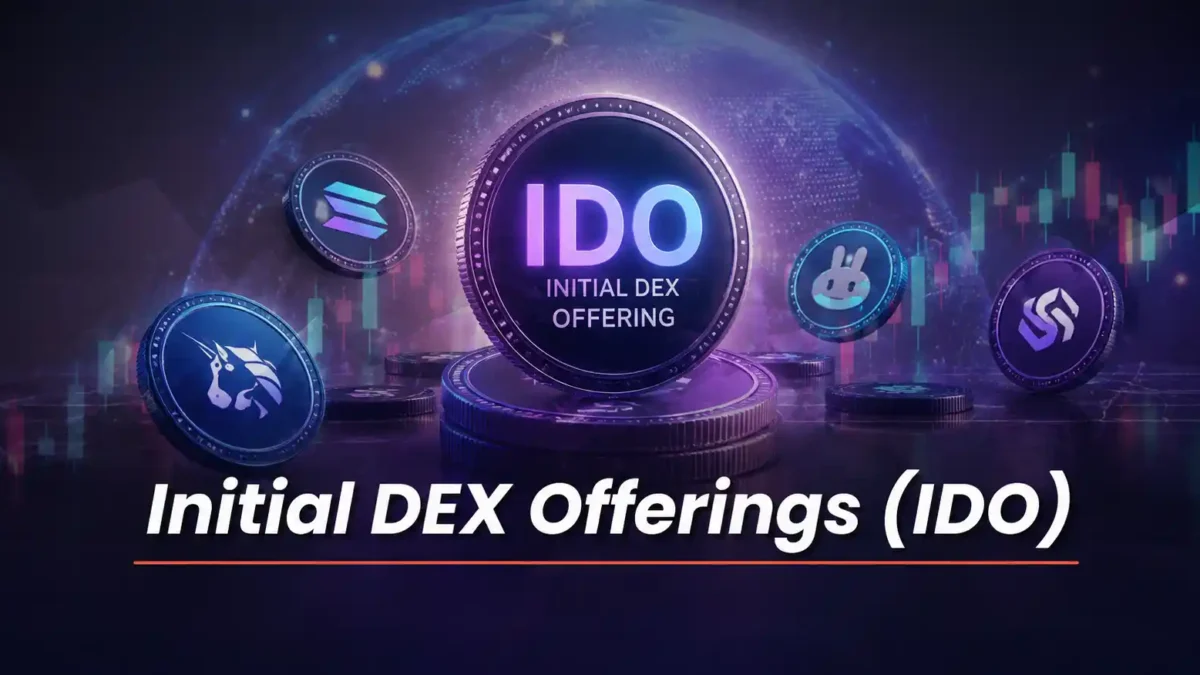
IDO stands for ‘Initial DEX Offering’. It is a fundraising method where a new crypto project sells its token to the public for the first time, directly on a decentralized exchange, or DEX. In simple terms, it is the moment a brand-new token first goes on sale and becomes tradable. People take part by sending crypto, such as ETH or USDT, to a smart contract, and in return they receive the new project’s tokens at the launch price.
The word ‘decentralized’ is important here. Because the sale runs on a DEX through automated smart contracts, there is no central company operating it and, in most cases, no identity checks. That makes IDOs fast, open, and global. It also means there is very little oversight, which is where nearly all of the risk comes from.
How Does an IDO Work?
An IDO usually happens on a ‘launchpad’, a platform that helps new projects run their token sale. The process is broadly the same each time. A project announces its IDO on a launchpad, interested people connect a crypto wallet and send funds in exchange for an allocation of the new token, and smart contracts handle the sale and often create an instant market so the token can be traded straight away.
That immediate tradability is a large part of the appeal, and also a large part of the danger, because prices can swing violently or collapse within minutes of launch. Taking part is often as simple as connecting a wallet and approving a transaction. Easy to do is not the same as safe to do.
Is There Such a Thing as an IDO Broker?
In traditional finance, a broker is a middleman who arranges deals for you. IDOs are built specifically to remove that middleman, since the point of a decentralized offering is that no central broker or gatekeeper exists. There is no genuine ‘IDO broker’.
The closest thing is a launchpad, the platform that hosts the sale. A launchpad is not a broker looking after your interests. Reputable ones may screen projects to some degree, but standards vary widely and many do little real vetting. A launchpad does not guarantee that a project is safe, and it will not refund you if things go wrong.
IDO vs ICO vs IEO
IDOs are the newest of three related token-sale models. The difference comes down to where the sale happens and who manages it, which also explains why investor protection differs so much.
ICO (Initial Coin Offering)
The earliest model, where projects sold tokens directly to the public with very little oversight. The ICO boom of 2017 and 2018 produced a large number of scams and failed projects. That record is the main reason the industry looked for better-structured models.
IEO (Initial Exchange Offering)
Here a centralized exchange runs the sale on its own launchpad, usually vetting the project first and requiring identity checks (KYC). That vetting offers more investor protection than an ICO. The trade-off is less openness, because the exchange decides which projects list and who can take part.
IDO (Initial DEX Offering)
The sale happens on a decentralized exchange, with no central manager and usually no KYC. It is the most open and permissionless of the three, and anyone with a wallet can join. It is also the least vetted, which makes it the highest scam risk of the three models.
The Risks of Taking Part in an IDO
Rug Pulls
A ‘rug pull’ is when a project’s team takes the money raised and disappears, or suddenly withdraws the token’s liquidity so nobody can sell. Your tokens still exist in your wallet, but there is no longer a market to sell them into, which leaves them effectively worthless.
Scams and Fake Websites
Fake IDO pages and phishing links are widespread, often promoted through paid ads and social media accounts that copy the real project. If you send funds to the wrong contract or a fake site, the money is gone with no way to reverse the transaction. Always reach a launchpad through a link you have verified yourself.
Failed or Worthless Projects
Many new tokens have no working product, no sustainable use, and no team capable of building one. Even without any fraud, the token can fall to near zero once the launch attention fades. A polished website and an active social media presence tell you nothing about whether a project will survive.
Extreme Volatility
Because trading starts instantly, prices can crash within minutes of launch. Automated bots are often positioned to buy and sell in the first seconds, which means ordinary buyers frequently get a worse price than they expected. A token can lose most of its value almost immediately.
No Recourse
If you are scammed or the project simply fails, there is usually no central authority, no customer support, and no way to recover your money. Blockchain transactions cannot be reversed, and an anonymous team cannot be pursued. The loss is permanent.
How to Reduce IDO Risk
This guide does not recommend taking part in IDOs. If someone chooses to anyway, the realistic goal is to reduce risk rather than remove it, because it cannot be removed. The basic discipline involves four checks. Research the team behind the project and whether they are public and credible. Read the tokenomics and check whether team and liquidity tokens are locked or vested. Look for an independent security audit of the contract. Reach the launchpad only through a verified link, never through an ad or a message.
The rule that matters most is never to commit money you cannot afford to lose completely, and never to let hype or a fear of missing out rush the decision. Even with careful research, an IDO can still be a total loss. Protect your wallet, and never share your seed phrase or private keys with any person or any site.
How IDO Crypto Tokens Are Taxed in India
In India, any crypto token you buy, including through an IDO, is treated as a Virtual Digital Asset (VDA). Profit on a sale is taxed at a flat 30 percent, plus a 4 percent cess and any applicable surcharge, and losses cannot be set off or carried forward. A 1 percent TDS applies on transfers, deducted at source and claimed as credit against your final bill. Many IDOs also operate without the KYC or regulatory protections you might expect, which can create legal and tax complications, so keep detailed records and take advice from a qualified chartered accountant. Use FIU-IND registered platforms wherever possible.
FAQs
Q1. What is an IDO in crypto?
An IDO, or Initial DEX Offering, is how a new crypto project sells its token to the public for the first time, directly on a decentralized exchange, usually through a launchpad. People take part by connecting a wallet and sending crypto to a smart contract, receiving the new token in return, which usually becomes tradable immediately.
Q2. What is the full form of IDO?
The full form is 'Initial DEX Offering'. 'DEX' stands for decentralized exchange, a crypto trading platform that runs on smart contracts rather than being operated by a central company. It is the decentralized successor to earlier models such as the ICO and the IEO.
Q3. Is there such a thing as an IDO broker?
Not really. In traditional finance a broker is a middleman who arranges deals, but IDOs are designed specifically to remove the middleman. The closest thing is a launchpad, which is not a broker acting in your interest: vetting standards vary widely, and a launchpad will not protect or refund you if a project turns out to be a scam.
Q4. How is an IDO different from an ICO and an IEO?
All three are ways of selling a new crypto token, and the difference is where the sale happens and who manages it. An ICO sells directly to the public with little oversight. An IEO is run by a centralized exchange that vets the project and usually requires KYC. An IDO happens on a decentralized exchange with no central manager and usually no KYC, making it the least vetted.
Q5. Are IDOs safe, and what are the risks?
IDOs are not safe. Common risks include rug pulls, where teams take the money and disappear or withdraw liquidity, along with scams and fake websites, failed or worthless projects, and extreme volatility that can crash a token within minutes of launch. There is usually no support and no way to recover your money.
Q6. Should beginners participate in IDOs?
This guide does not recommend that beginners participate. IDOs are complex and extremely high-risk, with frequent scams and a real chance of total loss. Beginners are better served by understanding crypto and risk properly first, and by treating early-stage token sales with caution.
IDOs are fast, open, and dangerous, with scams and total losses being common rather than rare. Learn how crypto, DeFi, and token launches work with CoinDCX's education guides, be sceptical of 'get in early' hype, risk only money you can afford to lose, and never share your seed phrase with anyone.