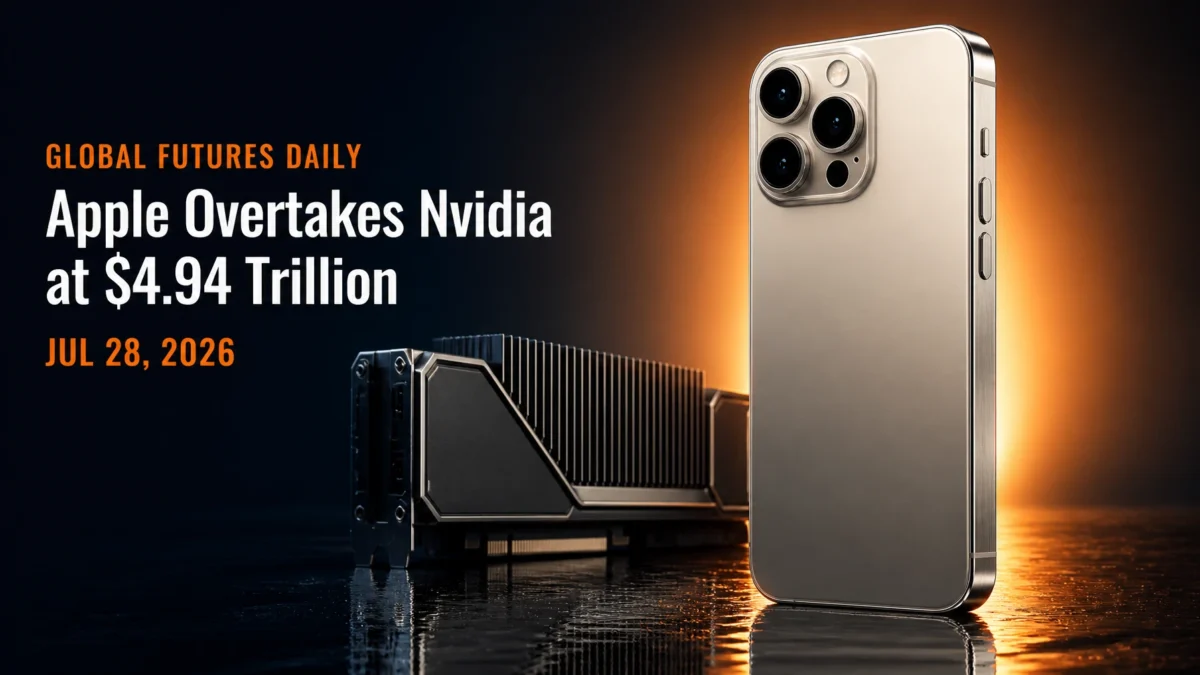

Apple reclaimed the most valuable company crown at $4.94T as Nvidia fell 5% on $250B OpenAI financing fears. Kospi crashed 10.8% overnight. Fed decision Wed.
TLDR
- Apple reclaimed the world’s most valuable company crown at a $4.94 trillion market cap on Monday, edging past Nvidia at $4.83 trillion after Nvidia fell 4.99% on renewed AI capex fears.
- Kospi crashed 10.8% and triggered a trading halt overnight, with Samsung Electronics down 13.4% and SK Hynix down 14.7% as Asia’s chip complex broke on AI bubble concerns.
- Nikkei 225 dropped 3.95%, Taiwan’s Taiex fell 4.7%, but Hang Seng bucked the trend, closing 0.4% higher on defensive rotation into industrials.
- Wall Street closed mixed: Dow +0.51%, S&P 500 +0.02%, Nasdaq -0.18% on the AI names dragging while oil-sensitive sectors caught a bid on the US-Iran attack pause.
- This week’s calendar is stacked. Fed decision Wednesday 2 PM ET with 36% hike odds priced in. Microsoft and Meta report Wednesday AMC. Apple and Amazon report Thursday AMC alongside Q2 GDP advance and June PCE.
Market Regime
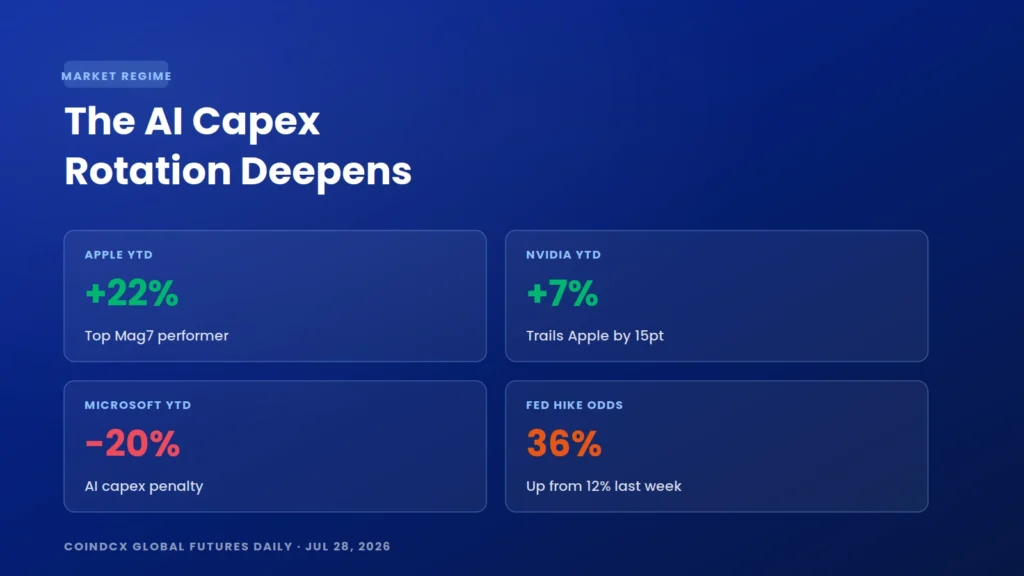
Positioning has flipped hard. The market is now rewarding companies that spent less on AI infrastructure and punishing the ones that spent more. Alphabet’s cloud beat last week was met with a 7% stock drop because capex guidance moved to $195 to $205 billion and free cash flow turned negative for the first time since its 2004 IPO. Microsoft is down 20% year to date. Apple is up more than 22% and has quietly become the top performer in the Magnificent Seven. Apple’s capex has actually declined over the past three quarters.
What could break it: the four biggest AI spenders all report inside the next 48 hours. If Microsoft prints Azure growth above 40% and Meta contains its capex guidance, the rotation reverses fast and Nvidia snaps back above $200. If either name raises capex like Alphabet did, the AI infrastructure trade takes another leg down, and Apple’s lead widens. The Fed decision Wednesday adds another swing factor: markets are pricing a 36% chance of a rate hike, up from 12% a week ago.
Bullish Factors
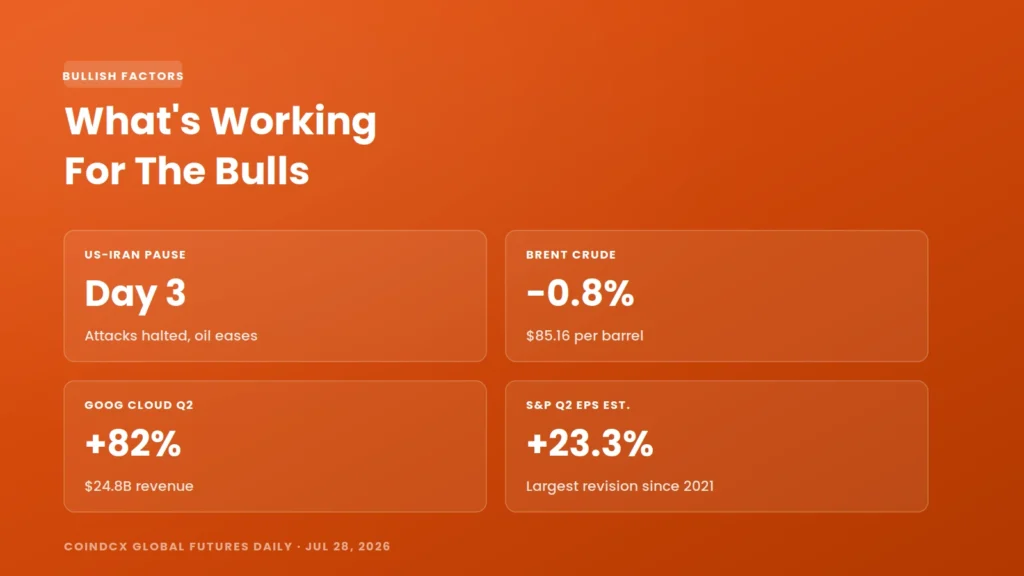
- US and Iran extended their attack pause to a third day. Brent crude fell 0.8% to $85.16, easing inflation pressure heading into the FOMC decision.
- Apple stock is up more than 22% year to date, the top Magnificent Seven performer, with the market rewarding restrained AI capital expenditure over infrastructure buildouts.
- Alphabet’s cloud revenue grew 82% year over year in Q2 to $24.8 billion, showing that hyperscaler demand for AI compute remains structurally strong.
- Analysts raised Q2 S&P 500 earnings estimates by 3.4%, the largest intra-quarter upward revision since 2021, expecting 23.3% EPS growth.
- Defensive rotation is working. The Dow gained 0.51% Monday as industrials and materials caught a bid from lower oil prices.
Bearish Factors
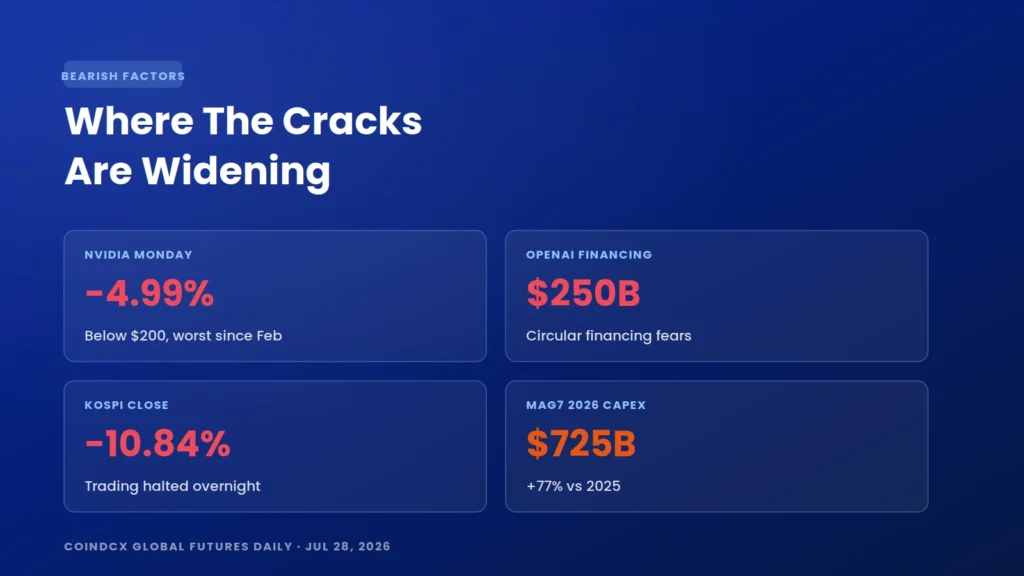
- Nvidia fell 4.99% to $196.51 on Monday, its largest single-day drop since February, breaking the psychologically important $200 level.
- The trigger was a Wall Street Journal report that Nvidia is in talks to guarantee up to $250 billion in financing for OpenAI’s data center buildout, reviving circular financing fears.
- Kospi triggered a trading halt overnight, closing 10.84% lower at 6,023.66, with Samsung down 13.4% and SK Hynix down 14.7% on AI bubble concerns.
- Fed rate hike odds have surged from 12% to 36% over the past week as oil prices earlier crossed $100 per barrel, keeping inflation pressure elevated ahead of Wednesday’s decision.
- The four largest AI spenders are projected to commit $725 billion in capex during 2026, up 77% from 2025, with markets increasingly questioning return on investment timelines.
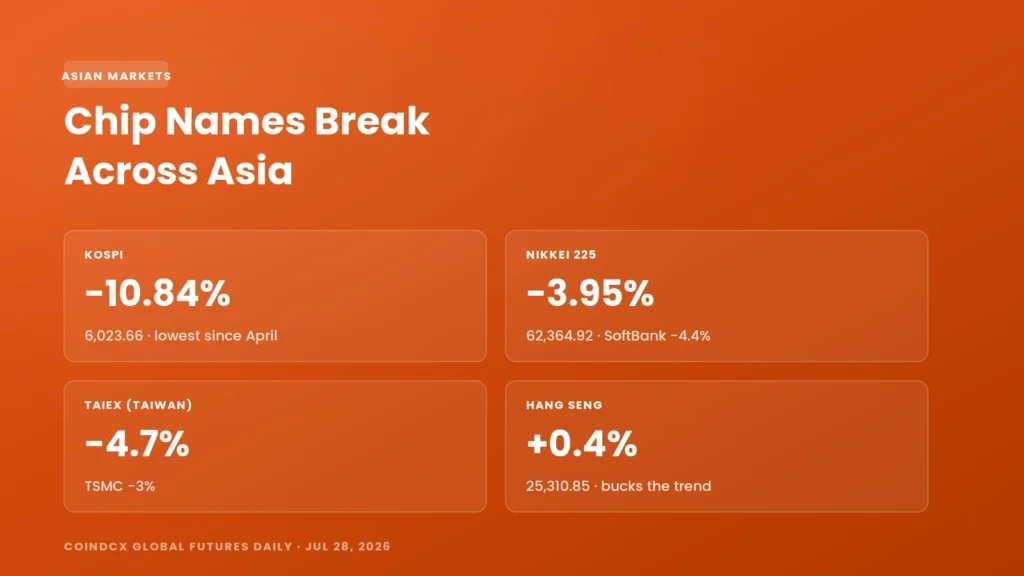
Asian Markets This Morning
South Korea’s Kospi index plunged 10.84% to close at 6,023.66, its lowest level since April, with trading temporarily halted at times as chip stocks led the collapse. Samsung Electronics fell 13.4% and SK Hynix tumbled 14.7%. The move reflected a combination of Wall Street’s AI capex worries, growing concerns about competition from cheaper Chinese AI models, and Korean-specific delisting pressure on high-conviction names.
Japan’s Nikkei 225 closed 3.95% lower at 62,364.92, with SoftBank sliding 4.43% and Advantest crashing over 10% as the AI infrastructure trade cracked across Asia. Taiwan’s Taiex fell 4.7%, dragged by TSMC’s 3% decline. Hong Kong’s Hang Seng bucked the regional pattern, edging 0.4% higher to 25,310.85 on strength in defensive industrial names. Shanghai Composite lost 1.2%, while Australia’s ASX 200 gained 0.6% supported by defensive rotation.
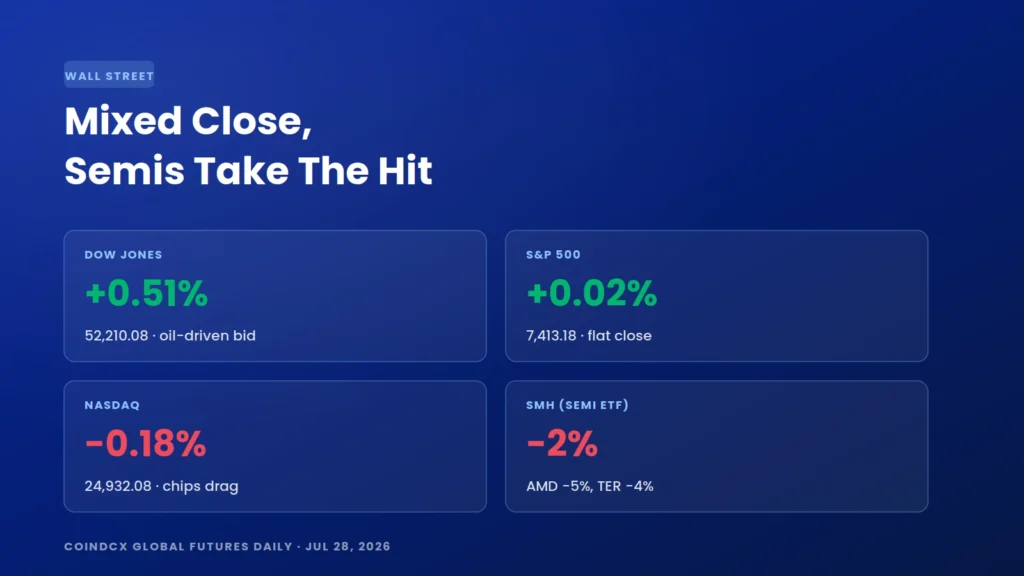
What Moved Wall Street Today
The Dow Jones Industrial Average gained 262.83 points, or 0.51%, to close at 52,210.08. The S&P 500 was essentially flat, adding 0.02% to settle at 7,413.18. The Nasdaq Composite fell 0.18% to 24,932.08, dragged by the semiconductor selloff. The VanEck Semiconductor ETF fell more than 2%, with AMD down 5% and Teradyne down 4%.
The AI capex story continued to dominate the tape. Reports that Nvidia is negotiating to guarantee up to $250 billion in OpenAI financing revived concerns first raised by Alphabet’s capex hike last week. The Nvidia guarantee would come on top of its previously announced $100 billion investment in OpenAI and a $500 billion multi-year cooperation agreement with SK Group. Investors are increasingly asking whether Nvidia is engineering artificial demand for its own chips through its financing arm.
Apple, meanwhile, gained 1.17% to close at a record high. The combination of AAPL up and NVDA down pushed Apple’s market cap to roughly $4.94 trillion versus Nvidia’s $4.83 trillion, ending Nvidia’s tenure as the world’s most valuable public company. Nvidia had held the title since June 2025, when it overtook Microsoft. Apple last held the crown in April 2025.
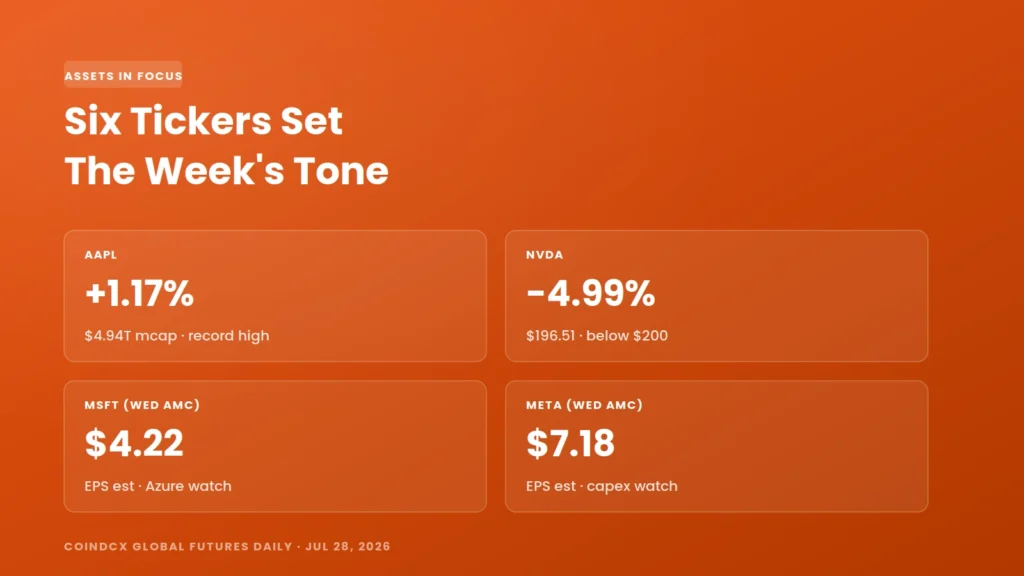
Assets in Focus
AAPL (Apple)
Apple closed at a record high on Monday, gaining 1.17% to push its market cap to approximately $4.94 trillion and reclaim the world’s most valuable company title. AAPL is up more than 22% year to date, outperforming every other Magnificent Seven member. The bull thesis has flipped from a bearish AI narrative to a bullish capex discipline narrative. Apple’s capital expenditure has actually declined over the past three quarters while peers have raised capex outlooks. Apple reports fiscal Q3 results Thursday July 30 after close, with expected EPS around $1.86. Consensus focus is hardware gross margin and services growth. Tim Cook’s final earnings call as CEO before John Ternus takes over on September 1.
NVDA (Nvidia)
Nvidia fell 4.99% to $196.51 on Monday, its worst single day since February 2026, breaking below the psychologically important $200 level. The catalyst was a Wall Street Journal report on Nvidia’s potential $250 billion OpenAI financing guarantee. Combined with the recently announced $500 billion SK Group deal and existing $100 billion OpenAI investment, the market is questioning whether the AI infrastructure buildout is creating circular financing risk. NVDA is up only about 7% year to date, materially trailing Apple’s 22% advance. Nvidia reports on August 26 with a $91 billion revenue guide setting up as the ultimate AI cycle test.
MSFT (Microsoft)
Microsoft reports fiscal Q4 2026 results Wednesday July 29 after close. Consensus estimates EPS between $4.22 and $4.24 on revenue of $87.5 to $87.67 billion. The single most important number is Azure growth, where management guided for 39 to 40% constant currency growth. Any print below 36% risks triggering a selloff regardless of the headline. MSFT is down roughly 20% year to date on concerns that FY26 capex, pacing above $190 billion, is running ahead of AI monetization. The stock reaction will set the tone for the AI infrastructure trade for the rest of the earnings cycle.
META (Meta Platforms)
Meta reports Q2 2026 results Wednesday July 29 after close, expected EPS between $7.18 and $7.24. Meta previously guided second-quarter revenue of $58 to $61 billion and 2026 capex of $125 to $145 billion. The key swing factor is whether operating margins hold above Q1’s 41.4% or whether Reality Labs and AI infrastructure costs compress them. META is down about 9.8% year to date. Advertising demand remains robust, but the story right now is capex discipline, not ad growth.
AMZN (Amazon)
Amazon reports Q2 results Thursday July 30 after close, with expected EPS around $1.85. AWS operating income and forward capex commentary are the primary swing factors. Amazon shares are roughly flat year to date, avoiding both the AI infrastructure selloff and the AI-discipline rally. If AWS growth accelerates and capex is contained, AMZN could catch a bid similar to Apple’s. If capex is raised, the stock joins the Alphabet/Microsoft/Meta camp under pressure.
GOOGL (Alphabet)
Alphabet gained 2.13% Monday, recovering some of last week’s post-earnings damage. GOOGL fell more than 7% following its Q2 print despite an 82% year over year cloud revenue surge because the company raised 2026 capex guidance to $195 to $205 billion, its first negative FCF quarter as a public company. The stock is now the reference point for how the market will react to Microsoft, Meta, and Amazon this week. If any of them mirror Alphabet’s playbook, expect similar reactions.
Index Levels to Watch
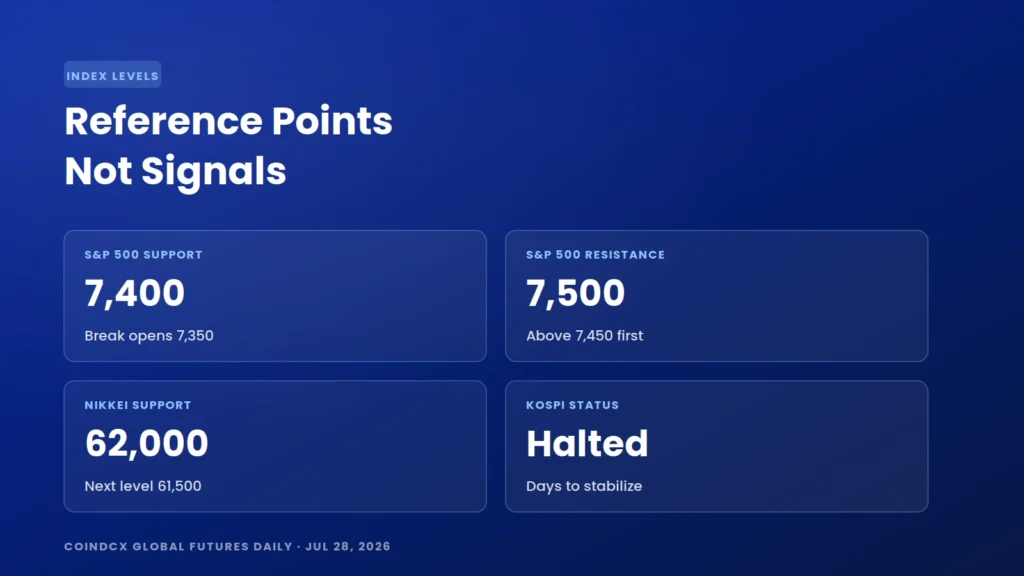
These are reference points for context, not entry or exit signals.
- S&P 500 (7,413.18): support at 7,400 and 7,375; resistance at 7,450 and 7,500. A break of 7,400 opens 7,350.
- Nasdaq 100 (via QQQ proxy): the semiconductor drag is the swing factor. Watch the VanEck Semiconductor ETF for direction.
- Dow Jones (52,210.08): held above 52,000 support on defensive rotation. Resistance at 52,500 and 52,750.
- Nikkei 225 (62,364.92): closed at 4-week lows on the AI selloff. Support at 62,000 and 61,500.
- Kospi (6,023.66): trading halt-triggering move to lowest level since April. Structural damage may need days to stabilize.
Disclaimer
This article is for educational and informational purposes only. It is not investment advice and should not be treated as a buy, sell, or hold recommendation for any security or financial product. Trading in futures and similar instruments involves significant risk including the potential loss of capital. Past performance is not indicative of future results.
Crypto products and NFTs are unregulated and can be highly risky. There may be no regulatory recourse for any loss from such transactions. For any queries, visit support.coindcx.com.
Frequently Asked Questions
Q1. Why did Apple overtake Nvidia as the world's most valuable company on July 27, 2026?
Apple closed at a record high on Monday with a 1.17% gain, pushing its market cap to $4.94 trillion. Nvidia fell 4.99% on reports of a $250 billion OpenAI financing guarantee, dropping its market cap to $4.83 trillion. Investors are rewarding Apple's restrained AI capex, which has declined over the past three quarters, while punishing companies making heavy AI infrastructure commitments.
Q2. What caused the Kospi to crash 10.8% on July 28, 2026?
The Kospi collapse was triggered by heavy selling in Samsung Electronics (down 13.4%) and SK Hynix (down 14.7%) on AI bubble concerns and competition from cheaper Chinese AI models. Trading was temporarily halted as the index fell to its lowest level since April. The move followed Nvidia's overnight decline and reflected broader Asian rotation out of AI infrastructure names.
Q3. When is the Federal Reserve decision on July 29, 2026?
The FOMC concludes its two-day meeting on Wednesday July 29 with the rate decision at 2 PM ET followed by Chair Kevin Warsh's press conference at 2:30 PM ET. Markets are pricing a 36% probability of a 25 basis point rate hike, up from 12% one week ago, driven by elevated oil prices and Iran conflict inflation risk. The current target range is 3.50 to 3.75%.
Q4. Which Big Tech companies report earnings this week?
Microsoft and Meta report Wednesday July 29 after close. Apple and Amazon report Thursday July 30 after close. Combined, these four companies represent the largest AI infrastructure spenders in the market, projected to commit $725 billion in capex during 2026. The market reaction to their capex guidance will define the second half of the year for large-cap tech.
Q5. What is circular financing in AI, and why is it a concern for Nvidia?
Circular financing describes a situation where a supplier (Nvidia) provides financing to a customer (OpenAI) that then uses those funds to buy products from the supplier. This can create the appearance of demand that is actually funded by the supplier's own capital. Nvidia's proposed $250 billion OpenAI guarantee, on top of its existing $100 billion OpenAI investment, has revived these concerns because most of the companies Nvidia invests in are also core buyers of its chips.