


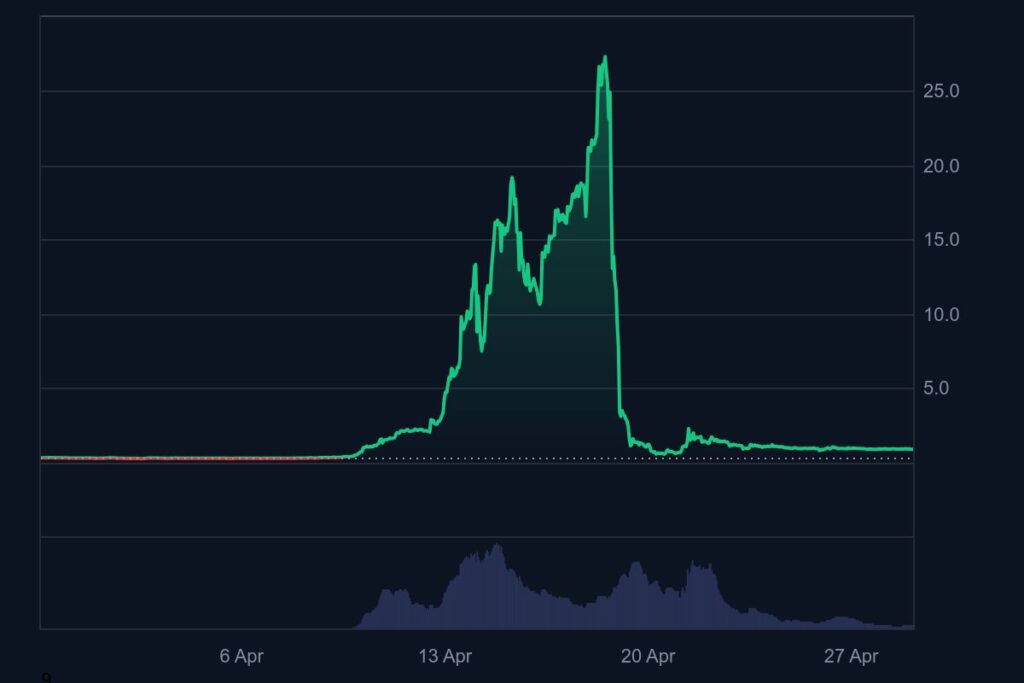
RAVE token has emerged as one of the most talked-about crypto assets this week after a massive price surge of over 1000% and heavy futures liquidations drew market-wide attention. However, the rally has also raised serious concerns around token concentration, with on-chain data showing that nearly 90% of the supply is controlled by a small number of wallets.
The combination of extreme volatility and concentrated ownership has sparked debates around market manipulation, liquidity risks, and long-term sustainability, especially as retail interest continues to surge.
Why RAVE Token Is Trending
RAVE’s recent surge is largely driven by a short squeeze in the derivatives market, where a high number of bearish positions were liquidated. Reports suggest that millions of dollars in short positions were forced to close, creating additional buying pressure and accelerating the price rally.
At the same time, retail FOMO and social media traction have amplified the move, with traders rushing to capitalize on momentum. However, analysts note that the rally appears to be driven more by market mechanics than fundamental developments, making the price action highly sensitive to sudden reversals.
High Concentration Raises Market Stability Concerns
Token distribution plays a critical role in determining a project’s long-term stability and trustworthiness. When a small group of holders controls a large share of supply, it increases the risk of sudden price swings. Large holders, often referred to as whales, can influence price movements by executing high-volume trades.
Market participants have raised concerns that such concentration could lead to coordinated selling or dumping, which can rapidly erode investor confidence. In thinly traded markets, this risk becomes even more pronounced, as liquidity may not be sufficient to absorb large sell orders.
In addition, centralized token ownership can limit organic price discovery. With fewer participants controlling supply, the market may not accurately reflect genuine demand and investor sentiment.
Growing Attention Around Trading Activity
The discussion has also drawn attention to RAVE’s broader market activity, with increasing interest from traders and online communities. Rising RAVE trading interest suggests that the token is gaining traction, even as questions around distribution persist.
However, analysts caution that heightened attention does not necessarily translate into long-term sustainability. In cases where ownership remains heavily concentrated, price movements may be driven more by a few large players than by widespread adoption.
Transparency and Project Credibility in Focus
The issue has also brought renewed attention to transparency within emerging token projects. Investors increasingly expect clear disclosures about token allocation, vesting schedules, and wallet ownership structures. While it is not uncommon for early-stage projects to have concentrated ownership, particularly during initial funding rounds or development phases, the lack of gradual decentralization over time can be a warning sign for investors.
RAVE Price Outlook
RAVE is currently trading near $15, rebounding after a sharp correction from its all-time high around $20. If the token holds above the $12.47 support level, a retest of $15.35 resistance is likely. However, a breakdown below this level could trigger further downside toward the $10 zone, especially if short-squeeze-driven momentum fades.
Read more: RaveDAO Price Prediction 2026-2031
Broader Implications for Crypto Markets
The RAVE situation highlights a broader issue across the crypto ecosystem: the balance between early-stage funding and decentralization. Many projects begin with concentrated ownership but aim to distribute tokens more widely through community incentives, staking rewards, or public sales. Failure to achieve this balance can undermine a project’s credibility and long-term viability. Investors are increasingly scrutinizing tokenomics, the economic structure behind tokens, as a key factor in decision-making.
Regulatory discussions worldwide have also begun to focus on ownership concentration as a potential risk factor. While not yet universally regulated, such metrics could play a role in future compliance frameworks.
What Investors Should Watch
For those tracking RAVE, key indicators to monitor include changes in wallet distribution, trading volume, and liquidity levels. Any significant movement from large wallets could signal upcoming volatility. Additionally, official communication from the project team regarding token distribution or decentralization plans could influence market sentiment. Transparent updates may help address concerns, while a lack of clarity could intensify scrutiny.
As the crypto market continues to mature, cases like RAVE serve as a reminder that, beyond price action, underlying data such as token distribution can offer critical insights into potential risks and opportunities.