


NYC Token triggered a wave of trader attention after a volatile launch that saw sharp price swings and social chatter about liquidity changes. The token, promoted publicly by former New York City Mayor Eric Adams, was introduced as part of an initiative tied to civic causes and blockchain education, but the market’s focus quickly shifted to trading activity and liquidity mechanics.
What Triggered NYC Token’s Volatility
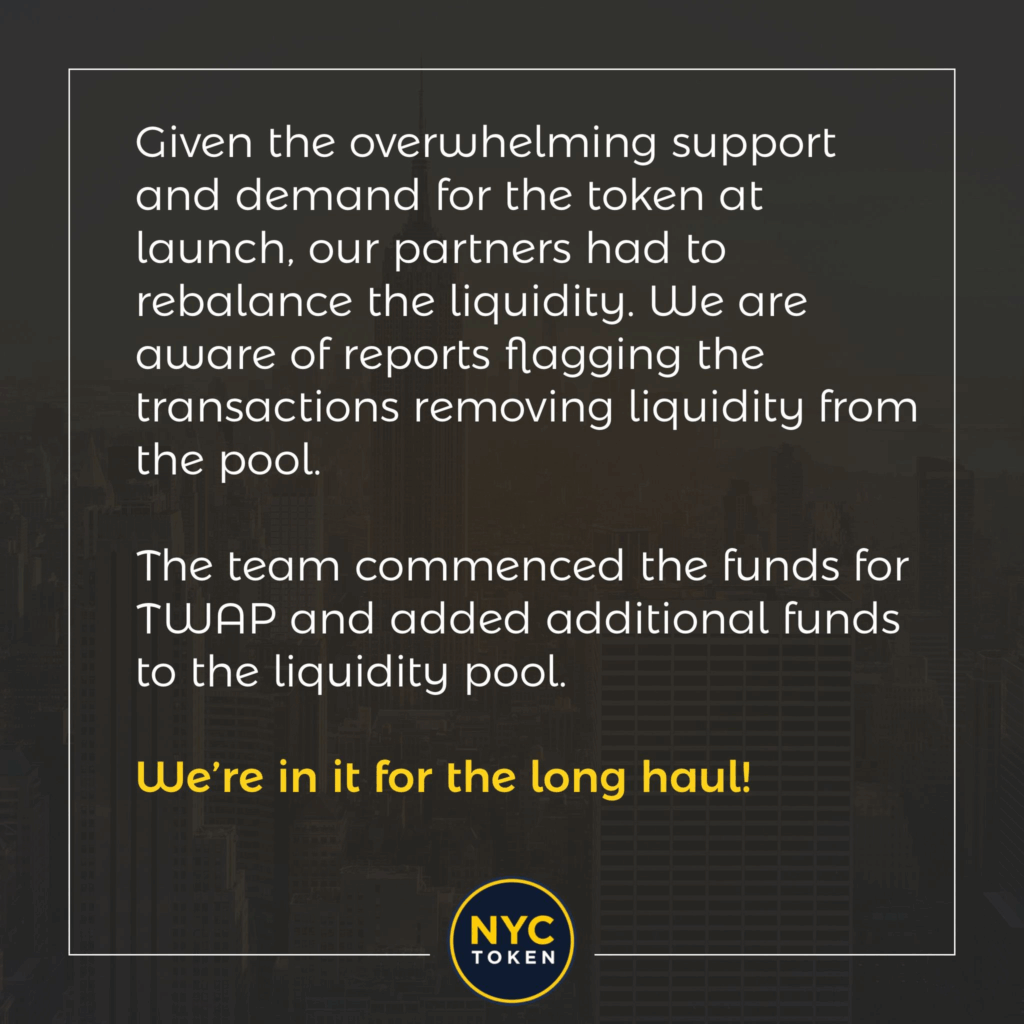
In the hours following launch, traders flagged on-chain activity suggesting liquidity was being removed from the pool, fueling concerns about stability and widening slippage. The project’s official account later acknowledged the reports, stating that partners had to “rebalance the liquidity” due to heavy demand and that the team had commenced funds for TWAP and added additional liquidity to the pool.
The website and documentation provided limited technical detail at launch, leaving open questions around governance, oversight, and how proceeds will be managed.
Adams characterized NYCToken as a revenue-generating digital asset whose proceeds would be funneled to a nonprofit organization yet to be formally established. In his words, the nonprofit would support the development of community safety and inclusion initiatives, civic education, and blockchain awareness among youth.
Adams provided only a token of the token’s technical framework, governance, or timeline, but he positioned the launch as part of a larger brand-label of work that explores how emerging technologies can be used to solve urban problems.
Vision, Message, and Outstanding Questions
During the unveiling, Adams emphasized the potential of blockchain technology to enhance transparency and operational efficiency, citing its use in corporate supply chains and data management systems.
According to Adams, NYCToken’s revenue would be allocated to a nonprofit that disburses funds to organizations working to combat certain polic. Additionally, he indicated that historically Black colleges and universities could play a role in the project’s education and outreach; however, no formal partnerships have been announced.
Addressing concerns around transparency and conflicts of interest, Adams said he would not draw a salary from the project at launch, while noting that any future compensation would be subject to public disclosure.
Despite the high-profile rollout, the project’s digital footprint remains limited. As of Monday, NYCToken’s website reportedly offered little information beyond general messaging and a link to its social media account, prompting questions from observers regarding governance, oversight, and accountability.
Trade Crypto in INR on 
Deposit and withdraw in INR (₹).
No Conversion to Crypto Required.

Adams’ Digital Asset Push and Early Reaction
Adams has long been a strong supporter of the adoption of crypto and blockchain technology. He has even been known to convert his paychecks into crypto during his tenure as mayor and to actively market New York City as a hub for digital asset innovation.
He acknowledged that there are three co-creators of NYCToken and that the other creators’ identities would be revealed to the public soon. Additionally, Adams set the record straight: the famous crypto personality Brock Pierce, whom the mayor has previously been linked to, is not part of the project.
The announcement has sparked divergent views. Some see the NYCToken as a follow-up of Adams’ passion for exploring blockchain-based civic innovation. Opponents interpret the lack of detail, the fusion of social causes with speculative financial products, and the risks of politically affiliated crypto initiatives as signs of criticism.
New city leadership seems doubtful. Flipping the question to the new New York City mayor, he reportedly gave a short, dismissive answer, which reflects the skepticism of local political circles.
Conclusion
NYC Token’s launch shows how quickly politically linked token launches can turn into market events—where liquidity, pool mechanics, and transparency drive sentiment more than the stated mission. For traders, the key near-term focus will be whether liquidity remains stable after the team’s rebalancing and TWAP support, and whether clearer documentation follows.


