


Lighter’s newly launched LIT token isn’t just another exchange governance asset. By routing all protocol-generated value back to token holders and dedicating half of its supply to ecosystem incentives, Lighter is positioning LIT as a revenue-linked infrastructure token rather than a speculative airdrop play.
What Is LIT and Why It Matters
The LIT token is designed to align incentives across the Lighter platform. According to the team, all value generated by Lighter’s products, whether from its decentralized exchange or future infrastructure tools, will ultimately flow back to LIT holders. Unlike many governance tokens that rely on future utility promises, LIT ties platform usage directly to token economics through transparent, on-chain revenue flows and buyback mechanisms.
To support transparency, all revenues will be visible and traceable on-chain. These funds will be used to drive growth initiatives and token buybacks, reinforcing the ecosystem’s long-term value.
Token Allocation Breakdown
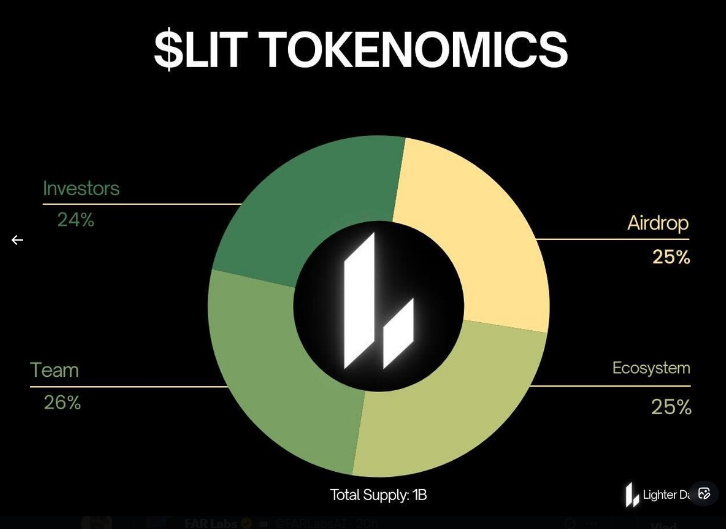
Lighter has allocated 50% of the total LIT supply to ecosystem development, highlighting a strong focus on users and builders rather than insiders. Notably, the 50% ecosystem allocation stands out at a time when many high-profile launches have drawn criticism for heavy insider ownership, signaling Lighter’s intent to prioritize long-term participation over short-term liquidity events.
- 25% of the supply will go toward airdrops, targeting users who participated in Lighter’s first two points seasons in 2025
- The remaining 25% will be reserved for future incentive programs, partnerships, and ecosystem expansion
The rest of the supply is split between internal stakeholders:
- 26% allocated to the Lighter team
- 24% allocated to investors
To promote long-term commitment, both team and investor allocations include a one-year lockup, followed by a three-year linear vesting period.
Staking, Utility, and Decentralization Plans
LIT also plays a key role in how Lighter’s infrastructure operates. Staking LIT grants access to higher infrastructure roles within the protocol, including transaction processing and fairness verification, functions that are currently centralized but designed to decentralize over time as participation grows.
Lighter operates as a U.S.-based C corporation and stated that it will continue to run the protocol at cost. Any additional value generated will be redirected to strengthen the ecosystem and benefit LIT holders.
$LIT’s Market Debut and Price Action
The LIT-USDC trading pair officially went live early 30 December 2025. Shortly after launch, LIT was trading around $2.34, down from its pre-market level of roughly $3.25. As with most new token launches, early price movement has been volatile.
Disclaimer: Early post-launch volatility is common for newly issued tokens, particularly following large airdrop distributions, as short-term sellers exit positions.
Since launching its public mainnet in October, Lighter has quickly become one of the largest decentralized perpetuals platforms. In November alone, the exchange processed $292.5 billion in trading volume, outperforming several well-known competitors.
The platform’s growth is backed by strong investor confidence. Lighter raised $68 million at a $1.5 billion valuation in November, led by Founders Fund and Ribbit Capital. It also expanded its offerings with the launch of spot trading in early December.
Conclusion
With a community-focused token model, transparent revenue sharing, and a clear decentralization roadmap, LIT’s launch marks an important milestone for Lighter. By dedicating half of the token supply to ecosystem rewards and incentives, Lighter is positioning itself as a serious long-term player in decentralized derivatives.


