
What is Bitcoin Mining?
Bitcoin Mining is a process of verifying transactions on the network and adding new blocks to the Bitcoin blockchain. This is done to achieve consensus of Bitcoin blockchain- Proof of Work, ensuring the network’s integrity and security.
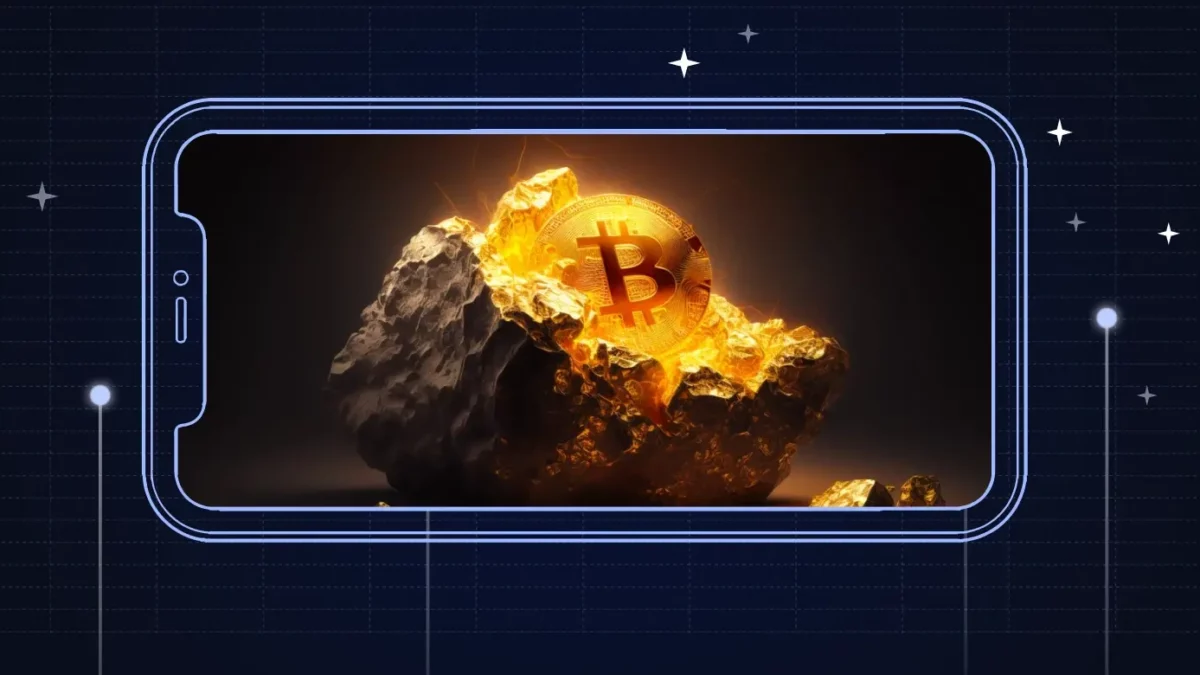
In the real world, “mining” is associated with the process of extracting valuable natural resources like gold, silver, minerals, etc from the surface of the Earth. This process is highly energy intensive, requiring heavy machinery and tools to extract the ores. However, Bitcoin mining is quite different from ore mining, but they both have a common objective: extracting something valuable.
Bitcoin mining requires users- called miners to employ their computational resources to mine Bitcoin (a valuable asset here) by solving some complex mathematical puzzle. The first miner to guess the right answer to the puzzle gets a chance to validate transactions, add them to a new block and receive a mining reward plus a transaction fee for the contribution.
How does Bitcoin Mining Work?
Before we get into the working of Bitcoin mining, let’s first understand the Proof of Work consensus mechanism. Proof of Work or PoW is an algorithm used by miner nodes to communicate with each other and achieve an agreement while validating the transactions. PoW is an essential part of Bitcoin architecture for the security of users’ funds and information, prevent fraud, double spending of coins, and decentralization of the network.
The process of mining Bitcoin takes off when new transactions are initiated on the network. All unverified transactions are collected into a mempool- short for memory pool, where miner nodes group a few transactions to check their validity. The miner node then passes pending transactions to Bitcoin’s cryptographic hash algorithm- SHA-256 or Secure Hashing Algorithm 256, creating a “block” of transactions. The SHA-256 hashing algorithm encrypts transaction information to a 256-bit string so that it can’t be decrypted back to retrieve the original data.
During this step, miner nodes compete to solve mathematical puzzles to find a unique nonce (an arbitrary number) which is then combined with block data and the hash of the previously generated block to create a unique hash string. This new hash of the block links it to the previous block, arranging them in chronological order forming a chain of blocks- a blockchain. The newly created block is broadcasted to other nodes for protocol validation and then updated to the Bitcoin blockchain ledger.
Additional Read: What is Bitcoin Lightning Network?
How much does it cost to mine Bitcoin?
Bitcoin’s design adjusts the mining difficulty according to network usage and miner participation. During the initial days, one could mine Bitcoin just using a normal pc or laptop. But as the network participation and number of miners have grown over the years, the difficulty of mining has also increased, resulting in high computational power and electrical energy consumption.
The cost of mining Bitcoin can vary according to equipment miners use, electricity incurred for mining, as well as other factors like cost of electricity, hash difficulty, etc. According to estimated data, the average energy consumption of Bitcoin mining is around 95.58 terra-watt hours of electricity per year, more than Finland’s total energy consumption alone. And the minimum cost to mine one Bitcoin is around $17,000 in the United States, and for India, it can vary to $23,000 depending on the unit price of electricity. At present, the mining reward a Bitcoin miner earns for employing their computational resources is 6.25 BTC, so till the Bitcoin value holds above this cost, one can make money mining Bitcoins.
Ways to Mine Bitcoin at Home
One can participate in Bitcoin mining in several ways, but all these methods will require a certain amount of investment and technical knowledge to begin with. To learn more about Bitcoin mining and its process, you go through the official whitepaper of Bitcoin and online learning sources. Here are some ways to mine Bitcoin at home:
- GPU and ASIC mining: This involves mining Bitcoin through computer hardware like Graphical Processing Unit and Application Specific Integrated Circuits. These are advanced equipment specifically designed to solve complex puzzles in mining activities and validate transactions to mine new BTC. They are more powerful as well as costlier than typical home PCs.
- Joining Mining Pool: Solo mining might take some time to actually earn from mining- depending upon the capabilities of your equipment. Here joining mining pools can increase your chance of guessing the correct answer to a puzzle, as your mining power will be combined with other miners to generate a specific hash rate. However, in joint mining, your earnings will depend upon the number of miners and their contributions.
- Cloud Mining: Here, you purchase computational power from external cloud-mining farms rather than buying expensive hardware. Since you are renting power from another miner, no storage and electricity bills are involved.
- Smartphone mining: This involves using your smartphone’s hardware to mine Bitcoin through mobile mining applications. However, this method may not make you significant earnings as smartphones do not have sufficient computational power required in mining.
Read On: How to Mine Bitcoin on Your Smartphone
Limitations of Bitcoin mining
- The Bitcoin mining process is highly energy intensive and consumes over hundreds of terawatts hours of electricity every year, leading to environmental concerns and high operating costs for miners.
- As the mining difficulty has risen over the years, new and advanced equipment like ASICs has emerged. But these specialized devices can be very expensive, creating an entry barrier for miner participation. This also causes centralization issues as mining power might become concentrated in the hands of large rigs.
- The Bitcoin mining process takes significant time to process just a few transactions, which limits its scalability and can cause users to go for alternative options.
- Some countries have banned mining and even the use of cryptos, while others lack regulations. This can affect mining operations as well as the profitability of miners.
Is Bitcoin Mining Profitable?
Mining profitability depends on multiple factors, including the type of hardware and software used and the electricity prices in your region. Since Bitcoin mining is a heavily resource-intensive process and its difficulty rate varies. So, if the mining rewards and value of Bitcoin crypto holds above the threshold mining cost- one will be able to make profits out of it.
Read in Detail: Is Bitcoin Mining Profitable in 2023?
Future of Bitcoin Mining
Overall, the future of Bitcoin mining depends upon a number of factors, like its value, mining rewards, development of mining technology, difficulty rate, and more. As the environmental concerns of Bitcoin mining persist, the need for energy-efficient methods and regulations will likely intensify. So, one should keep an eye on upcoming development, innovations, and change in market conditions, as they will shape the future of this industry.
FAQs
Can I mine Bitcoin on my own?
Yes, you can mine Bitcoin through various ways like specialized hardware, mining pools, cloud mining, and more. But note these methods involve significant capital investment and knowledge.
Why Do Bitcoins Need to Be Mined?
Bitcoin mining is essential to maintain decentralization and security, verify and update transactions on the publicly distributed ledger. In this process, miner nodes validate transactions and create blocks, earning rewards of mined BTC.
Is Bitcoin Mining Legal?
While some countries have imposed bans even on the use of cryptos, others are yet to establish rules and regulations concerning mining operations. So, one should carefully ascertain the specific guidelines and laws governing Bitcoin mining in their respective countries.
How long does it take to mine one Bitcoin?
New Bitcoins are generated every 10 minutes through the process of mining. However, the time a miner takes to mine a single Bitcoin can vary significantly, depending on the computational resources they employ.